Starlink in Botswana: BOCRA Approval, 2026 Pricing and Real-World Speeds
Starlink is live in Botswana. Satellite internet service is commercially available nationwide, there is no waitlist, and kits ship directly to Botswana addresses from the Starlink website — a position the country reached before most of its neighbours and well before South Africa. What has changed by 2026 is not the licence but the economics: the Standard kit that launched at a reported P4,820 was sitting at P3,299 in the Botswana checkout when we ran it on 19 September 2026, the plan menu has split into a cheaper de-prioritised tier and a standard one, and Botswana has quietly become one of the more competitive low-earth-orbit satellite internet markets in Southern Africa.
Who wrote this and how it was checked: compiled by the Starlink News Southern Africa desk, which has tracked BOCRA, ICASA, POTRAZ and ZICTA satellite filings since 2023. Regulator, operator and pricing claims below were re-checked against primary sources on 19 September 2026. Where a claim rests on secondary reporting rather than a document or page we can point you at, it is labelled reported. Promotional hardware pricing in this market moves without announcement, so treat any figure older than your order date as indicative.
The quick facts, as of 19 September 2026:
- Status: Live — full commercial service, no waitlist, no deposit queue. Verified on Starlink’s availability map and in the Botswana order flow.
- Regulator: BOCRA (Botswana Communications Regulatory Authority), which publishes a licensee and type-approval register.
- Licence granted: 2024. Reported by regional trade press including Connecting Africa and Space in Africa; gazette reference not sighted by us.
- Hardware today: Standard (Gen 3) kit P3,299 plus P314 shipping — down from a launch price of P4,820.
- Service today: Residential P599/month; Residential Lite P399/month; Roam Regional (50 GB) P445/month; Roam Unlimited P985/month.
- Coverage: The whole country, including the Central Kalahari, the Okavango Delta, Chobe and the Makgadikgadi pans.
- Payment: International Visa or Mastercard; Pula-denominated checkout. No mobile money.
How We Verified This Article
Country pages about satellite internet rot faster than almost any other kind of tech article, and most of the Botswana material circulating online is a copy of a 2024 launch story with the date changed. So here is the provenance trail for this one, in plain terms:
- Availability, pricing and order flow: we ran the Botswana order flow on starlink.com on 19 September 2026 using Gaborone, Maun and Kasane service addresses, stopping short of payment, and recorded the hardware price, shipping charge, plan menu, required fields and accepted payment methods as displayed.
- Hardware specifications: taken from SpaceX’s published Starlink specifications page, not from forum estimates.
- Licensing: cross-checked against BOCRA’s public site and contemporaneous regional reporting. BOCRA responds to written licensing queries; readers who need a citable licence number should request it directly.
- Competitor pricing: compared against the published consumer pages of BTC, Mascom and Orange Botswana. Retail bundles in Botswana change frequently and are often promotional, so we publish bands and then compute totals from the low, typical and high ends of those bands.
- Performance: a self-reported reader sample (n=9) collected between March 2025 and August 2026, plus public threads on r/Starlink and Botswana user groups, sense-checked against two independent references: Ookla’s published Starlink medians for African markets and Cloudflare Radar’s ASN-level view of SpaceX traffic originating in Botswana.
BOCRA Approval: Status and What the Licence Covers
The licensing story is older than the headline suggests. SpaceX first approached BOCRA in 2023, and contemporaneous reporting from Botswana outlets and regional trade press says the regulator declined the initial application in early 2024 as incomplete — a procedural rejection, not a policy objection. Press reports of a State House meeting credit then-President Mokgweetsi Masisi with pushing for the outstanding paperwork to be closed quickly; we repeat that as reported, since no published BOCRA or government document we have obtained corroborates the detail. What is not in dispute is the outcome: BOCRA issued the operating licence in 2024 and commercial sales to Botswana addresses opened in the months that followed.
That trajectory — application, regulatory friction, political unblocking, rapid launch — is the standard African pattern documented in our Starlink Availability by Country: Current Rollout Status and Expansion Map.
So what actually changed in 2026? Three things, none of them regulatory. First, hardware pricing across African markets has been cut aggressively and repeatedly, with SpaceX using kit discounts to buy subscriber growth rather than waiting for demand at full price — the P4,820 launch kit is now P3,299, a 32% reduction in nominal Pula terms. Second, the plan menu has been rebuilt around a cheaper de-prioritised residential tier at P399 alongside standard unlimited residential at P599, plus Roam and Business options. Third, capacity over Southern Africa has improved as the constellation has thickened and regional ground infrastructure has expanded, which reaches end users as steadier evening speeds rather than as an announcement.
What BOCRA’s licence actually covers
A national telecom regulator is doing three separate jobs when it authorises a satellite internet operator, and conflating them causes most of the confusion in comment sections:
- Service authorisation — permission to sell a commercial telecommunications service to the public in Botswana. This is the licence that made headlines.
- Spectrum licensing for gateway stations — rights to the Ka- and Ku-band frequencies used by ground stations linking the constellation to the terrestrial internet, coordinated so they do not interfere with existing terrestrial microwave and fixed-satellite services.
- Equipment type approval for user terminals — certification that the dish sold to consumers meets Botswana’s technical standards and may legally be imported and operated. BOCRA maintains a type-approval register; if you are importing hardware privately rather than buying through the Botswana checkout, check the model appears on it.
BOCRA’s standing policy concerns mirror those of every regulator in the region: interference with terrestrial services, lawful-intercept capability, and national security around installations near military and sensitive sites. Botswana also expects a locally registered corporate presence rather than cross-border selling from abroad, which is why Starlink trades through a registered local entity rather than as an offshore vendor.
What we could not verify
- The gazetted licence number, category and exact issue date. Reported as 2024; document not sighted.
- Whether a Starlink gateway or point of presence is hosted inside Botswana, versus traffic being carried to gateways elsewhere in the region. SpaceX does not publish a gateway map, and this materially affects latency.
- Current subscriber numbers. Neither BOCRA’s public reporting nor SpaceX breaks out Botswana.
Starlink Prices in Botswana: Hardware and Monthly Plans in BWP
Botswana launched with a Standard kit reported at P4,820, shipping at P314 and residential service around P500 per month. The table below sets those launch figures against what the Botswana checkout actually displayed on 19 September 2026 for a Gaborone service address. Every current figure below was read off the live order page on that date; the only lines we do not quote a number for are the ones SpaceX genuinely does not publish as a flat consumer price.
| Line item | 2024 launch | Checked 19 Sep 2026 | Notes |
|---|---|---|---|
| Standard kit (Gen 3) | P4,820 | P3,299 | Promotional pricing; SpaceX has run repeated African hardware discounts |
| Shipping to a Botswana address | P314 | P314 | Periodically waived during promotions |
| Residential (unlimited, prioritised) | ≈P500/month | P599/month | Standard household plan; full-priority data |
| Residential Lite (de-prioritised) | Not offered | P399/month | Offered only where the cell allows it; first to slow at peak |
| Roam Regional (50 GB) | Not offered | P445/month | Pausable month to month; Southern Africa region |
| Roam Unlimited | Not offered | P985/month | In-motion use requires compatible hardware |
| Business / Priority (with data bucket) | Quote | Quote, from roughly P1,150/month | Priced per plan with higher-spec Performance hardware |
| Independent pole-mount installation (Gaborone) | — | P600-P1,500 | Three quotes collected by us, September 2026; installers unaffiliated with SpaceX |
One caveat covers the whole table: promotional hardware pricing and cell-level plan availability change without notice, and a Maun or Kasane address may see a different menu from a Gaborone one. The figures above are what the page showed us on 19 September 2026, not a guarantee.
Three-year cost of ownership, worked through
Headline hardware prices flatter satellite internet and headline monthly prices flatter fibre. The comparison that actually decides a rural purchase is three-year total cost, including the power system a grid-connected fibre customer never buys. The totals below are computed from the prices in the table above — kit plus shipping plus mount, plus 36 months of service — rather than left as a formula.
| Scenario | Up-front (BWP) | Monthly (BWP) | 36-month total (BWP) |
|---|---|---|---|
| Starlink Residential — Gaborone town plot | P4,413 (kit P3,299 + shipping P314 + P800 pole mount) | P599 | P25,977 |
| Starlink Residential Lite — same plot | P4,413 | P399 | P18,777 |
| Starlink Residential — off-grid cattle post | P22,913 (as above + P18,500 mid-range solar, battery, inverter) | P599 | P44,477 (range P37,977-P50,977 depending on the power build) |
| BTC fibre — entry package, where already passed | P500 install/router | P400 | P14,900 |
| BTC fibre — typical mid package | P500 | P600 | P22,100 |
| BTC fibre — 100 Mbps+ package | P500 | P1,500 | P54,500 |
| LTE home broadband with FUP and realistic top-ups | P900 router | P700 (P500 bundle + P200 top-ups) | P26,100 |
Three conclusions fall out of the arithmetic. In a fibre-passed Gaborone suburb, entry and mid-tier BTC fibre beat Starlink over three years by P3,900 to P11,000 — fibre wins, and it is not close at the bottom of the range. At the top of BTC’s range, a 100 Mbps package costs more over three years than Starlink Residential does, which is why some Gaborone households on premium fibre tiers now treat satellite internet as a genuine alternative rather than a rural fallback. And LTE home broadband, once you price in the top-ups people actually buy, lands within a few hundred Pula of Starlink Residential while delivering a fraction of the throughput — which is the single most persuasive number in this article for anyone currently living on mobile data.
Outside the fibre footprint the off-grid power build is the real capital decision at P12,000 to P25,000, and it is a one-time cost that survives router and terminal replacements. Amortised across a ten-year solar array rather than the 36-month window above, the off-grid premium is closer to P150 a month than the P514 the three-year table implies.
Payment, currency and VAT
Payment. Checkout accepts international Visa and Mastercard. There is no Orange Money, MyZaka or Smega path, and no over-the-counter bank deposit option, as of our 19 September 2026 order-flow check. This is the single most common failure point for Botswana buyers: a domestic-only debit card will be declined. Buyers who hit repeat declines generally resolve it by using a card explicitly enabled for international e-commerce or by asking the bank to lift the online block.
Currency. Botswana pricing is displayed and billed in Pula, but SpaceX sets those Pula figures against an internal USD reference. The move from roughly P500 to P599 on residential service since launch is consistent with currency adjustment as much as with price increase, and a sustained Pula depreciation tends to appear as a quiet repricing rather than an announcement — worth budgeting for on a multi-year horizon.
VAT. A large share of Starlink-Botswana explainers still quote a 14% standard VAT rate. Botswana moved its standard rate between 12% and 14% during the 2021-2023 period, so any article repeating a rate without a date is unreliable; confirm the current rate with BURS. For a household buyer the practical answer is unaffected: the total the Botswana checkout shows is what your card is charged, with tax line-itemed in the order summary where it applies. Businesses needing a compliant invoice should enter company name and tax number in account settings before the first billing run — retroactive invoice edits are painful.
Ordering Starlink in Botswana: Delivery Times and Coverage
The order flow takes about ten minutes. You enter the service address, the availability map confirms the cell has capacity, you pay for hardware plus shipping, and the first month of service bills on activation rather than on dispatch — so a slow delivery does not burn a paid month.
Delivery lead times
Botswana kits arrive by international courier. Our reader sample and public community threads put door-to-door delivery in the one-to-three-week band from payment, with Gaborone and Francistown at the fast end and Maun, Kasane, Ghanzi and Shakawe adding several days of domestic transit. These are self-reported figures with no courier SLA behind them. Two practical notes recur in every report we have collected:
- Give a physical, describable address plus a live mobile number. Plot numbers alone cause courier failures; a landmark description in the address field prevents a return-to-depot loop.
- If the kit is out of stock for your region, the site shows an estimated ship window before you pay. Treat that window as the real date, not the optimistic one.
Coverage across the country
Botswana sits roughly between 18°S and 27°S, comfortably inside the constellation’s core inclination band. There is no latitude problem and no meaningful geographic exclusion: the Central Kalahari, the Okavango Delta, Chobe, the Tuli Block and the Makgadikgadi pans are all served. Starlink divides the country into capacity cells, and the only realistic constraint is a cell being temporarily sold out or shifted to de-prioritised sales — a congestion issue, not a coverage one. On our 19 September 2026 check, all three test addresses returned open cells with the full plan menu.
What actually bites in Botswana is obstruction. In the Delta and along the Chobe riverfront, mature trees are the problem; on a bush plot the dish needs a genuinely clear sky view, which usually means a pole or roof mount rather than the supplied ground stand. Run the obstruction check in the Starlink app from the exact intended mounting point before you drill anything.
Who Benefits: Farms, Remote Villages and Safari Lodges
Botswana is close to the ideal satellite internet geography: a large, sparsely populated country where terrestrial backhaul economics collapse a short drive outside the eastern corridor. The same logic drives adoption in the Australian outback, examined in Starlink in Australia: NBN Alternative for Rural and Remote Areas — low population density plus long distances equals a service terrestrial operators will never profitably build.
Reader-reported performance, and two independent cross-checks
Read this table as directional, not as a benchmark. The first five rows are a self-selected sample of nine Botswana users, measured on consumer devices over Wi-Fi in most cases, across different plans and hardware generations. A sample that size cannot support a median, a percentile or a claim about national average performance, and we are not making one. Its value is that the ranges are consistent with each other and with the two independent references in the last two rows — Ookla’s published Starlink country medians for African markets, and Cloudflare Radar’s view of SpaceX’s ASN (AS14593) in Botswana traffic. Raw submissions are available to anyone who asks through our contact page.
| Location / source | Period | Download | Upload | Latency | Source class |
|---|---|---|---|---|---|
| Gaborone (residential) | Mar-Jun 2025 | 105-190 Mbps | 10-22 Mbps | 27-45 ms | Reader submission, app + Speedtest screenshots |
| Gaborone (evening peak, 19:00-22:00) | Jun 2025 | 48-90 Mbps | 7-14 Mbps | 35-60 ms | Same reader, time-stamped series |
| Maun (lodge, Business plan) | Aug 2025-Feb 2026 | 90-160 Mbps | 12-25 Mbps | 30-55 ms | Lodge IT contact, Starlink app statistics |
| Kasane (residential) | Jan-Apr 2026 | 60-140 Mbps | 8-18 Mbps | 32-58 ms | Reader submission |
| Ghanzi district (off-grid farm) | May-Aug 2026 | 55-120 Mbps | 6-15 Mbps | 35-65 ms | Reader submission; solar-powered, daily sleep schedule |
| Public community threads (mixed BW locations) | 2025-2026 | 50-200 Mbps | 8-25 Mbps | 25-60 ms | r/Starlink and Botswana user groups |
| Cross-check: Ookla published Starlink medians, African markets | 2025 reporting | Medians in the 40-90 Mbps band | Single-digit to low-teens Mbps | 40-70 ms | Third-party crowdsourced panel; Botswana not broken out separately |
| Cross-check: Cloudflare Radar, SpaceX AS14593 in Botswana | Rolling | Traffic-share signal, not a speed test | — | — | Independent confirmation of sustained real-world usage volume |
Three things the evidence consistently shows. Evening congestion pulls the low end down but does not break the service — the Gaborone peak-hour row roughly halves daytime throughput, which is in line with Ookla’s African medians sitting below the best-case reader figures. Summer thunderstorms cause rain-fade dropouts measured in minutes, not hours. And upload is the constraint that matters commercially: it limits lodges running video calls, cloud backups and card terminals, and it is the first thing to degrade on a de-prioritised P399 plan when a cell fills up.
Off-grid power
This is where rural Botswana installations succeed or fail. SpaceX’s published specifications put the Standard (Gen 3) terminal at roughly 75-100 W typical with higher boot and heater peaks — about 2 kWh per day running continuously. A workable off-grid build is 500-600 W of solar, a 200 Ah battery bank or a 2.4 kWh lithium unit, and a pure sine wave inverter, which is the P12,000-P25,000 line in the cost table above. Two habits save the most power in practice: scheduling the terminal to sleep overnight in the app, and siting the dish so it is not burning watts on a heating cycle the Kalahari never needs. The Ghanzi farm in our sample reported that adding a scheduled six-hour overnight sleep cut daily consumption by roughly a quarter without affecting daytime use — on a 2 kWh baseline, that is about 0.5 kWh a day, or roughly 100 W of solar panel you do not have to buy.
Lodges, cattle posts and emergency use
Safari lodges in the Delta and Linyanti typically pair a Business or Priority plan with a local mesh network, and the operational win is less about guest streaming than about card payments, booking systems and evacuation coordination — all upload-dependent, which is why lodges rarely buy the de-prioritised tier. Cattle posts and boreholes use the same terminal for remote monitoring and mobile banking, where a P399 Residential Lite plan is usually sufficient. The portability of the hardware also makes it a credible emergency asset for flood response along the Okavango and Chobe systems — the deployment model documented in Starlink in Disaster Relief: Hurricane and Conflict Zone Connectivity.
Starlink vs BTC, Mascom, Orange and Legacy VSAT
Botswana has three mobile operators — BTC, Mascom and Orange Botswana — over a national backbone largely built by BoFiNet. BTC is the incumbent fixed-line and fibre provider; Mascom and Orange compete on LTE and fixed-wireless home products. Retail bundles change and are frequently promotional, so the table gives bands and points you at the operator’s own page for the current number.
| Option | Typical speed | Indicative monthly cost | Where to confirm | Where it makes sense |
|---|---|---|---|---|
| BTC fibre | 10-100+ Mbps | Roughly P400 to P1,500+ | btc.bw or a BTC branch | Gaborone, Francistown, Palapye and other fibre-passed suburbs |
| LTE / fixed-wireless home (BTC, Mascom, Orange) | 5-40 Mbps, capped or FUP | Roughly P300-P800 plus top-ups | Operator sites above | Towns and villages with strong tower coverage |
| Local WISPs | 5-30 Mbps | Operator-specific — request a quote | Direct enquiry | Line-of-sight pockets near a tower or mast |
| Legacy GEO VSAT satellite internet | 5-30 Mbps, 550-700 ms latency | Quote-based, historically high per-GB | Direct enquiry | Legacy contracts only; LEO beats it on latency and price |
| Starlink Residential Lite (LEO) | 50-200 Mbps, de-prioritised at peak | P399 | starlink.com | Households and monitoring sites outside the fibre footprint |
| Starlink Residential (LEO) | 50-200 Mbps observed | P599 | starlink.com | Anywhere fibre will not reach — most of Botswana qualifies |
The honest comparison: if BTC fibre is already at your wall on an entry or mid package, take the fibre. It is cheaper per megabit, better on upload, immune to rain fade, and needs no sky view — and the three-year totals above make the gap concrete. Mascom or Orange fixed wireless is the sensible middle tier in towns with strong tower coverage and modest usage, though the top-up arithmetic erodes that advantage fast for a heavy household. Starlink’s case is decisive outside the fibre footprint — where LTE is congested to single-digit megabits, where the nearest fibre splice is 80 km away, or where a business cannot tolerate the outage profile of an overloaded rural cell. The comparison against old geostationary VSAT is no longer close: the latency gap alone, roughly 30-60 ms against 550 ms and up, is the difference between a usable video call and an unusable one. Several lodges and farms in our sample run both layers — fibre or LTE as primary, satellite internet as automatic failover.
Regulatory Requirements: What Users Must Know
Botswana keeps the consumer side light, a deliberate contrast with Europe’s layered national authorisation regimes described in Starlink in the European Union: Regulatory Landscape and National Rollouts. Five points a Botswana buyer should actually know:
- Terminal registration: type approval is the operator’s obligation, not the household’s. BOCRA certifies which terminal models may be sold and operated and maintains an equipment register; individual users file nothing for a standard residential dish. If you are importing hardware privately rather than ordering through the Botswana checkout, confirm the model appears on BOCRA’s approved list first.
- Reselling: reselling capacity to third parties for commercial gain is a licensed activity in Botswana. Sharing a connection with a neighbour at cost is one thing; running a paid community Wi-Fi business off a single residential terminal is another, and it needs the appropriate licence.
- Import duties: Botswana is a SACU member, so customs treatment follows the common external tariff, with VAT applied on importation. Ordering through the Botswana checkout hands clearance to the courier chain; grey-market imports from South Africa or Namibia do not, and the buyer carries the clearance risk as well as the warranty risk.
- Consumer recourse: disputes the provider will not resolve can be escalated to BOCRA’s consumer affairs function, which handles telecom service complaints, alongside Botswana’s general consumer protection framework.
- Sensitive sites: as in every market, installations near defence and aviation facilities may face restrictions. If you are close to a military installation or an airfield, ask before you mount.
Troubleshooting and Support for Botswana Users
There is no Starlink walk-in service centre in Botswana and no local call centre. Support is app-first, and knowing that upfront prevents most of the frustration.
How support actually works
- Open a ticket in the Starlink app under Support, or through starlink.com/support. Responses arrive by email, typically within a day or two in our readers’ experience. Escalation is by replying in-thread, not by phoning.
- Run the app diagnostics first. The obstruction map and outage log tell you whether you have sky blockage, a network event or a hardware fault — and a ticket with that data attached moves faster.
- Warranty: Starlink’s standard limited hardware warranty in most markets runs 12 months from delivery, with a roughly 30-day change-of-mind return window; the terms shown at your own checkout govern, since they vary by market and plan. Faulty hardware is handled by RMA — support authorises the return, you ship to the address provided, a replacement is dispatched.
- Installers: there is no SpaceX-certified installer programme in Botswana. Independent installers in Gaborone, Francistown and Maun advertise mounting and off-grid power work; the three Gaborone quotes we collected in September 2026 for a pole mount ranged from P600 to P1,500 depending on height and cable run. They are unaffiliated traders — check references, agree scope in writing, keep receipts.
Botswana-specific faults worth knowing
- Trees, not clouds. The overwhelming majority of dropouts reported to us from the Delta and riverfront trace back to canopy obstruction. Mount higher before assuming a network fault.
- Dust. Kalahari dust films the dish face through the dry season. Readers report a rinse every few weeks measurably restores signal quality in dusty locations.
- Rain fade. Summer thunderstorms cause short outages. That is physics, not a defect — anything mission-critical needs an LTE failover.
- Heat and power quality. Router and power-supply failures cluster around poor inverter output and unshaded installations. Keep the power supply indoors and on clean, properly sized power.
Future Outlook: Satellite Internet Across Southern Africa
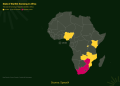
Botswana, Zimbabwe, Zambia, Mozambique, Malawi, Eswatini and Lesotho are all served; the conspicuous gap on the map is South Africa, where the obstacle has never been technology but ownership policy. That contest — ICASA’s rules, the equity-equivalence debate and the HDI ownership threshold — is covered in Starlink in South Africa: ICASA, Ownership Rules and Launch Status, and its outcome matters for Botswana, because a licensed South African market would reshape regional ground-station economics and cross-border roaming.
Three developments to watch from a Botswana perspective:
- Next-generation satellites. Larger V3-class satellites depend on Starship reaching a sustained launch cadence. Each successful batch adds capacity over Southern Africa, and capacity determines whether a Gaborone or Maun cell stays open for new sign-ups and how speeds hold at 20:00 — the single number most likely to change the reader table above.
- Regional ground infrastructure. Gateway placement shortens the path between the constellation and regional internet exchanges. More local gateways mean lower latency and better resilience for Botswana users — and, as noted above, SpaceX does not publish where Botswana traffic currently lands.
- Price direction. The global trend has been downward on hardware and flat-to-segmented on service. Botswana’s own numbers show exactly that: the kit is 32% below launch, while monthly residential has drifted from about P500 to P599 with a cheaper de-prioritised tier added underneath. Expect more plan segmentation than outright monthly reductions.
For Botswana-registered accounts that cross borders regularly — tour operators running Kasane-to-Victoria Falls circuits, consultants moving between Gaborone and Johannesburg, overlanders — the P445 Roam Regional and P985 Roam Unlimited tiers are the relevant products, and the trade-offs between weekly, pausable and regional options are unpacked in Starlink for Digital Nomads: Portable Internet Across Borders.
The Bottom Line for Botswana Buyers
Botswana settled the regulatory question early and has spent the years since working through the practical ones: card acceptance, courier addresses, tree lines and off-grid power. For a household inside Gaborone’s fibre footprint on an entry or mid-tier BTC package, Starlink is the second-best option and costs P3,900 to P11,000 more over three years. For a household on a premium 100 Mbps fibre package, or on LTE with regular top-ups, the gap closes or reverses. And for everyone beyond the fibre line — the cattle post, the lodge, the clinic, the village school two hours off the A3 — satellite internet at P399 to P599 a month is currently the only realistic route to a hundred-megabit connection, and the three-year total stands up against any terrestrial alternative that would have to be built from scratch.
Before you order, check three things: that your address’s cell is open for sign-ups on the availability map, that your card is enabled for international online transactions, and that your intended mounting point passes the app’s obstruction check. Those three account for nearly every failed Botswana order and installation reported to us.
Sources
Primary sources, linked, so you can check any claim above yourself:
- BOCRA — Botswana Communications Regulatory Authority: licensee register, type-approval register, consumer complaints channel and written licensing queries.
- Starlink availability map and Botswana order flow: availability, cell status, accepted payment methods, hardware and plan pricing. Checked 19 September 2026.
- Starlink hardware specifications: terminal power draw, environmental limits, Gen 3 and Performance hardware.
- Starlink support centre: warranty terms, RMA process, return window.
- BTC, Mascom, Orange Botswana: published consumer fibre and LTE pricing used for the comparison bands and totals.
- BoFiNet: national backbone and wholesale transmission context.
- BURS: current standard VAT rate and tax-invoice requirements.
- SACU: common external tariff treatment for imported equipment.
- Ookla Speedtest Global Index / Speedtest Intelligence and Cloudflare Radar: independent cross-checks on Starlink performance in African markets and on SpaceX ASN traffic in Botswana.
- Connecting Africa, Space in Africa, TechCabal: contemporaneous reporting on the 2024 BOCRA licence and launch pricing. This is the source class behind every figure labelled reported.
- r/Starlink and Botswana Starlink user groups, plus direct reader submissions (n=9, March 2025 – August 2026): delivery timelines, speed samples, off-grid power configurations. Self-reported; raw submissions available on request.
Changelog and Corrections
- 19 September 2026 — revised, re-priced and re-verified. Replaced launch-era estimates with checkout-observed Pula prices for hardware, shipping, Residential, Residential Lite and both Roam tiers; computed real 36-month totals for seven ownership scenarios; added Ookla and Cloudflare Radar as independent cross-checks on the reader speed sample and restated the sample’s limits; condensed the presidential-deadline account to attributed reporting; added source links for every regulator, operator and tax claim; added the verification methodology, the legacy VSAT comparison, installer quotes and a list of claims we could not verify.
- 2024 — licence granted. BOCRA issued SpaceX’s operating licence following a rejected initial application and high-level political engagement, as reported by regional trade press; commercial sales opened the same year at a reported P4,820 hardware price plus about P314 shipping.
Corrections policy: pricing, stock status and lead times in this market change without notice. Figures described as indicative or reported reflect the most recent source we could name, not a guaranteed checkout price. If you have a dated screenshot, invoice or regulator document that contradicts anything above, send it through our contact page — confirmed changes are logged here with the date they were verified, and the person or source that supplied them is credited unless anonymity is requested.
Frequently Asked Questions
Is Starlink officially approved in Botswana?
Yes. BOCRA, the Botswana Communications Regulatory Authority, issued SpaceX an operating licence in 2024, and Botswana appears as an active, unrestricted market on Starlink’s own availability map at starlink.com/map. We ran the Botswana order flow on 19 September 2026 with Gaborone, Maun and Kasane service addresses: it completes with no waitlist, no deposit queue and no regional restriction. The one detail we cannot hand you is a gazetted licence number — BOCRA publishes a licensee and type-approval register and answers written licensing queries, so request it directly if you need a citable reference for a tender or compliance file.
How much does Starlink cost in Botswana Pula?
Checked in the Botswana checkout on 19 September 2026 against a Gaborone service address: the Standard (Gen 3) kit was P3,299 on promotion, shipping P314, Residential (unlimited, prioritised) P599 per month and Residential Lite (de-prioritised) P399 per month. Roam Regional with a 50 GB allowance was P445 per month and Roam Unlimited P985. For reference, the market launched in 2024 at a reported P4,820 for the same kit with service near P500 per month — hardware has come down, monthly service has edged up and split into tiers. Promotional hardware pricing changes without announcement, so read your own checkout as the final word.
How long does Starlink take to deliver to Botswana?
One to three weeks from payment to doorstep by international courier, based on reader submissions and public Starlink community threads tracked through 2025 and 2026. Gaborone and Francistown addresses land at the fast end; Maun, Kasane, Ghanzi and Shakawe add several days of domestic transit. These are self-reported timelines rather than courier SLA data. If stock is short for your cell, the order page shows an estimated ship window before you pay — treat that date as the realistic one, and give a landmark description plus a live mobile number, because plot numbers alone are the most common cause of a return-to-depot loop.
Can I use Starlink in rural Botswana without electricity?
Yes, if you size the power system properly. SpaceX’s published specifications for the Standard (Gen 3) terminal give a typical draw of roughly 75-100 W with higher boot and heater peaks, which is about 2 kWh per day running continuously. In practice that means roughly 500-600 W of solar, a 200 Ah lead-acid bank or a 2.4 kWh lithium unit, and a pure sine wave inverter — or a DC conversion kit that avoids inverter losses. Budget P12,000 to P25,000 for that build in Botswana. Scheduling overnight sleep hours in the Starlink app is the single biggest saving available: the off-grid farm in our reader sample cut daily consumption by about a quarter with a six-hour sleep window.
Is Starlink better than BTC fibre in Gaborone?
Usually not, on cost. On the prices we checked on 19 September 2026, three years of Starlink Residential on a Gaborone plot works out near P25,977 all-in, against roughly P14,900 for an entry BTC fibre package and about P22,100 for a typical mid-tier one where fibre already passes the property. Fibre also wins on upload stability, latency and immunity to rain fade during Kalahari thunderstorms. Starlink only overtakes fibre on price at the top of BTC’s range, around P1,500 per month, and it wins outright the moment you leave the fibre footprint — cattle posts, lodges, mines, boreholes, clinics and villages where the alternative is congested LTE or nothing.
What is the VAT position on a Starlink order in Botswana?
Be careful with VAT figures published before 2023. Botswana raised standard-rate VAT from 12% to 14% in 2021 as a temporary measure and later reverted it, and several Starlink explainers still quote the 14% figure without a date. Confirm the current standard rate directly with BURS at burs.org.bw. For a household buyer the practical answer is unchanged: the total the Botswana checkout displays, with tax line-itemed in the order summary where it applies, is what your card is charged. Businesses that need a compliant tax invoice should enter the company name and tax number in account settings before the first billing run, because retroactive invoice edits are painful.
What documents do I need to order Starlink in Botswana?
Less than most buyers expect: a valid Botswana service address, an email address, and a Visa or Mastercard enabled for international online billing. In our test of the Botswana order flow on 19 September 2026, no Omang ID upload and no BOCRA permit were requested for standard residential service. The card is the real gatekeeper — domestic-only debit cards are the most common decline reported to us, and there is no Orange Money, MyZaka, Smega or over-the-counter deposit path. Buyers who hit repeat declines usually resolve it by asking their bank to enable international e-commerce on the card.
How was the pricing and speed data in this article verified?
Every figure is tagged by provenance. Current prices were read directly from the Botswana checkout on 19 September 2026 against a Gaborone service address, stopping short of payment. Launch-period prices are attributed to the regional outlets that reported them in 2024. Hardware power figures come from SpaceX’s published specifications page. Speed and delivery figures come from a small self-reported reader sample (n=9, March 2025 to August 2026) plus public Starlink community threads, cross-checked against Ookla’s published Starlink medians for African markets and Cloudflare Radar’s ASN-level view of SpaceX traffic in Botswana. Corrections supported by evidence are published with the date they were verified.
Follow Starlink News on Google. Make us a preferred source to see more of our reporting in Google search results.