Starlink is, before it is anything else, a satellite internet business: millions of dishes on roofs, in vehicles, on ships and now in phones. The environmental argument that surrounds it splits into two findings that point in opposite directions.
Optically, the satellites really have been dimmed. Published photometry took the earliest operational batches at roughly visual magnitude 2–3; SpaceX’s stated design target for later generations is magnitude 7 or fainter, and independent observers can check the claim with a calibrated camera.
Structurally, nothing has changed the underlying issue. Starlink now accounts for the large majority of active manoeuvrable spacecraft in orbit, and the filings behind it reach 42,000 satellites.
That is the whole debate in three paragraphs. Per-satellite mitigation has worked better than most astronomers expected in 2019; constellation-scale growth has outrun it. Everything below is the detail: the measurements, the hardware fixes, the collision-avoidance numbers as filed with regulators, the debris arithmetic, the regulatory gaps that neither the FCC nor the ITU was designed to close — and, in a section most coverage skips, how all of that actually reaches subscribers through Starlink availability and Starlink price.
Why Starlink’s Scale Matters for Space Sustainability
Scale is the variable that turns an ordinary satellite programme into an environmental question. The cleanest public accounting of that scale is not an encyclopaedia entry but the running Starlink statistics maintained by astronomer Jonathan McDowell from US Space Force Space-Track catalogue data, which tracks satellites launched, currently in orbit, currently working and re-entered, and is updated as the catalogue changes.
Read alongside the European Space Agency Space Debris Office’s annual Space Environment Report, which publishes the total active-payload population, those catalogue counts are what generate the widely quoted share figures: with Starlink’s in-orbit fleet passing 5,000 in 2024 and continuing to grow, a single operator holds roughly two-thirds to three-quarters of all active satellites, and a higher proportion still of the subset that can manoeuvre. The exact percentage moves every week; the order of magnitude does not.
Subscriber numbers need a different health warning. They are self-reported: SpaceX announced 4 million Starlink customers in September 2024 and has issued successive milestone announcements since, but there is no audited disclosure behind any of them. Cite them as company statements, not as verified market data.
The authorised ceiling and the filed ceiling are also different numbers, and conflating them is the most common error in coverage of this topic:
- ~12,000 satellites — the aggregate constellation size authorised by the US Federal Communications Commission across Starlink’s Gen1 licence and the December 2022 partial Gen2 grant, which approved 7,500 of the nearly 30,000 Gen2 spacecraft requested and deferred the remainder.
- 42,000 satellites — the total filed through the International Telecommunication Union, which reflects requested spectrum and orbital coordination rather than granted operating authority.
- ~550 km — the primary operational altitude, mostly in shells inclined at 53 degrees, with additional higher-inclination shells for polar coverage; the approved Gen2 shells sit slightly lower still, at roughly 525–535 km.
The 550 km figure carries more environmental weight than any other specification. Starlink is not a geostationary system at 35,786 km, where a failed satellite becomes a permanent hazard, and it is not at 1,200 km, where atmospheric drag is weak enough that decay takes centuries.
At 550 km there is still measurable air, so an uncontrolled satellite falls out of orbit in roughly five years without any propulsion at all. That single design choice is the strongest card in SpaceX’s debris argument — and the reason astronomers, not debris modellers, have been the more persistent critics.
Generation matters too. Gen1 spacecraft were sized for Falcon 9, in the low hundreds of kilograms. Gen2 designs, including the V2 Mini already flying on Falcon 9, are substantially heavier, and the full-size V3 spacecraft intended for Starship are heavier again, with public statements placing them in the tonne-plus class. Heavier satellites launched at higher cadence mean more mass entering and re-entering the atmosphere each year, which is why the re-entry chemistry question discussed below has grown louder rather than quieter.
Light Pollution: How Bright Are Starlink Satellites?
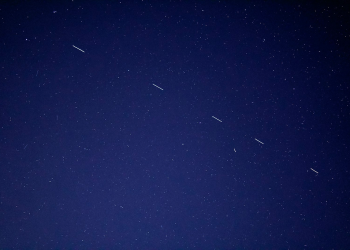
Satellite brightness is measured in apparent visual magnitude, a logarithmic scale on which smaller numbers mean brighter objects and each step of 1 magnitude is a factor of about 2.5 in flux. The original v0.9 and early v1.0 Starlink satellites were reported at magnitude 2–3 — comparable to Polaris, the North Star, at about magnitude 2. They were bright enough that the post-launch trains became a public-sighting phenomenon and, briefly, a source of UFO reports worldwide.
For professional astronomy the relevant threshold is fainter. Working figures discussed in the satellite-constellation literature and in IAU-convened workshops put the interference boundary for large survey telescopes around magnitude 6–7, roughly the naked-eye limit under dark skies. Above that brightness, a satellite crossing a wide-field exposure does not just leave a line: it can saturate pixels, bleed charge along detector columns, and introduce ghosting and crosstalk artefacts that corrupt data well beyond the trail itself.
Why twilight is the pinch point
Geometry decides who is affected. A satellite is visible only while it is still in sunlight and the observer is in darkness. At 550 km that window is the hour or two after sunset and before sunrise, and it shrinks toward the middle of the night — which is why Starlink’s optical impact concentrates on twilight science rather than on all-night observing.
Unfortunately, twilight is exactly when surveys hunt for the objects that are hardest to catch: near-Earth asteroids interior to Earth’s orbit, and fast-fading transients whose light curves collapse within hours.
The facilities most exposed are wide-field survey machines. The Zwicky Transient Facility documented a steadily rising fraction of twilight images containing satellite streaks as the constellation grew. The Vera C. Rubin Observatory — which began its decade-long Legacy Survey of Space and Time era in the mid-2020s with a 3,200-megapixel camera and a very wide field — is the canonical case study, because its survey design makes it statistically certain to catch satellites rather than merely unlucky.
The radio side of the problem
Optical trails are the visible complaint; radio astronomers have a separate one. Beyond the allocated downlink bands, studies using LOFAR in the Netherlands have reported unintended electromagnetic radiation from Starlink spacecraft electronics at low frequencies, including bands formally protected for radio astronomy.
This matters for the Square Kilometre Array sites in Australia and South Africa, which sit inside legally protected radio-quiet zones that offer no protection whatsoever against emissions arriving from overhead. Darkening a satellite’s exterior does nothing about this failure mode, which is why the two mitigation tracks have to be judged separately.
Mitigation: SpaceX’s Brightness Reduction Efforts
SpaceX’s response has gone through three identifiable hardware phases, and the engineering trade-offs in each are instructive.
DarkSat (2020): the coating that worked optically and failed thermally
DarkSat was a single satellite launched in January 2020 with a darkened coating applied to reflective surfaces. Photometric follow-up published by Tregloan-Reed and colleagues in 2020 found a real reduction — on the order of half the reflected brightness, slightly under a magnitude’s worth — confirming the physics.
The problem was thermal: a darker skin absorbs more solar energy, and a spacecraft that cannot dump that heat suffers in component temperature margins and pointing stability. SpaceX did not carry the coating forward. It remains the clearest example of an astronomy fix that a satellite engineer cannot simply accept.
VisorSat (2020–2022): sunshades instead of paint
The next approach blocked sunlight from reaching the brightest surfaces rather than absorbing it. VisorSat added a deployable visor to shade the phased-array antennas, the dominant reflectors when a satellite is viewed from below.
Independent magnitude measurements — including the long-running photometric series by Anthony Mallama and datasets compiled by amateur observers in communities such as Cloudy Nights — placed shaded satellites in the magnitude 5–6 range, roughly a magnitude fainter than unmodified units at the same altitude. Visors were dropped when laser inter-satellite links changed the spacecraft configuration: an example of mitigation hardware losing out to a design change made for entirely unrelated reasons.
Gen2: mirror films and pointing strategy
Later Starlink generations use dielectric mirror films that reflect sunlight specularly, away from the ground, instead of scattering it diffusely toward observers. That is combined with off-pointing manoeuvres during orbit raising and with solar-array orientation chosen to reduce reflection toward the night side.
SpaceX has published brightness mitigation guidance intended for other operators — a genuinely useful contribution, since the industry’s next problem is the operators who have done none of this. The company’s stated target, formalised in its 2023 coordination agreement with the US National Science Foundation, is magnitude 7 or fainter. Some astronomers argue the working requirement for the most sensitive wide-field surveys is fainter still, around magnitude 8, and the residual gap between those two figures is where much of the current technical argument sits.
In practice, three caveats keep recurring in the literature. Dimming reduces but does not remove trails, so survey pipelines still need masking and streak-detection software. Brightness varies with phase angle, so a satellite that meets its target on average can still flare. And nothing in the optical programme addresses radio emissions.
Orbital Debris: Collision Risk and Space Traffic
Starlink’s debris posture rests on four elements, and they are easier to evaluate than the brightness question because the underlying physics is unforgiving.
- Autonomous collision avoidance. Conjunction data derived from US Space Force tracking — historically the 18th Space Control Squadron, now organised under Space Delta 2 — is screened against Starlink ephemerides, and each satellite can execute an avoidance burn onboard without waiting for a ground operator. At constellation scale, human-in-the-loop manoeuvre approval would not keep up.
- Short design life. Satellites are built for roughly five years of service, which means the fleet is continuously replaced rather than aged into failure — newer hardware, but also a permanent launch and re-entry flux.
- Passive compliance through altitude. From about 550 km, a dead satellite decays in roughly five years with no propulsion. This is what allows Starlink to satisfy post-mission disposal expectations even in a total failure case.
- Active controlled re-entry. A functioning satellite lowers itself and targets re-entry over the South Pacific Ocean Uninhabited Area, the standard disposal corridor for large re-entering hardware, minimising casualty risk from surviving fragments.
The manoeuvre numbers, as filed
SpaceX is required to report conjunction-avoidance activity to the FCC every six months, and those semi-annual constellation status reports are the primary record. The published totals show the trend more clearly than any summary adjective:
| Reporting period | Avoidance manoeuvres disclosed |
|---|---|
| 1 Dec 2020 – 31 May 2021 | 2,219 |
| 1 Jun 2021 – 30 Nov 2021 | 3,358 |
| 1 Dec 2021 – 31 May 2022 | 6,873 |
| 1 Jun 2022 – 30 Nov 2022 | 13,612 |
| 1 Dec 2022 – 31 May 2023 | 25,299 |
| 1 Jun 2023 – 30 Nov 2023 | 24,410 |
| 1 Dec 2023 – 31 May 2024 | 49,478 |
Source: SpaceX semi-annual Starlink constellation status reports filed with the FCC (IBFS, Gen1 and Gen2 NGSO licences). Later reporting periods follow the same six-month cadence; readers should check the most recent filing for current figures. Figures as filed by the operator and not independently audited.
Two features of that series matter. The count roughly doubled in most reporting periods, which tracks both constellation growth and improved screening sensitivity rather than a deteriorating environment alone. And the manoeuvres are overwhelmingly precautionary: SpaceX manoeuvres at a far lower probability-of-collision threshold than the industry norm, so a high number signals conservatism as much as congestion.
Two complications deserve more attention than they usually get. First, drag is not constant: elevated solar activity heats and expands the upper atmosphere, increasing drag — which shortens decay times, helpfully, but also caused the documented loss of newly launched satellites during the February 2022 geomagnetic storm and forces more station-keeping propellant use across the fleet.
Second, catalogue coverage is partial. Autonomous avoidance protects against tracked objects; the population of fragments too small to catalogue but large enough to destroy a spacecraft is precisely the population no operator can manoeuvre around.
The chemistry problem nobody can deorbit away
The newest environmental question is chemical rather than kinetic. When satellites burn up, their aluminium structures oxidise into aluminium oxide particles deposited in the stratosphere.
Modelling work published in Geophysical Research Letters in 2024 estimated that satellite re-entries were already injecting tens of tonnes of alumina per year, with projections rising by more than an order of magnitude once megaconstellations reach steady-state replacement. The authors flagged potential ozone chemistry effects as a research priority rather than a demonstrated harm — but it is the one impact pathway where a faster, cleaner deorbit does not help, because deorbiting is the mechanism.
Debris Statistics: How Much Risk Does Starlink Actually Add?
Context first. Catalogues maintained by the US Space Force and the environment models published by ESA’s Space Debris Office track on the order of 35,000 to 40,000 objects, depending on catalogue and date, against an estimated population of well over a million fragments above one centimetre that are not tracked at all. Most of that mass came from historic upper stages, abandoned payloads, and two events: the 2007 Fengyun-1C destruction and the 2009 Iridium-Cosmos collision.
Starlink’s contribution to that inventory is unusual in being large in number, small in individual mass, short-lived, and manoeuvrable. Cumulative Starlink re-entries passed several hundred spacecraft within the first five years of deployment and have continued to climb as the first-generation fleet is retired; McDowell’s Starlink statistics page, derived from Space-Track, is the running tally, and any single number should be read as a dated snapshot rather than a stable statistic.
The meaningful comparison is with the other megaconstellations now deploying:
| Operator | Constellation size | Main shell altitude | Decay if control is lost |
|---|---|---|---|
| Starlink | ~12,000 FCC-authorised (incl. 7,500 Gen2 partial grant); 42,000 filed at ITU | ~525–550 km | ~5 years |
| OneWeb (Eutelsat) | ~600 operational | ~1,200 km | Estimates run to centuries |
| Amazon Kuiper | 3,236 FCC-approved; deployment under a 2026 milestone deadline | ~590–630 km | Years to a decade |
| China Guowang | ~13,000 planned; deployment began 2024 | Multiple shells, reportedly including above 1,000 km | Varies sharply by shell |
Sources: FCC IBFS authorisations and ITU filing records; operator statements; ESA Space Environment Report; Space-Track catalogue summaries. Constellation counts and shell parameters are contested and change frequently — figures compiled September 2026 and should be re-checked against the latest filing before reuse.
Read that table as the sustainability argument in miniature. A satellite at 1,200 km that fails is a hazard for generations; a satellite at 550 km that fails is a hazard for about five years. On that metric Starlink’s architecture is the more forgiving one, and OneWeb’s higher shell — chosen for coverage efficiency with fewer satellites — is the harder legacy.
But architecture is only half the equation. Aggregate traffic in the 500–650 km band is now shared by three or four large operators plus everything already there, and no single operator’s good behaviour controls the conjunction rate in a shell it does not own. The absence of a binding, enforceable space-traffic coordination authority across those operators is the structural risk, not any one company’s manoeuvre log.
Regulatory Responses: FCC, ITU, and National Licensing
The governing framework was assembled for a world of dozens of satellites per year, and its seams show.
The FCC and NEPA
In the United States, satellite licensing sits with the FCC, and environmental scrutiny runs through the National Environmental Policy Act. The FCC has historically treated satellite authorisations under a categorical exclusion — a determination that this class of action does not normally require an environmental assessment or impact statement.
Critics argue the exclusion predates the facts it is now applied to. A 2022 Government Accountability Office report recommended the Commission revisit it in light of megaconstellations, and litigation challenging the FCC’s reliance on the exclusion has so far not overturned the approach.
Debris policy has moved faster than environmental-review policy. The Commission’s orbital-debris order adopted on 29 September 2022, phased in from 2023, shortened the expected post-mission disposal window for low-Earth-orbit satellites from the long-standing 25-year guideline to five years.
Debris mitigation plans are now a routine licensing requirement rather than a courtesy filing. That rule is the most consequential debris regulation of the decade — and Starlink’s 550 km architecture already complied with it by construction, which is precisely why the rule cost SpaceX nothing and will cost higher-altitude operators a great deal.
The December 2022 Gen2 grant added a second precedent that gets less attention: it authorised only 7,500 of the requested spacecraft, deferred the rest, and attached conditions including coordination with the National Science Foundation on astronomy impacts. Optical and radio astronomy are now, in the United States, licence conditions rather than voluntary good behaviour.
The ITU
The ITU’s Radio Regulations govern spectrum allocation and orbital coordination between administrations — the principle of equitable access to orbit and spectrum expressed in Article 44 of the ITU Constitution. Post-WRC-19 milestone rules require operators to bring a filed constellation into use progressively — 10% within two years of the end of the regulatory period, 50% within five and 100% within seven — to curb speculative filings and paper constellations.
What the ITU does not do is environmental review. There is no ITU process that weighs the night sky, the debris environment, or stratospheric chemistry, and reading a 42,000-satellite ITU filing as an approval of 42,000 satellites misreads the instrument.
National licensing and the market-access lever
Because every constellation needs landing rights, national regulators hold real leverage even without orbital jurisdiction. France’s space operations legislation requires safety and environmental authorisation for operators under its jurisdiction, and New Zealand’s Outer Space and High-altitude Activities Act requires payload permits assessed against national interest criteria that include debris and astronomy considerations. Chile, host to several of the world’s premier optical observatories, has pursued dark-sky protection through domestic regulation.
Non-binding instruments — the UN COPUOS Long-Term Sustainability Guidelines, ISO debris-mitigation standards, and the IAU’s dark and quiet skies recommendations — supply the technical consensus that national rules increasingly borrow. The gap that remains in 2026 is enforcement: no global body can compel a non-cooperating operator, and the most likely trigger for tighter rules is an incident rather than a negotiation.
What the Debate Means for Satellite Internet Availability and Starlink Price
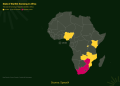
Most coverage stops at the telescope. But the astronomy and debris arguments reach subscribers through a specific, traceable channel — licensing — and it is worth setting out exactly how, because it explains both the Starlink availability map and the logic behind Starlink price changes better than the usual speculation does.
How the debate reaches Starlink availability
Satellite internet needs two keys in every country it serves: spectrum and landing rights from the national telecom regulator, and — increasingly — a space-safety or environmental clearance somewhere in the chain. The first key is the slow one. Multi-year authorisation processes in large markets have historically been driven by security, data-localisation and licensing-fee questions rather than debris, and those remain the dominant cause of a country sitting grey on the availability map.
The second key is the one this debate is turning. Where a jurisdiction has a national space act with debris and safety criteria, or an observatory community with domestic political weight, an operator now has to document disposal plans, brightness measures and coordination arrangements before service is approved. That is not a veto — no regulator has yet refused satellite internet service on astronomy grounds — but it is a delay, and delay is what availability actually consists of for a user waiting on a waitlist.
There is a capacity dimension too. Starlink availability is sold cell by cell, and cells sell out when subscriber demand in a geographic area exceeds the throughput overhead passing over it. Anything that caps satellite numbers, restricts shell altitudes, or slows launch cadence therefore shows up first as sold-out cells and waitlists in dense regions, not as a global outage. A regulatory limit on constellation size is, functionally, a limit on how many households can be served in the places that want service most.
How the debate could reach Starlink price — and how it has not yet
No public filing or company statement attributes any Starlink price change to environmental compliance. The price moves that have happened — hardware discounts and regional promotions, congestion charges in busy cells, credits in under-used ones, and the restructuring of Roam, Priority and business tiers — have all been explained in terms of capacity and demand.
The plausible causal route, if one ever materialises, is not a compliance line item. Visors, mirror films and additional propellant are cheap next to a launch; the real cost is mass. A heavier satellite means fewer satellites per launch, which raises the cost of each unit of delivered capacity. And because Starlink prices against congestion, the mechanism by which a debris rule would eventually touch a monthly bill is capacity scarcity, not paperwork.
The corollary is worth stating plainly for anyone budgeting: the rules most likely to affect what you pay are the ones that constrain how many satellites can fly and how heavy they can be — not the ones that dictate how dark they have to be. Brightness mitigation is close to free. Constellation caps are not.
Astronomer–SpaceX Dialogue: Current Status
The relationship has matured from confrontation into structured, unfinished negotiation. SpaceX engineers participate in the International Astronomical Union’s Centre for the Protection of the Dark and Quiet Sky from Satellite Constellation Interference, established in 2022 as the standing forum for operators, observatories and regulators, and the company contributed to the technical exchanges that grew out of the SATCON workshops convened by the US astronomy community.
The 2023 coordination agreement with the National Science Foundation is the most concrete artefact of that process: it committed SpaceX to the magnitude-7 brightness target, to avoiding laser transmissions over radio observatories, and to continued data sharing. Coordination with the Rubin Observatory on predicted satellite passage has been the most practical output, because ephemeris sharing lets survey schedulers and data pipelines anticipate and mask crossings rather than discover them in the data.
What has been achieved is real. Brightness came down by roughly one to two magnitudes across generations. A large operator accepted that brightness is a design requirement and published guidance for others. Observatories got data-sharing channels that did not exist in 2019.
What has not been achieved is closure. The astronomer position, stated consistently in IAU-affiliated work, is that mitigation reduces per-satellite harm while constellation growth increases aggregate harm — and that the aggregate is what determines whether a survey achieves its science goals.
Three specific gaps remain open in 2026: the residual distance between SpaceX’s magnitude-7 target and the fainter thresholds some surveys want; unintended radio emissions, which the optical fixes do not touch; and the behaviour of operators outside the IAU dialogue entirely, where neither guidance nor peer pressure currently applies. Anyone describing the astronomy problem as solved is describing one satellite, not the sky.
What This Means for Starlink Users
For subscribers, the debris debate has had no measurable effect on day-to-day satellite internet service, and the reasons are structural rather than reassuring rhetoric. Autonomous collision avoidance has to date prevented conjunctions without a confirmed Starlink collision, and constellation density provides redundancy: with thousands of satellites in overlapping shells, the loss of individual spacecraft is absorbed by the network. The roughly three dozen satellites lost to geomagnetic-storm drag shortly after the February 2022 launch produced no coverage gap at all.
The realistic user-facing exposure is regulatory, and it already has precedents rather than hypotheticals attached to it:
- Licence conditions are already astronomy-aware. The FCC’s Gen2 grant capped the authorisation at 7,500 satellites and required NSF coordination. The practical effect on users is schedule: Gen2 and V3 capacity arrives in approved tranches, which is what governs when a sold-out cell reopens.
- National clearances gate country launches. Where a space act or observatory-protection rule applies, market entry takes longer. This is the single most common reason a country that is technically covered by the constellation still shows as pending on the availability map.
- An orbital incident would reset everything. A collision involving any operator in the 500–650 km band would change the policy conversation for every operator in it, regardless of fault — the one scenario in which service-affecting rules could arrive quickly rather than over years.
The wider balance sheet is worth holding in view alongside the costs. The same low-altitude architecture that limits debris persistence is what enables low latency and satellite-to-handset service, and the public-interest case is clearest in emergencies, where a terminal in a hurricane zone is the difference between a functioning response and none.
A serious environmental debate does not require pretending the benefits are imaginary. It requires deciding who sets the limits, and on what evidence.
Related Reading
- Starlink Satellite Constellation: Orbital Mechanics, Launch Cadence, and Deorbiting — the launch and orbit-raising sequence behind the numbers above.
- Starlink V3 Satellites and Starship: What Changes for Users — how the heavier next-generation hardware changes capacity, availability and price.
- Starlink Direct to Cell: How Satellite-to-Phone Service Works — the application that depends most directly on the low-altitude architecture.
- Starlink in Disaster Relief: Hurricane and Conflict Zone Connectivity — the public-interest side of the ledger.
- Starlink for Digital Nomads: Portable Internet Across Borders — how plan structure and pricing behave in practice.
Sources and Update Log
Primary sources for this analysis: FCC satellite licensing records in IBFS, including the December 2022 Gen2 partial grant and SpaceX’s semi-annual Starlink constellation status reports (the source of every manoeuvre figure quoted above); the FCC orbital-debris order adopted 29 September 2022; ITU Radio Regulations, Article 44 of the ITU Constitution and post-WRC-19 milestone rules; Jonathan McDowell’s Starlink statistics pages derived from US Space Force Space-Track catalogue data; ESA Space Debris Office Space Environment Reports; peer-reviewed photometry including Tregloan-Reed et al. (2020) on DarkSat and the magnitude series published by Anthony Mallama; IAU Centre for the Protection of the Dark and Quiet Sky technical reports and SATCON workshop outputs; the 2023 SpaceX–NSF coordination agreement; the 2024 Geophysical Research Letters modelling of stratospheric aluminium oxide from satellite re-entries; the 2022 GAO report on FCC environmental review; and SpaceX’s published Starlink updates, brightness mitigation guidance and customer-milestone announcements.
Last reviewed 25 September 2026. Change log: the constellation-share and subscriber claims were re-sourced from a tertiary encyclopaedia entry to Space-Track-derived catalogue statistics and SpaceX’s own customer announcements, with the self-reported status of subscriber figures made explicit; collision-avoidance totals were replaced with the exact per-period numbers as filed with the FCC; the operator-comparison table gained a source and compilation-date footnote; a section was added on how licensing transmits the debris and astronomy debate into satellite internet availability and Starlink price; the 2024 stratospheric aluminium-oxide research remains flagged as an emerging, unresolved impact pathway rather than an established harm. Corrections and new filings are incorporated as they are published.
Frequently Asked Questions
How bright are Starlink satellites compared to stars?
The first operational Starlink satellites were reported in published photometry at roughly visual magnitude 2–3, which puts them in the same brightness class as Polaris and makes them easy to see with the unaided eye during twilight. After SpaceX added sunshades and, later, dielectric mirror films, independent magnitude measurements by Anthony Mallama and others moved into the magnitude 5–6 range, near the naked-eye limit. SpaceX’s stated design goal, restated in its 2023 coordination agreement with the US National Science Foundation, is magnitude 7 or fainter, which would put the satellites below unaided-eye visibility for most observers.
What is SpaceX doing to reduce Starlink’s impact on astronomy?
Three main things: physical darkening of the spacecraft (the 2020 DarkSat coating experiment, then the VisorSat deployable sunshade, then reflective dielectric mirror films on later generations), attitude control that tips solar arrays and the satellite body away from the observer during orbit raising, and data sharing so observatories can predict satellite passes and plan exposures. SpaceX also published brightness mitigation guidance for other operators, signed a coordination agreement with the National Science Foundation covering brightness targets and laser-link avoidance over radio observatories, and participates in the IAU Centre for the Protection of the Dark and Quiet Sky. Dimming reduces trail brightness but does not eliminate trails, and it does nothing for radio astronomy.
What happens to Starlink satellites when they stop working?
A healthy satellite at end of life uses its ion thrusters to lower its orbit and perform a controlled re-entry, with any surviving debris targeted at the South Pacific Ocean Uninhabited Area. A satellite that fails and cannot manoeuvre still re-enters through atmospheric drag, which from the roughly 550 km operational shell takes about five years — far shorter than the centuries-long decay associated with shells above 1,000 km. That short decay time is the single most important design decision behind Starlink’s debris case, and it is why the constellation already complied with the FCC’s five-year disposal rule on the day that rule was adopted.
Could Starlink satellites collide with other objects in space?
Yes, the risk is non-zero, which is why every operational Starlink satellite carries an autonomous collision-avoidance function that ingests conjunction data derived from US Space Force tracking and manoeuvres without waiting for a ground command. SpaceX’s semi-annual constellation reports to the FCC disclose the totals: 2,219 avoidance manoeuvres in the period ending 31 May 2021, 13,612 in the period ending 30 November 2022, 25,299 in the period ending 31 May 2023, and 49,478 in the period ending 31 May 2024. No confirmed Starlink-on-object collision has been reported to date, but the system depends on catalogue data that does not cover small untracked debris.
Are there international rules about satellite constellations and space debris?
There is no single binding environmental regime. The ITU allocates spectrum, coordinates orbital use and enforces deployment milestones (10% of a filed constellation within two years, 50% within five, 100% within seven), but its Radio Regulations are not an environmental review process. Debris rules come from national licensing — for example the FCC’s order adopted on 29 September 2022 shortening post-mission disposal in low Earth orbit to five years — supplemented by non-binding UN COPUOS Long-Term Sustainability Guidelines and ISO standards, plus national space acts in countries such as France and New Zealand that require safety and environmental assessment.
Is the astronomy community satisfied with SpaceX’s mitigation efforts?
Partly. Astronomers generally credit SpaceX with being the most responsive large operator on brightness, and the IAU’s dark and quiet skies centre treats the cooperation as a working model. The unresolved objection is scale: mitigation per satellite does not offset a filed constellation of 42,000 spacecraft plus competing systems, and radio interference from unintended electromagnetic emissions remains an active concern for facilities including LOFAR and the Square Kilometre Array.
Does the space debris debate affect Starlink availability in my country?
Indirectly, and increasingly so. Starlink availability in any territory depends on a national telecom regulator granting landing rights and spectrum, and a growing number of jurisdictions now attach space-safety conditions to that approval — New Zealand assesses payload permits against national-interest criteria that include debris, France requires a safety and environmental authorisation, and the FCC’s Gen2 grant was conditioned on coordination with the National Science Foundation over astronomy impacts. These processes rarely block satellite internet outright, but they add months to country-by-country approval timelines, which is why the availability map moves more slowly than the launch manifest.
Will space debris rules increase the Starlink price?
There is no public evidence that they have. Starlink price changes to date — regional promotions, hardware discounts, congestion-based pricing in busy cells and the restructuring of Roam and Priority plans — have been explained by capacity and demand, not by compliance costs. The plausible indirect route runs through capacity rather than paperwork: mitigation hardware adds mass, heavier satellites mean fewer per launch, and any regulatory cap on satellite numbers or altitude reduces the capacity available per coverage cell, which is the variable Starlink actually prices against. Treat any claim that debris rules will raise your monthly bill as speculation until a filing or company statement says so.
Follow Starlink News on Google. Make us a preferred source to see more of our reporting in Google search results.
![Using Your Own Router with Starlink: Bypass Mode [2026]](https://starlink-news.com/wp-content/uploads/2026/09/using-your-own-router-with-starlink-bypass-mode-20-f6c09f95-350x250.png)