Starlink works for telemedicine because of latency, not headline speed. A low Earth orbit link measured in the 20 to 40 ms range keeps a video consultation conversational, while a geostationary link at 600 ms or more turns the same consult into a walkie-talkie exchange where clinician and patient talk over each other. That single difference is why health ministries that ignored satellite internet for twenty years are now buying it.
Two questions then decide most procurements before a clinical requirement is ever discussed: Starlink availability at the facility’s exact coordinates — whether the local cell has capacity and whether the national regulator has authorised the service — and the Starlink price once hardware, subscription, import duty and five years of recurring cost are added together rather than quoted separately. After that come upload headroom, power, rain fade, the absence of an uptime guarantee, and data-protection law written without satellite constellations in mind.
Here is what a rural clinic actually gets, what it costs in 2026, and where Starlink stops being the right answer.
Quick Reference
Clinic planning numbers at a glance
- Latency: 20–40 ms typical on Starlink in mature markets; 600 ms or more on legacy GEO satellite
- Throughput: 25–220 Mbps download, 5–20 Mbps upload in commonly reported working ranges
- Binding constraint: upload, always — telemedicine sends more than it receives
- Price: Business around $250/month plus roughly $2,500 hardware; residential $90–$120/month plus $450–$600 hardware in established markets, cheaper in several African ones, per Starlink’s published pricing
- Power: plan 75–100 W continuous for terminal plus router, against Starlink’s published average consumption figures
- Compliance: no HIPAA Business Associate Agreement, no data-residency guarantee, no uptime SLA
Why Rural Clinics Need Satellite Internet
The connectivity gap in health care is a terrain problem disguised as a budget problem. Cost models filed with the US Federal Communications Commission and with state broadband offices — the same modelling that underpins the FCC’s Connect America cost model — repeatedly put last-mile fibre construction between roughly $10,000 and $50,000 per mile once the route involves rock, wetland, mountain switchbacks or long spans with no intermediate customers to share the build. A health post twelve miles past the end of the network is therefore a six-figure capital request competing against vaccines and staff salaries, and it loses that argument every budget cycle.
Mobile coverage does not close the gap either. Coverage maps published by national telecom regulators, read alongside the GSMA’s coverage-gap analysis, consistently show large shares of rural territory in lower-income countries sitting outside usable 4G. Geographic coverage maps also flatter reality, because they model predicted signal rather than measure it inside a concrete clinic building with a metal roof. A facility can appear covered on a regulator’s map and still need staff to walk to a hilltop to send a referral — a discrepancy worth testing physically before anyone writes “has mobile coverage” on a site survey.
The legacy alternative, geostationary satellite, has been available to these clinics for decades and mostly failed them clinically. A GEO satellite orbits at 35,786 km; the signal travels up and down twice for a round trip, which is nearly 143,000 km of propagation and about 480 ms of unavoidable delay before any processing, queuing or contention is added. GEO links handled email, batch reporting and file transfer adequately and interactive consultation badly — which is why a generation of health workers learned to distrust “satellite internet” as a category.
What a disconnected clinic actually loses
The absence is not only about video calls, and framing it that way undersells the business case. Offline facilities cannot:
- push DHIS2 reporting on schedule, so district health information arrives weeks late and stock forecasting drifts against real consumption;
- verify commodity availability at the referral hospital before sending a patient on a four-hour journey;
- run remote cold-chain temperature alerting for vaccine refrigerators, so a compressor failure is discovered at the next stock check rather than the same night;
- authenticate a patient against a national health ID or insurance scheme, which pushes the facility back to cash and paper;
- obtain a second opinion on an ECG trace or an obstetric ultrasound without physically transporting the patient.
Each is a separate, measurable failure mode with its own cost line, and each is solved by the same 45-centimetre dish. Ministries that evaluate a terminal against a single telemedicine use case usually conclude it is marginal; evaluated against the full list, including logistics and reporting, it stops being a close call.
How Starlink’s LEO Technology Enables Real-Time Telemedicine
Starlink satellites operate in low Earth orbit at altitudes around 550 km rather than 35,786 km. The round-trip propagation distance falls to roughly 2,200 km, or about 7 ms at the speed of light, leaving the remaining delay to ground-station routing, terrestrial backhaul and the public internet. Ookla’s Speedtest Intelligence reporting on satellite performance has repeatedly placed Starlink’s median latency in the double digits in mature markets, consistent with the 20 to 40 ms band operators plan around.
Why that number is the whole argument: ITU-T Recommendation G.114 sets 150 ms one-way as the threshold below which interactive conversation feels natural, with quality degrading sharply past 400 ms. A Starlink path leaves budget to spare inside that envelope even after codec and network processing. A GEO path consumes it three times over before the video encoder has done anything at all. That is the difference between a consultation and a radio call.
Upload is the binding constraint, and it decides clinic design
Throughput matters second. Starlink’s marketing cites peak speeds beyond 400 Mbps in favourable conditions, but healthcare planning should use conservative working ranges: 25 to 220 Mbps down and 5 to 20 Mbps up. The download figure is comfortable for anything a clinic does. The upload figure determines how many consulting rooms the link can serve, because telemedicine is an upstream application — the clinic sends the video, the images, the vitals and the synced records, and receives comparatively little.
A realistic concurrency budget for a health post looks like this: one 1080p consultation at 2 to 4 Mbps upstream, a cloud EHR session at under 1 Mbps, a connected ultrasound or ECG feed at 1 to 3 Mbps, and background record synchronisation filling whatever is left. That fits inside 10 Mbps upload with margin, on a quiet network, with guest Wi-Fi disabled. Three simultaneous consults plus an imaging push does not fit, and no amount of download speed rescues it. Facilities with more than two consulting rooms should plan quality-of-service traffic shaping — prioritising real-time video above sync and above guest traffic — before they plan a second terminal, because shaping is free and a second subscription is not.
Jitter deserves a line of its own. Starlink hands traffic between satellites as they pass overhead, and brief variation in delay is normal. Video codecs absorb it; control loops do not. That distinction reappears in the surgical use cases below, and it is the most common technical misunderstanding in procurement documents that treat “low latency” and “deterministic latency” as the same property.
Starlink Healthcare Deployments: African Health System Examples
Read every count in this section as ministry- or regulator-reported and not independently audited. Pilot counts routinely include facilities that are provisioned but not yet clinically live, and no African health ministry has, to our knowledge, published a facility-level uptime dataset. The numbers are directional evidence that the model is being adopted, not verified operational statistics.
Zambia: the first African authorisation and the clearest health rollout
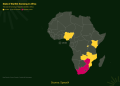
The Zambia Information and Communications Technology Authority licensed Starlink in October 2023, making Zambia the first country on the African continent to authorise the service. Health-sector deployment followed within the Ministry of Health’s digital transformation programme, with ministry communications citing more than 100 connected facilities — the single figure on which every later repetition of Zambia’s number rests.
Installations at rural health posts were positioned explicitly as infrastructure for electronic records, telemedicine referral and health management information reporting rather than as a generic internet subsidy. We covered that rollout in November 2024 in Starlink for Rural and Remote Areas: Bridging the Digital Divide, including the ministry’s framing of the programme and the facility types involved. The internal argument was about time as much as money: terminals could be commissioned in weeks at facilities that had been on a terrestrial waiting list for years.
Rwanda: licensing first, clinics second
Rwanda has reported Starlink connectivity at over 50 remote clinics, tied to the Ministry of ICT and Innovation’s rural connectivity agenda and to licensing handled through the Rwanda Utilities Regulatory Authority — again a ministry figure, with the caveat above attached.
Rwanda is the instructive example on sequencing: national licensing, spectrum authorisation and a data-protection framework under the 2021 law were settled before clinical scale-up. That is the order most ministries get backwards, and getting it backwards is how a pilot ends up with 40 live terminals and a legal opinion that says the patient data crossing them is not lawfully transferred.
Mozambique and the emergency case
Mozambique shows the disaster-response pattern. The Instituto Nacional de Gestão de Calamidades has coordinated satellite connectivity for health facilities cut off by cyclone damage, where the requirement is not elegance but a working link within days at a facility whose fibre spur and mobile mast are both underwater. Deployments of the same shape have been reported in Nigeria, Kenya, the Democratic Republic of Congo, Pacific island health systems and Arctic community clinics.
How the installations were paid for
Three funding patterns dominate, and their sustainability profiles differ sharply:
- Ministry capital budgets buy hardware efficiently but frequently fail to budget recurring subscription — the specific mechanism by which a connected clinic goes dark in month fourteen with a working dish on the roof.
- Development-partner grants typically cover hardware plus two to three years of service, then hand over. The handover date, not the installation date, is the risk milestone.
- Universal service and access funds, financed by levies on operators, are the only instrument designed for indefinite recurring cost, and the one ministries under-use — usually because the fund’s eligibility rules were drafted for tower subsidies rather than subscriptions.
Bandwidth Requirements for Clinical Applications
Vendor documentation, not intuition, should set the target. Epic’s published technical requirements put patient-portal access at around 1.5 Mbps sustained, with roughly 5 Mbps needed for full EHR functionality per concurrent workstation once imaging thumbnails, document scanning and printing are in play. Below that threshold the failure is not an outage — it is clinicians abandoning the system and returning to paper, which is worse than no deployment at all because the record is now split across two media and neither is complete.
How to read the verdict column. All verdicts assume one Starlink terminal and a conservative 10 Mbps upload planning floor. Comfortable = consumes under 25 percent of that upload budget and has no latency ceiling that Starlink’s 20–40 ms typical path can breach. Works = fits only with quality-of-service prioritisation and the stated concurrency limit. Constrained = completes only when scheduled off-peak or compressed. Not appropriate = requires a contractual worst-case latency guarantee that Starlink does not sell.
| Clinical application | Bandwidth (planning figure) | Latency ceiling | Starlink verdict against threshold |
|---|---|---|---|
| Patient portal / appointment booking | 1.5 Mbps down, <0.5 Mbps up | None | Comfortable — under 5% of a 10 Mbps upload |
| Full EHR workstation | 5 Mbps per concurrent seat | <300 ms | Comfortable — up to 4 seats on a 20 Mbps link |
| HD (1080p) video consultation | 2–4 Mbps up per stream | <150 ms one-way (ITU-T G.114) | Works — maximum 2 concurrent streams on 10 Mbps up |
| Store-and-forward dermatology / ECG | 2–5 Mbps burst | None (asynchronous) | Comfortable — any Starlink tier |
| DICOM CT / MRI transfer | 50–100 Mbps up preferred | None | Constrained — 500 MB ≈ 7 min at a saturated 10 Mbps up; compressed and off-peak only |
| Cold-chain / device telemetry | <0.1 Mbps | <5 s alert delivery | Comfortable — run always-on |
| Surgical telementoring | 10 Mbps symmetric minimum | <150 ms, tolerates brief jitter | Works — wired, QoS-prioritised, no competing traffic |
| Robotic tele-surgery | Symmetric, deterministic | <150 ms guaranteed worst case | Not appropriate — no contracted latency ceiling; inter-satellite handovers |
Teleradiology deserves its caveat spelled out. A modern CT series can run to hundreds of megabytes and a multi-sequence MRI into the gigabytes. At 10 Mbps upload, a 500 MB study takes roughly seven minutes of fully saturated link — acceptable for a scheduled read, unacceptable inside a stroke protocol where the clock starts at the door. The practical pattern at connected district hospitals is lossless compression, overnight queued transfer for routine studies, priors sent separately from the current study, and a prioritised manual push with the rest of the clinic throttled when a read is genuinely urgent.
Robotic surgery is where honesty is required and vendors are often vague. The constraint is not average latency but guaranteed worst-case latency and jitter. Starlink hands off between satellites, can show brief spikes, and carries no contractual latency commitment, so it should be excluded from any protocol where a control-loop timeout has a clinical consequence. Telementoring — a remote specialist advising a surgeon who is physically present and in control — is a different risk class, degrades gracefully when the link wobbles, and is being done over satellite links today.
Starlink Price for Clinics: Hardware, Subscription and Five-Year Cost
Starlink’s published pricing pages list two tiers relevant to health facilities. Business service runs about $250 per month with hardware near $2,500, and buys priority data allocation, a public IP address and a higher-performance terminal with better rain-fade margin. Residential service sits in the $90 to $120 per month band in most established markets with hardware at $450 to $600, and US promotional and regional tiers have been quoted as low as roughly $55 per month. Several African markets list residential service well below the US price — figures in the $25 to $50 equivalent range have been reported by local resellers and press — while Business pricing tracks closer to global levels. Because the Starlink price varies this sharply by market and changes without notice, the only authoritative figure is the one on the order page for your own address on the day you buy.
Five-year totals make the comparison legible:
- Business: ~$2,500 hardware + ~$15,000 service = $17,500
- Residential: ~$525 hardware + ~$6,300 service = under $7,000
- Five-mile fibre spur at commonly cited construction costs of $10,000–$50,000 per mile = $50,000–$250,000 capital, before recurring transport
Landed cost: duty, VAT and lead time
Two purchasing traps recur, and both are jurisdictional rather than technical, which means no guide can give you the number.
Tax treatment. Import duty and VAT on the terminal are frequently omitted from ministry requisitions that quote only the Starlink list price, and because duty schedules differ by country the landed cost of identical hardware can differ materially across a border. We have not found a published comparative study of terminal duty rates across African markets, so do not rely on a regional rule of thumb: check your own customs tariff schedule for the relevant HS code, and check specifically whether medical equipment, educational equipment or government-procurement exemptions apply, before the requisition is signed.
Fulfilment time. Procurement teams and installers commonly report delivery in a couple of weeks in established markets and noticeably longer in newly authorised ones where stock is being allocated for the first time. The only figure worth planning against is the shipping estimate shown at checkout for your address. Confirm it before committing to a grant disbursement deadline, and where a deadline is tight, order the hardware on a separate, earlier purchase order from the installation contract.
Subsidy programmes worth applying to
- United States: the FCC’s Rural Health Care programme, administered by the Universal Service Administrative Company, includes the Healthcare Connect Fund with a 65 percent discount on eligible broadband for qualifying rural health providers. Eligibility, competitive-bidding rules and service-type restrictions apply, so confirm satellite eligibility and the current filing window with USAC before committing to a contract.
- Universal service and access funds: operator-levied funds such as ZICTA’s Universal Access and Service Fund in Zambia, Nigeria’s Universal Service Provision Fund, GIFEC in Ghana and comparable instruments elsewhere are explicitly mandated to fund rural connectivity including health posts. Ask the fund directly whether subscriptions, as opposed to capital works, are eligible — several funds have amended their rules to allow it.
- Shared-infrastructure funding: ministries increasingly fund one terminal per community campus rather than one per institution, which splits recurring cost across two budget lines. That pattern, including the bandwidth-management problems it creates, is covered in Starlink for Schools: Connecting Rural Classrooms.
Starlink Availability: Coverage, Cell Capacity and Licensing
Starlink availability is three separate checks that procurement teams routinely collapse into one, then discover at delivery that they are not the same thing.
Service availability at the coordinates. Capacity is allocated by geographic cell, and the availability map answers for the cell, not the country. A waitlisted cell can sit directly beside an available one. Query the map using the facility’s GPS position, not the nearest town, and re-check it if the site survey moves the mounting point across a boundary.
Sky availability at the mount point. The terminal needs an unobstructed field of view of roughly 100 degrees, oriented toward the pole opposite your hemisphere. A single tree or water tank inside that arc produces repeating short dropouts that staff will misdiagnose as a faulty dish for months. The obstruction tool in the Starlink app takes ten minutes per candidate position and should be run from every one of them, at the height the dish will actually sit.
Legal availability. Service is authorised country by country through landing rights and spectrum grants — the FCC in the US, Ofcom in the UK, ACMA in Australia, RURA in Rwanda, ZICTA in Zambia, the NCC in Nigeria, the Communications Authority in Kenya. Availability in a neighbouring country tells you nothing about legality in yours, several markets have suspended or restricted the service, and some permit residential but not commercial or mobile use. Confirm current status against the regulator’s published authorisations before ordering hardware, not after it clears customs.
Reliability and Redundancy for Critical Care
Starlink’s practical availability in clear conditions is high — operators plan around 99 percent or better — but that figure describes good weather, and health facilities do not get to schedule emergencies for good weather. Heavy precipitation causes rain fade on Ku-band links, which installers and users commonly describe as short degradations or dropouts concentrated in the most intense part of a storm rather than day-long outages. In tropical rainy seasons this can recur several times a week, and facilities typically add cellular backup after their first wet season rather than before it.
The contractual point matters more than the weather. Starlink’s subscriber terms do not carry a guaranteed uptime service level agreement of the kind a hospital would expect from an enterprise carrier. There is no medical-grade SLA to invoke, no credit regime that reflects clinical harm, and no priority restoration commitment. Any facility running life-critical dependencies on the link must build the redundancy itself, and should record that decision in its risk register rather than assume the provider carries it.
The redundancy pattern that works
- Dual-WAN router with automatic failover to a cellular modem, even a weak 3G signal on a hilltop-mounted external antenna, so EHR sessions survive a rain-fade window instead of timing out mid-consultation.
- Offline-capable clinical software. EHR and HMIS clients that queue locally and synchronise when the link returns convert an outage into a delay rather than a stoppage. This is a software-selection decision made years before the dish arrives, and it is the highest-leverage resilience choice a ministry makes.
- Power continuity. Starlink’s published hardware specifications list average consumption in the region of 50 to 75 W for standard kit, with higher draw under load and for higher-performance terminals, so plan 75 to 100 W continuous for terminal plus router — roughly 1.8 to 2.4 kWh per day. A typical off-grid design pairs a 600 to 800 W solar array with 2 to 3 kWh of usable battery for the terminal, router and a few clinical devices. Grid-connected clinics still need a UPS, because the dish reboots and re-acquires after every flicker.
- A written failover runbook naming who switches to the backup, what the offline triage path is, and which phone number reaches the referral hospital when nothing at all works. One page, laminated, taped inside the cupboard.
The emergency-response record is the best argument for keeping a terminal on the inventory even at a facility that already has fibre. Rapid-deployment connectivity after storms and in conflict-affected areas is documented in Starlink in Disaster Relief: Hurricane and Conflict Zone Connectivity. A clinic that survives the storm but loses its terrestrial link is in exactly that posture, and the same kit that restores a field hospital restores an outpatient department.
Regulatory and Data Sovereignty Considerations
Satellite routing does not respect borders by default. Traffic from a terminal is relayed to a gateway and onto the public internet, and depending on constellation routing and gateway placement that path may transit infrastructure in more than one jurisdiction. Starlink’s privacy policy and service documentation offer no data-residency guarantee — the single fact most likely to derail a health-ministry sign-off late in procurement, usually at legal review, after the hardware has shipped.
HIPAA, stated precisely
Starlink is not certified under a Business Associate Agreement and does not sign one for standard service. US covered entities generally treat a transmission-only network provider as a conduit under HHS Office for Civil Rights guidance, which means the compliance obligation stays with the provider organisation:
- encrypt protected health information in transit and at rest;
- tunnel EHR traffic through a VPN terminating on the health system’s own network;
- enforce authentication and role-based access control;
- log access and retain the audit trail;
- document the conduit analysis in your security risk assessment rather than assuming the ISP is covered.
The link is a pipe; the safeguards are yours.
Outside the US, the questions multiply
- GDPR: the Regulation restricts transfers of health data outside the EEA without an adequacy decision or appropriate safeguards, and a routing path that cannot be pinned to a jurisdiction is awkward to document in a transfer impact assessment.
- Rwanda: the 2021 data protection law leans toward in-country storage, with regulator authorisation required for transfers.
- Nigeria: the Data Protection Act 2023 imposes its own conditions on sensitive health data and cross-border flows.
- South Africa: POPIA restricts transfer to jurisdictions without comparable protection.
- India: the Digital Personal Data Protection Act adds government-notified restrictions on destination countries.
The workable answer in every one of these cases is architectural rather than contractual: keep the record system in-country, terminate the VPN on domestic infrastructure, and use Starlink purely as encrypted transport, so the satellite path carries ciphertext and nothing a foreign gateway could read even in principle. That design survives a change of routing, a change of gateway and, importantly, a change of law.
Implementation Checklist for Rural Health Facilities
The deployment is simple compared with the paperwork around it. Work through these in order; steps two and six are where projects fail.
- Verify service at the exact coordinates. Use the availability map for the facility’s GPS position, not the nearest town, and record the result with a date — cell status changes.
- Confirm regulatory status and the recurring-payment owner.
- Check the national regulator’s current authorisation, including whether commercial use is permitted.
- Settle in writing whether the ministry, a donor or the facility holds the account.
- Name the budget line that pays month thirteen. This is where deployments quietly die.
- Survey the sky. Run the app’s obstruction tool from each candidate mounting point at the intended height, and reject any position with obstructions in the polar arc rather than hoping they are tolerable.
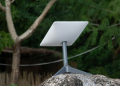
- Choose the mount and have it installed properly. Ridge, wall or pole mounts all work; for a permanent healthcare installation use professional installation with correct sealing, cable routing, lightning protection and a grounded mast. In high-wind regions, over-specify the pole rather than the dish.
- Size the power system. Budget 75 to 100 W continuous for terminal plus router, add a UPS on grid sites, and for off-grid sites specify solar and battery capacity covering overnight operation with two days of autonomy for cloudy weather.
- Segment the network.
- Separate VLANs for clinical systems and for staff or patient guest access, with firewall rules between them.
- Apply quality of service prioritising consultation video above sync and guest traffic.
- Put the EHR on a VPN to the national or hospital data centre.
- Never run open guest Wi-Fi without bandwidth management: a waiting room streaming video will starve a consultation on a 10 Mbps upload.
- Train the staff. Two to four hours covers day-to-day operation: reading the app’s status screen, restarting the terminal, clearing snow or debris, switching to cellular backup, and recognising rain fade rather than logging a fault ticket.
- Document and test failover monthly. Record account details, serial number, support path and the offline clinical procedure on one sheet — then actually unplug the dish once a month to prove the backup works.
- For outreach and mobile clinics, plan for portability. Roam and flexible plan options allow pausing and relocating service between campaigns, which changes the economics of mobile immunisation and screening teams; the portability rules and in-motion restrictions are set out in Starlink for Digital Nomads: Portable Internet Across Borders.
Bottom Line for 2026
Starlink has moved from novelty to default option for health facilities beyond the reach of the terrestrial network. SpaceX’s own announcements have tracked subscriber growth into the millions and service is authorised across a steadily growing list of markets, though the current subscriber figure and country list should be read off SpaceX’s and the regulators’ latest publications rather than quoted from any guide, including this one.
It solves latency, it solves deployment time, and at roughly $7,000 to $17,500 over five years it removes the capital-cost objection that kept fibre spurs off ministry budgets for two decades. It does not solve upload-constrained imaging workflows, it does not provide an uptime guarantee, and it does not sign a Business Associate Agreement. Treat it as excellent transport that needs a backup path, an in-country record system and encryption you own, and the clinical case holds up under legal review as well as in the consulting room.
How This Guide Was Sourced
This is a desk-research guide, not a laboratory test report. We have not independently measured a terminal in a clinic, and where a figure is operational rather than published we have said who reports it. Technical and commercial figures are drawn from Starlink’s own published service terms, pricing pages and hardware specifications; latency data from Ookla Speedtest Intelligence reporting on satellite performance; interactive-quality thresholds from ITU-T Recommendation G.114; EHR bandwidth requirements from major vendor technical documentation including Epic’s; compliance framing from HHS Office for Civil Rights guidance on conduits and from the text of GDPR, Rwanda’s 2021 data protection law, Nigeria’s Data Protection Act 2023, South Africa’s POPIA and India’s DPDP Act; subsidy details from USAC Healthcare Connect Fund programme documentation and the published mandates of national universal service funds; and fibre construction costs from cost models filed with the FCC and US state broadband offices. Deployment counts are ministry- and regulator-reported and are flagged as such at their single point of statement. Where a claim is a planning convention used by installers rather than a published specification — the 10 Mbps upload floor, the 75 to 100 W design allowance, typical delivery times — it is labelled as a planning figure so you can substitute your own measurements.
Published 25 September 2026. Pricing, availability and regulatory status are reviewed quarterly, with immediate updates when a regulator changes an authorisation affecting healthcare use. Corrections and field data from clinic deployments are welcome and will be credited in an update log on any future revision.
Frequently Asked Questions
Is Starlink reliable enough for emergency telemedicine?
It is reliable enough for routine and urgent consultations, but it should never be the only path for a life-critical dependency. The decisive issue is contractual rather than technical: Starlink’s residential and business terms are sold without a guaranteed uptime service level agreement, so there is no credit regime, no priority restoration commitment and nobody to escalate to at 2am. Add the Ku-band rain-fade behaviour that installers commonly describe as short degradations during the heaviest part of a storm, and the sensible posture is a dual-WAN router with cellular failover, clinical software that queues offline, and a printed triage procedure for the minutes when nothing works.
What internet speed does a rural clinic need for telemedicine?
Size the link by concurrency, not by a single headline number. One 1080p consultation consumes roughly 2 to 4 Mbps upstream, an EHR workstation about 5 Mbps according to major vendor documentation such as Epic’s technical requirements, a connected ultrasound or ECG feed 1 to 3 Mbps, and background sync the remainder — which is why a single-room health post fits inside about 10 Mbps upload and a three-room facility does not. Download is almost never the binding constraint on Starlink; upload is, because telemedicine is an upstream application. The failure mode below threshold is not an outage but abandonment: clinicians revert to paper and the record splits in two.
How much does Starlink cost for a healthcare clinic?
Budget three separate lines, not one. Hardware and subscription come from Starlink’s published pricing pages — Business around $250 per month with hardware near $2,500, residential in the $90 to $120 band with hardware at $450 to $600 in established markets, and materially cheaper residential pricing in several African markets. Landed cost adds import duty and VAT under your own customs tariff schedule, which ministries routinely omit from the requisition. Recurring cost is the line that kills deployments: hardware grants that do not fund year two leave a connected clinic dark by month fourteen, which is why universal service and access funds, designed for indefinite recurring spend, are the right instrument.
Can Starlink support teleradiology and medical image transmission?
Yes for compressed and store-and-forward studies, with real caveats for volume and urgency. A 500 MB CT series over a saturated 10 Mbps upload takes roughly seven minutes, which is fine for a scheduled read and unacceptable inside a stroke protocol. Connected district hospitals handle this with lossless compression, overnight queued transfer for routine work, priors sent separately from the current study, and a prioritised manual push with the rest of the clinic throttled when a read is urgent. Full-fidelity multi-sequence MRI at the 50 to 100 Mbps commonly specified for comfortable turnaround is beyond Starlink’s upload envelope.
Is patient data safe on Starlink? Does it comply with HIPAA?
Starlink does not sign a HIPAA Business Associate Agreement for standard service and offers no data-residency guarantee, so compliance is architectural rather than contractual. US covered entities generally treat a transmission-only network provider as a conduit under HHS Office for Civil Rights guidance and carry the obligation themselves: encryption in transit and at rest, a VPN terminating on the health system’s network, role-based access control and audit logging. Outside the US, GDPR transfer rules and national statutes including Rwanda’s 2021 data protection law, Nigeria’s Data Protection Act 2023 and South Africa’s POPIA add residency conditions that a satellite path does not satisfy by default. Keep the record system in-country and let the satellite link carry ciphertext only.
Which countries are using Starlink for healthcare and telemedicine?
Zambia is the most documented case — it was the first African market to license the service, through ZICTA in October 2023, and Ministry of Health connectivity at rural health posts followed. Rwanda is the second clearest example, with clinic links tied to the Ministry of ICT and Innovation’s rural agenda and RURA licensing, and Mozambique’s INGC has used satellite connectivity for cyclone-affected facilities. Deployments also exist in Nigeria, Kenya, the DRC, Pacific island health systems and Arctic community clinics. The facility counts published for Zambia and Rwanda are set out once in the deployments section of this guide; they are ministry-reported rather than independently audited, and some provisioned sites are not yet clinically live.
Follow Starlink News on Google. Make us a preferred source to see more of our reporting in Google search results.
![Using Your Own Router with Starlink: Bypass Mode [2026]](https://starlink-news.com/wp-content/uploads/2026/09/using-your-own-router-with-starlink-bypass-mode-20-f6c09f95-350x250.png)