Iraq’s telecoms regulator says Starlink’s licence is now official and that using the satellite internet service inside the country is legal, while conceding that the company has not yet built an access gateway on Iraqi soil. Baligh Abu Kalal, who heads the executive authority of the Communications and Media Commission (CMC), made the statements to the Iraqi News Agency, the state news service, in remarks published on 27 September and reported in English by 964media.
Key facts
- Abu Kalal said Starlink’s licence “has become official and operating under it is legal in Iraq,” according to 964media.
- He rejected claims that Iraqi users’ data sits in Qatar, saying a security regulation attached to the licence gives Iraq “full control over the data.”
- He said authorities hold detailed information on active terminals and their owners, through a direct link with Starlink.
- He said Starlink had planned to build access gateways inside Iraq only after two years, and that the commission negotiated earlier installation using Iraqi infrastructure because demand was growing.
- 964media notes that without a gateway in Iraq, traffic from Iraqi users lands at gateways elsewhere.
- He gave no gateway date or location, no subscriber numbers and no prices.
Why it matters
The dispute is not abstract: it is about which country’s ground infrastructure Iraqi internet traffic touches first. On the facts both Iraqi officials have stated, Starlink users in Iraq are connecting through satellites whose traffic is landed at gateways outside Iraq, because there is no gateway inside Iraq to land it. Sanad, the communications minister, named Qatar in August. Abu Kalal disputes the destination but not the underlying arrangement.
That leaves Iraq’s claim of control resting on legal and contractual instruments — a security annex to the licence and a direct data link with Starlink that the commission says lets it identify every terminal and owner — rather than on infrastructure it hosts. It is a distinction any regulator licensing satellite broadband has to live with in the gap between signing a licence and commissioning a ground station, and it is the reason the CMC says it pushed the two-year timetable forward.
The dispute over where Iraqi data goes
The commission’s denial answers a claim made by Iraq’s own government, not by an outside critic. 964media reported that Sanad said in August there was no Starlink ground station in Iraq, that traffic was routed through Qatar, and that the company had proposed waiting two years before building locally.
Abu Kalal said the assertion that Iraqi data is in Qatar is inaccurate, and pointed to the security regulation attached to the licence and the direct link with Starlink as the basis for Iraqi control. On the underlying infrastructure point, the two officials describe the same situation: no Starlink gateway is operating inside Iraq yet, and Abu Kalal confirmed the two-year timetable the company had originally proposed. Neither official has published technical detail — routing data, contract text or the annex itself — that would let the Qatar question be settled from outside government.
Gateways, and why they are the sticking point
What a gateway actually is
A gateway, also called a ground station, is the cluster of dishes that connects satellites to terrestrial fibre and hands user traffic to the wider internet. Its location decides which country’s networks, peering arrangements and legal jurisdiction a subscriber’s traffic passes through before it reaches the sites they are visiting. That is why the presence or absence of one inside a licensed market is a political question and not only an engineering one.
The two-year timetable the commission says it renegotiated
964media’s explanation is narrow and worth keeping narrow: with no gateway in Iraq, user traffic reaches gateways in other countries. Abu Kalal said the commission pushed to bring that installation forward and to use Iraqi infrastructure for it, citing rising demand rather than any security finding. He did not say when construction would start, where a gateway would be sited, or whether Starlink has agreed to a revised date.
The same gap shows up in other markets
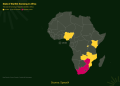
Iraq is not unusual in licensing the service before the ground infrastructure arrives. Starlink News has reported separately on a South African company building Starlink ground stations in 14 African countries — work that determines where each of those markets’ traffic is landed and handed to local networks, and that in most cases follows rather than precedes the licence. Where a national operator fronts the service instead, the commercial terms are settled first and the routing question stays with SpaceX, as in Airtel Uganda’s Starlink setup, steps, trial and price.
How many terminals were already in use — and why the counts differ
Before the licence, Starlink terminals in Iraq were treated as unlicensed equipment, 964media reported, and customs officers seized 24 of them at Baghdad airport in June. The two officials have given figures for the scale of that grey market that look far apart: Sanad put the number of terminals operating illegally at about 42,000, while Abu Kalal put the pre-launch base at roughly 200,000 people using some 40,000 devices.
Read closely, the two accounts are closer than the headline numbers suggest. The device counts — 42,000 and 40,000 — are within about 5% of each other and were given roughly a month apart; it is the unit of measurement that differs. Sanad counted hardware, while Abu Kalal counted hardware and the people behind it, and his own pair of figures implies about five users per terminal, consistent with kits shared over Wi-Fi, resold by the hour or run as neighbourhood connections. What neither figure establishes is the definition of an active device: a count of terminals detected on the network at a moment in time and a count of terminals imported or sold in the country are different measures, and neither official said which they were using.
The gap has not been reconciled publicly, and the commission has not said how many of those existing devices have since been brought under the licence — the number that would show whether legalisation is converting the grey market or running alongside it.
Subscriptions, deliveries and prices
Abu Kalal said subscription requests are being taken on Starlink’s website, that the first subscriptions have been activated after security reviews caused delays, and that deliveries will continue to people who already placed orders, according to 964media. He did not give subscriber numbers, a monthly subscription price or a hardware cost, and the commission has not published a tariff for the service in Iraq. For scale on the business behind those sign-ups, Starlink News has covered Starlink’s latest revenue disclosures separately.
Iraq’s incumbent is not standing still. Sanad said this month that the communications ministry had accelerated its fibre rollout and introduced faster packages in response to Starlink, 964media reported — which puts the ministry in competition with a service the state has just licensed, and gives the minister who raised the Qatar routing claim a commercial stake in the comparison.
What the commission said at launch
The licence itself is not new. 964media reported that the commission said at the launch on 29 July that a security annex gave the prime minister’s office, the National Intelligence Service, the National Security Service and the National Cybersecurity Center oversight of users and devices. That annex is the condition Abu Kalal now cites as the basis for his claim of full data control, but its text has not been published, so what it obliges Starlink to do — and where it says data may be processed — remains unverifiable outside the commission.
What to watch next
- A gateway date or site. The commission says it negotiated earlier installation; it has named neither a location nor a start date, and Starlink has not publicly confirmed a revised timetable.
- The security annex. Publication, or any independent description, of the regulation Abu Kalal says guarantees Iraqi control of user data.
- Where traffic is landed. Any technical confirmation — from either official or from SpaceX — of which gateways currently serve Iraqi users, the point Sanad and Abu Kalal disagree on.
- Conversion of the grey market. How many of the roughly 40,000 pre-licence terminals are now licensed subscriptions, and what happens to those that are not.
- Prices. A published tariff for Iraq, which would allow the first real comparison with the ministry’s accelerated fibre packages.
How we reported this
This account is based on remarks Abu Kalal made to the Iraqi News Agency, the Iraqi state news service, as reported in English by 964media on 27 September, together with 964media’s earlier reporting on the 29 July launch, the June airport seizures and Sanad’s August and September statements. Starlink News has not independently verified the terminal counts, the existence or contents of the security annex, or the routing of Iraqi traffic, and none of those claims can be checked from outside the Iraqi government on the material published so far. SpaceX, which operates Starlink, has made no public statement on the Iraqi licence or on where Iraqi traffic is landed in any of the reporting reviewed for this story; the two government accounts quoted here are the only on-the-record sources. This story will be updated if the commission, the communications ministry or SpaceX addresses the open questions above.
Frequently Asked Questions
Does Starlink have a gateway in Iraq?
No. Baligh Abu Kalal of the Communications and Media Commission said Starlink has not yet built an access gateway inside Iraq, according to remarks to the Iraqi News Agency reported by 964media. He said Starlink had originally planned to install gateways only after two years and that the commission negotiated to bring that forward using Iraqi infrastructure. Communications Minister Mustafa Sanad said in August that there was no Starlink ground station in the country.
What is a Starlink gateway, and why does it matter?
A gateway, also called a ground station, is the dish farm that links satellites to terrestrial fibre and hands traffic to the wider internet. Where the gateway sits determines which country’s networks and legal jurisdiction a user’s traffic passes through first. 964media reported that without a gateway in Iraq, traffic from Iraqi users lands at gateways elsewhere.
Is Iraqi Starlink user data stored in Qatar?
Abu Kalal said claims that Iraqi users’ data sits in Qatar are inaccurate, and that a security regulation attached to the licence gives Iraq full control over the data, 964media reported. The claim he was rejecting came from inside Iraq’s own government: Sanad said in August that Iraqi traffic was being routed through Qatar. Neither official published technical evidence, and SpaceX has not commented publicly in the reporting reviewed for this story.
Which Iraqi authorities can see Starlink users and devices?
According to 964media, the Communications and Media Commission said at the July 29 launch that a security annex attached to the licence gave the prime minister’s office, the National Intelligence Service, the National Security Service and the National Cybersecurity Center oversight of users and devices. Abu Kalal said authorities also have a direct link with Starlink to identify terminals operating in Iraq.
How much does Starlink cost in Iraq, and can people subscribe now?
Abu Kalal told the Iraqi News Agency that subscription requests are being taken on Starlink’s website and that the first subscriptions have been activated after security reviews caused delays, 964media reported. He gave no monthly subscription price, no hardware cost and no subscriber numbers, and the commission has not published a tariff for the service.
Were Starlink kits confiscated in Iraq before the licence?
Yes. 964media reported that Starlink terminals were treated as unlicensed equipment before the licence was issued, and that customs officers seized 24 terminals at Baghdad airport in June.
Follow Starlink News on Google. Make us a preferred source to see more of our reporting in Google search results.