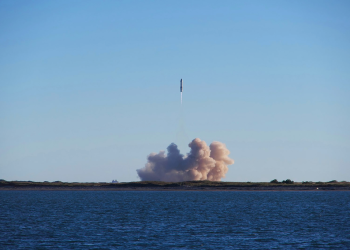
SpaceX is attempting to put its Starship rocket into orbit for the first time on Monday, 28 September, flying from the company’s Starbase site in South Texas with 26 next-generation Starlink satellites on board. According to CNBC, the 75-minute launch window opens at 8:15 a.m. ET, or 7:15 a.m. local time, and the US Federal Aviation Administration cleared the flight two days earlier.
Key facts
- The license: the FAA told CNBC by email that it issued a “license authorization for the SpaceX Starship Super Heavy Flight 14 launch and reentry operations” on 26 September.
- The milestone: this is the 14th Starship test flight and the first intended to reach orbit, CNBC reports; Space.com says the previous 13 missions, dating from the rocket’s April 2023 debut, were all suborbital.
- The payload: the flight is due to deploy 26 Starlink Version 3 satellites, both outlets report.
- The hardware: Space.com describes Starship as the biggest and most powerful rocket ever built, standing 407 feet (124 metres) tall when fully stacked, with a 171-foot (52-metre) Ship upper stage.
- The competitive context: SpaceX operates around 11,000 active satellites in orbit today, CNBC reports, against roughly 650 for Eutelsat OneWeb, the rival European satellite internet operator.
What the FAA actually approved
The regulatory step is worth separating from the rocket. The FAA’s own wording, as supplied to CNBC, covers both “launch and reentry operations” for Flight 14 — the reentry half matters because this is the first Starship profile designed to come back from orbital velocity rather than from a suborbital lob. CNBC reports the authorization was issued on 26 September, two days before the window opens.
Neither CNBC nor Space.com reports any outstanding FAA condition, airspace dispute or mishap investigation attached to Monday’s attempt, and we have not independently reviewed the license document or any associated airspace notices. Readers should treat the FAA statement relayed by CNBC as the authoritative public record for now.
Why it matters
CNBC reports that Starship is critical to SpaceX’s expansion plans, and that the company is counting on the rocket to scale its Starlink, or Connectivity, business — which was its largest and only profitable segment as of the second quarter. That is CNBC’s framing, not ours.
The link from Monday’s flight to the satellite internet business is one this publication has argued separately: Starlink News set out what a bigger constellation could mean for Starlink capacity ahead of this attempt, and reported Starlink’s reported revenue of $4.3bn in a $7.8bn SpaceX quarter earlier this month. Neither CNBC nor Space.com draws a direct causal line from this specific launch to either capacity or revenue figures, and no analyst quoted in either report puts a number on it.
On SpaceX’s August earnings call, Musk said, according to CNBC: “It’s not out of the question that at some point, Starlink will deliver a majority of the world’s internet, at least in countries where we’re allowed to operate, which is the vast majority of countries.”
The flight profile
Space.com reports that the Ship will circle Earth six times after deploying its satellites, then head home for a splashdown in the Pacific Ocean off the coast of Chile nearly 10 hours after launch. That is a sharp break from the suborbital profile: those flights lasted a maximum of 65 minutes and targeted the Indian Ocean off Western Australia, the outlet says.
Both stages — the Super Heavy booster and the Ship upper stage — are designed to be fully and rapidly reusable, which Space.com says SpaceX has called the “holy grail of rocketry”. CNBC frames the same design goal in cost terms: lifting more cargo into orbit for less money than any prior spacecraft. Neither outlet publishes a per-launch price for Starship, so the size of that cost advantage remains a company claim rather than a disclosed figure.
What the V3 satellites change
CNBC reports that the new V3 satellites are produced at a SpaceX facility in Redmond, Washington, and carry solar arrays that generate twice as much power as previous generations. They are also larger and designed to be more powerful, transmitting data more rapidly to Starlink subscribers than earlier versions, according to CNBC.
Space.com describes the 26 spacecraft as the first members of a new megaconstellation in low Earth orbit, separate from the fleet already flying. The number to watch on later flights is satellites per launch: Starship’s payload volume is the reason SpaceX can talk about a constellation an order of magnitude larger than today’s, and 26 V3s on a first orbital attempt is the opening data point, not the ceiling.
What it means for Starlink availability and pricing
For subscribers, the honest answer is that Monday’s flight is upstream of anything visible on a bill. Neither CNBC nor Space.com reports a change to Starlink pricing, plan structure, hardware cost or country availability tied to Flight 14, and we found no statement from SpaceX in either report promising one.
What the sources do support is the mechanism. CNBC’s reporting ties Starship to scaling the Connectivity segment, and describes V3 satellites built to move data faster with double the solar power. More capacity per orbital plane is what historically lets a satellite internet operator lift congestion caps, open sold-out cells and price more aggressively — but that is a general property of the industry, and no source cited here says SpaceX will do it, or when.
On availability, the binding constraint Musk himself named on the August call was regulatory: “countries where we’re allowed to operate”. That is a licensing question decided market by market, and it is not resolved by a rocket reaching orbit. Readers in Zimbabwe and elsewhere in Africa should note that neither source addresses Starlink licensing or availability in any African market, and we make no forecast about it here.
What Starship still has to prove
Even a flawless flight on Monday leaves milestones outstanding, Space.com reports. SpaceX has not yet demonstrated off-Earth propellant transfer, and each Starship mission beyond Earth orbit will require multiple rendezvous with “tanker” Ships to refuel the voyaging spacecraft.
The Ship will also have to be fitted with a life-support system before crewed missions, according to Space.com. During operational flights, the outlet says, SpaceX plans to return both stages to the launch pad to be caught by the tower’s arms — something it has done three times with a booster and never with a Ship.
Background
CNBC reports that SpaceX went public in June in the largest IPO on record and is now valued at about $2 trillion. Chief operating officer Gwynne Shotwell said at the All-In Summit earlier this month that the company also plans to use Starship to put “supercompute in space”, launching what CNBC quotes her calling “AI compute satellites” into orbit in 2027. CNBC also reports SpaceX is preparing Starship for a major NASA test flight next year.
How this report was sourced
This account is built on two published reports — CNBC and Space.com — plus three primary statements relayed in them: the FAA’s emailed description of the Flight 14 license authorization, Musk’s remarks on SpaceX’s August earnings call, and Shotwell’s comments at the All-In Summit. We have not independently verified the license document, the launch window or the payload manifest, and we have not obtained comment from SpaceX, the FAA or an independent launch analyst. Where the two outlets do not address a question — consumer pricing, plan changes, African licensing — this report says so rather than filling the gap. We will update after the window opens.
Frequently Asked Questions
How can I watch the Starship launch live?
SpaceX is streaming the flight itself, and Space.com says webcast coverage starts about 30 minutes before liftoff. The 75-minute window opens at 8:15 a.m. EDT, which Space.com gives as 1215 GMT and CNBC notes is 7:15 a.m. local time at Starbase in South Texas.
Will SpaceX try to catch the booster with the launch tower on this flight?
No. Space.com reports that Super Heavy is scheduled to splash down in the Gulf of Mexico about seven minutes after liftoff, as on previous flights. SpaceX has caught a Super Heavy with the tower’s "chopstick" arms three times, but has never attempted a catch with the Ship upper stage. Space.com says that on operational flights SpaceX plans to bring both stages back to the pad for tower catches.
Does this launch change Starlink prices or availability where I live?
Not directly, and not on any timetable either outlet gives. Neither CNBC nor Space.com reports a price change, a new country activation or a service-plan change tied to Monday’s flight. The cost argument both outlets describe is upstream: CNBC says Starship is designed to lift more cargo to orbit for less money than any prior spacecraft, which is a launch-cost claim rather than a consumer-tariff one. On availability, the clearest public marker remains Elon Musk’s own framing on SpaceX’s August earnings call, quoted by CNBC, that Starlink could one day carry a majority of the world’s internet "at least in countries where we’re allowed to operate" — a regulatory question, not a capacity one.
How does the V3 satellite differ from the ones already in orbit?
CNBC reports that the V3 satellites are built at a SpaceX facility in Redmond, Washington, are larger than earlier generations, carry solar arrays that generate twice as much power, and are designed to transmit data more rapidly to Starlink subscribers. Space.com describes the 26 on this flight as the first members of a new megaconstellation in low Earth orbit, separate from the roughly 11,000 satellites SpaceX already operates — so the V3s add capacity alongside the existing fleet rather than replacing it on this launch.
What role does Starship play in NASA’s moon programme?
Space.com reports that NASA selected the Ship upper stage as the first crewed lunar lander for its Artemis programme, which aims to land people on the moon for the first time in 2028 on the Artemis IV mission. Space.com adds that SpaceX has not yet demonstrated off-Earth propellant transfer, and that each Starship mission beyond Earth orbit will need multiple rendezvous with "tanker" Ships. CNBC reports SpaceX is preparing Starship for a major NASA test flight next year.
Follow Starlink News on Google. Make us a preferred source to see more of our reporting in Google search results.