SpaceX’s Starship rocket reached orbit for the first time on 28 September 2026, lifting off from Starbase in Texas and deploying 26 of the company’s next-generation Starlink V3 satellites. In an analysis published on 2 October, the Nigerian technology outlet Techeconomy made a pointed argument about who should be paying attention: the flight matters, its headline says, because of “why regulators, not just telcos, should be watching.”
That framing holds up, because the two things African regulators actually control — licences and spectrum — are also the two things that currently decide Starlink’s price and availability in any given market. The hardware got better in orbit last week. Whether that reaches consumers is decided on the ground.
Key facts
- The mission was Starship Flight 14 and it was not flawless: Techeconomy reports that an engine problem ended the flight earlier than planned. It still met two objectives — reaching orbit and deploying a first revenue-generating payload.
- SpaceX says each Starlink V3 satellite is designed for 1 terabit per second of downlink capacity and 160 gigabits per second of uplink — roughly ten times the downlink and 22 times the uplink of a V2, Techeconomy calculates — with substantially more beams, so capacity can be concentrated over clusters of users rather than spread thinly.
- SpaceX’s Direct to Cell material describes the relevant satellites as functioning like cellphone towers in space, working with existing LTE phones “with no changes to hardware, firmware, or special apps.”
- Nigeria already has a satellite rulebook: the Nigerian Communications Commission’s Commercial Satellite Communications Guidelines came into effect in 2018, and the Commission keeps separate licensing frameworks for space-segment and ground-segment operators. Starlink Internet Services Nigeria Limited appears in NCC records among authorised space-service operators.
- Nigeria’s National Broadband Plan 2020–2025 set an affordability target of no more than ₦390 for 1GB of data — the benchmark any satellite offer is implicitly measured against.
Why it matters
Techeconomy’s argument is economic rather than technical. Where the cost and availability of terrestrial infrastructure is the binding constraint, the analysis contends, connectivity no longer has to wait for fibre, towers and backhaul to be built everywhere first.
The scale of that constraint is documented independently. The International Telecommunication Union, the United Nations telecoms agency, puts Africa’s internet-use rate at around 38% in its Facts and Figures estimates, the lowest of any region, with a large share of the world’s roughly 2.2 to 2.6 billion unconnected people living there.
Techeconomy is careful about how far the substitution goes. Fibre and mobile networks remain essential for dense urban areas, enterprise connectivity, data centres and backhaul; satellite becomes a substitute, or a competitive alternative, only where terrestrial build-out is uneconomic or simply absent.
Why the operators do not simply disappear
Mobile operators own or lease spectrum, run terrestrial radio networks, manage subscriber identities, provide voice and messaging, operate retail and distribution, connect enterprises and sit inside national infrastructure ecosystems. In Nigeria and across East Africa, many also run the mobile-money service that is frequently the stickier product.
SpaceX’s own strategy assumes they stay. Direct to Cell is built to work with mobile network operators, using their licensed spectrum, and SpaceX likens the integration to a roaming partnership. The ITU describes the result as a hybrid of satellite and terrestrial mobile networks — a description that matters legally, because hybrids are exactly what most national licensing regimes were not drafted for.
The more credible disruption, Techeconomy writes, is not the disappearance of MTN or Airtel but a change in what counts as a telecommunications network: the tower increasingly has a counterpart in space. That is already commercial rather than theoretical. In Nigeria, satellite links are already being tested as rural backhaul in Nigeria, with a satellite feed sitting behind a conventional cell site.
The regulatory questions, itemised
Because Direct to Cell targets ordinary handsets, consumers are unlikely to care whether a signal arrives from a mast or a spacecraft — only whether the phone works, what it costs and whether there is coverage. That, Techeconomy argues, forces regulators past the old split between “telecom operator” and “satellite operator.” The questions it puts to Nigeria’s regime fall into three groups.
Spectrum and licence class
- Who holds the rights to the spectrum a direct-to-device service would use, and on what terms may a satellite operator use an operator’s assignment.
- Which licence class permits direct-to-device service at all, and whether a satellite company needs a Nigerian mobile partner to connect ordinary Nigerian SIMs.
Identity, interception and routing
- How numbering ranges and subscriber identification are handled when the serving network is in orbit — a live question for SIM-registration rules.
- What happens to lawful-interception and assistance obligations when traffic is carried by a foreign-operated constellation.
- Where traffic is routed and where it lands, with the attendant data-localisation and gateway questions.
Consumers, quality and emergencies
- Which consumer-protection obligations apply, who handles complaints, and who is accountable for billing and refunds.
- How quality of service is measured and enforced on a shared, weather- and congestion-sensitive link against metrics designed for terrestrial networks.
- What applies during national emergencies, including priority access and any continuity or shutdown obligations.
- And the structural one: how a country regulates a communications network whose critical infrastructure sits physically outside its territory.
What Nigeria already has on the books
The NCC is not starting from zero: the 2018 guidelines and its two-tier space- and ground-segment licensing are the framework under which Starlink is authorised. What is new, Techeconomy argues, is the combination of markedly more capable satellites and the expansion of direct-to-device connectivity, which raises questions conventional satellite-broadband licensing was never asked to answer.
Price and availability: where regulation actually bites
Nigeria’s pricing record
Starlink launched in Nigeria in January 2023 — the first African market — at about ₦19,260 a month with a kit near ₦274,000. The subscription was later raised to roughly ₦38,000, then to about ₦75,000 a month, applied to new customers from the end of October 2024 and to existing customers from late January 2025, with the standard kit reported at around ₦590,000. The NCC publicly questioned that increase, stating that it had not approved the new tariff — a direct demonstration that a regulator, not a constellation, sets the ceiling on what can be charged. Current figures should be checked against Starlink’s order page, and read against the broadband plan’s ₦390-per-gigabyte benchmark.
Capacity caps and the licensing gap
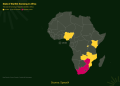
Availability has been constrained by physics as well as paperwork. Starlink suspended new residential sign-ups in Lagos and several other Nigerian cities from late 2024, citing network capacity, with affected cells displayed as sold out on its availability map. That is the exact bottleneck additional V3 capacity is designed to clear, which is why the engineering and regulatory stories are not separable: capacity reopens waitlists, licences decide whether there is a waitlist to join. South Africa, the continent’s most valuable telecoms market, still has no Starlink licence, with ICASA’s local-ownership requirements for licensees the unresolved obstacle. No amount of orbital downlink changes that outcome.
Background: capacity in proportion
Techeconomy frames V3 as an attempt to change the economics of satellite broadband rather than a routine hardware refresh, while cautioning that greater launch capacity mainly accelerates constellation deployment and guarantees nothing at the till. Readers can weigh that against the capacity that single flight added to the network — a single-digit percentage increase, and a useful corrective to the terabit headlines.
What to watch next
Three markers will show whether the regulatory shift Techeconomy describes is real: whether the NCC issues or amends guidance covering direct-to-device services rather than treating them under existing satellite-broadband categories; whether any African operator signs a Direct to Cell agreement with SpaceX and how its regulator treats the spectrum question; and whether sold-out cells in Nigerian cities reopen as V3 capacity accumulates, with what price attached.
Reporting note: the regulatory framing and Nigerian licensing details come from Techeconomy’s 2 October analysis, linked above; satellite and Direct to Cell specifications are from SpaceX’s published material, connectivity estimates from ITU Facts and Figures, and the guidelines and ₦390/GB target from NCC and National Broadband Plan documents, all linked in text. Pricing and availability figures are the most recently published values on the public record and may have changed. Neither SpaceX nor the NCC provided comment for this report.
Frequently Asked Questions
Does 1 Tbps per satellite mean each Starlink user gets 1 Gbps?
No. The one-terabit-per-second figure is design downlink capacity for the whole satellite, shared across beams, geographic cells and every user under them. Residential speeds quoted in African markets run in the tens to low hundreds of megabits per second, depending on how congested the local cell is.
Do you need a special satellite phone for Starlink Direct to Cell?
No. SpaceX says the service works with existing LTE handsets, with no changes to hardware, firmware or special apps. The catch is commercial rather than technical: it depends on an agreement with a licensed mobile operator in your country, using that operator’s spectrum.
Will Starlink V3 make Starlink cheaper in Africa?
Not automatically, on Techeconomy’s reading. Consumer pricing turns on spectrum costs, terminal and ground infrastructure, regulatory fees, taxation, local operating costs, competition and currency movements as much as on orbital capacity. Where prices have moved in African markets so far, local costs and regulatory decisions have driven them, not satellite design.
Where in Africa is Starlink available?
Starlink has gone live in a widening set of markets since Nigeria in January 2023, including Kenya, Rwanda, Mozambique, Malawi, Zambia, Zimbabwe, Botswana, Ghana, Eswatini and Madagascar. Coverage is decided cell by cell, so the company’s own availability map is the authoritative check for a specific address.
Is Starlink Direct to Cell available in Africa?
Not as a launched consumer service on the continent. Direct to Cell runs through partnerships with licensed mobile operators, and Techeconomy’s analysis treats an African agreement as a future event rather than a current one — which is why the spectrum question sits with regulators before it reaches subscribers.
Follow Starlink News on Google. Make us a preferred source to see more of our reporting in Google search results.