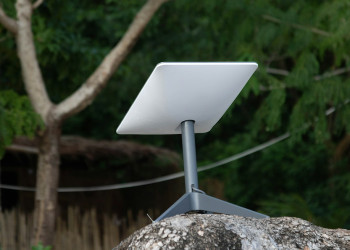
Israeli Prime Minister Benjamin Netanyahu held up a Starlink satellite internet terminal during his address to the UN General Assembly in New York on Thursday evening and said he would leave the device behind as a “gift” for Iran’s delegation, according to Israel Today. Israel’s ambassador to the UN, Danny Danon, then carried a device over to Nasser Asadi, a member of Iran’s UN mission, who did not take it.
The two outlets that covered the handoff do not agree on when it happened. WANA places the exchange a few minutes after the speech; Israel Today places it later the same evening. Neither account says Asadi accepted the terminal.
Netanyahu displayed the receiver while discussing internet restrictions in Iran and said it could help Iranians get online and communicate with people outside the country, according to NewsX.
Key facts
- The session was the 80th UN General Assembly, WANA notes.
- Israel Today says the speech came 33 days before Israel’s elections.
- Israel Today reports the Iranian delegation was absent from the chamber and had left a picture of Qassem Soleimani on its seat, a photograph the outlet described as an allusion to retaliation.
- Accounts of the walkout differ in scale: Israel Today says representatives of around 70 countries left as Netanyahu began, NewsX describes “dozens of delegates” walking out, and WANA refers to dozens of delegations.
- Israel Today reports that Netanyahu’s office had arranged in advance for the public gallery to be filled with supporters, who applauded throughout.
- None of the three outlets reports a comment from SpaceX or from Elon Musk on the episode.
What was said
From the podium
Israel Today reports that Netanyahu opened by addressing the delegates who were leaving, calling on any remaining “moral cowards” to go as well. Turning to Iran, he suggested that delegation members who “inevitably defect” could use the device to describe their experiences on social media, NewsX reports. WANA reports that he said change in Iran was “only a matter of time” and spoke of the “power of the people” against the country’s rulers.
The Starlink segment was one of several props and targets in the address. Israel Today reports that Netanyahu attacked Turkish President Recep Tayyip Erdoğan, whom he called a “dictator,” as well as Qatar, New York Mayor Zohran Mamdani and French President Emmanuel Macron, and that he held up a pager when referring to the operation against Hezbollah. NewsX reports that he also rejected allegations of genocide in Gaza.
On the floor, after the speech
Danon filmed himself extending the device toward Asadi and posted the footage online, writing that the Iranian representative “didn’t want the Starlink,” NewsX and Israel Today report. According to NewsX, Danon told Asadi: “Do you want to take it and deliver it back to Tehran? It could be very useful for people in Iran. We love the Iranian people, and we pray for regime change in Iran. The day will come.” WANA also reports Danon saying Israel “loves the Iranian people” and that he prays for regime change. Asadi looked away and did not engage, according to NewsX; WANA reports that he declined to accept the device.
Iran’s response
WANA reports that Asadi answered Netanyahu’s remarks by accusing him of using the UN platform to promote war, saying the organisation was created to protect future generations from war and to establish peace and justice. Asadi said resistance was part of Iran’s national identity and that Iran would prevail against its aggressors, WANA reports. Its conclusion: Iran’s reply was not a counter-speech but the refusal of the device itself.
Why it matters
What the sources say
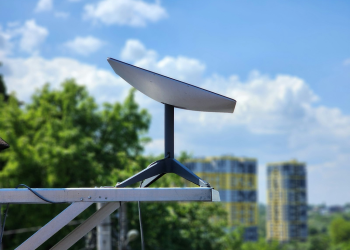
WANA describes Starlink as a satellite internet service that uses low Earth orbit satellites to deliver access without direct reliance on terrestrial telecommunications infrastructure — a feature it says becomes significant in a country where internet access may be disrupted or cut off during a crisis. WANA also states the constraint that limits that advantage: reception depends on a ground terminal in the user’s hands, which the outlet says makes broad access much harder to achieve in practice.
WANA further argues the gesture cannot be read as a simple technology demonstration. In its account, Tehran was being offered a communications tool by a party it has fought in both covert and open warfare, and such an offer would not be interpreted independently of that history.
Our reading: a signal without a receiver
What follows is this site’s analysis rather than reported fact. The same technical feature that makes the terminal useful as a stage prop is what limits it as an actual offer. A dish that talks straight to orbit is easy to hold up and easy to understand; it is also useless until someone inside Iran is physically holding one and the service has been switched on for that location. On the reporting available, neither condition is established: none of the three outlets says Starlink is sold or licensed in Iran, and none says the specific unit Danon carried could have been activated had Asadi taken it.
That leaves a set of questions the three reports do not answer, and we flag them as gaps rather than as findings: who would pay for the kit, how it would cross a border, which authority would permit it to transmit, and what SpaceX — a private company, not a party to the exchange — thinks of being cast in the scene. Our earlier same-day report covered Israel offering Iran a Starlink kit at the UN as it happened.
What a Starlink kit normally costs, and why no price attaches to this one
This section is general background on how the service is sold, clearly separate from the reporting above. In every market where SpaceX operates, Starlink is priced in two parts: a one-off charge for the hardware — the dish, its mount and the router — followed by a recurring monthly subscription for service at a registered address or, on some plans, in motion. We are deliberately not quoting figures for Iran’s neighbourhood: none of the three outlets in this story gives a price, and we have not independently verified current regional rates, so any number here would be decoration rather than reporting.
The more important point for this story is sequencing. A price only becomes meaningful once a country is a market. Before a subscription can be billed, the service has to be authorised where the customer sits and a terminal has to be in the customer’s possession. For Iran, on the sourcing available, both steps are missing, which is why the cost of Netanyahu’s prop is unstated in all three reports rather than merely unknown.
Background: Starlink and Iran since 2022
The question of using Starlink inside Iran did not start at the UN, WANA reports. In 2022, after protests in Iran, Elon Musk said he would seek to activate the service there. WANA notes that activation was never the whole problem, because the signal is only half of a connection: someone still has to get receiving equipment into the country and into users’ hands. That split — capacity overhead, hardware on the ground — has shaped every version of the debate since, including the one staged at the General Assembly this week.
One further claim sits in the record, and it should be read with caution. WANA reports that former Israeli prime minister Naftali Bennett said Israel had at one point attempted to move tens of thousands of Starlink terminals into Iran so that protesters could keep communicating during an internet shutdown. That is a single account of a covert effort, relayed by one outlet and attributed to a former officeholder rather than to the Israeli government; none of the reports we reviewed carries official Israeli confirmation, a date for the attempt, or any indication that hardware arrived. WANA goes further and argues the remarks show the issue had moved beyond a purely technical discussion within Israeli policy, and that the record gives grounds for viewing Starlink terminals inside Iran as potentially connected to Israeli efforts. That inference is the outlet’s own reading, and on the evidence presented we would not treat it as established.
A pattern in our own recent coverage
None of the three outlets we reviewed places the UN moment in any wider sequence, so what follows is our observation, based on this site’s reporting over the past fortnight rather than on their accounts. Within that window we have now covered three separate instances of a national leader or government treating Starlink coverage as something to be negotiated rather than purchased — and in each one the decision sits with a private company rather than a state. Donald Trump pointed Kyiv at the company’s owner, as we reported when Donald Trump telling Ukraine to ask Musk about Starlink and strikes inside Russia surfaced, and Helsinki approached the company directly in the case of Finland’s president reportedly asking Musk to extend Starlink. The UN episode differs in being performed for an audience: a network whose coverage is a political question, offered by one government to another on camera.
The trip around the speech
Israel Today reports that Netanyahu’s US trip was unusually short, that he did not meet President Trump — who was meeting China’s President Xi Jinping at the time — and that a planned meeting with Musk was cancelled after the Secret Service objected to an unplanned trip to Texas. The same report carries the assessment that the speech was aimed primarily at an Israeli audience ahead of the election; Israel Today does not name the commentators it credits with that reading, so we cannot attribute it to any identified individual and pass it on only as the outlet’s own characterisation.
What is not confirmed
- The timing of the handoff: WANA puts it minutes after the speech, Israel Today later the same evening.
- The scale of the walkout: accounts range from “dozens of delegates” to representatives of around 70 countries.
- Bennett’s account of an attempt to move tens of thousands of terminals into Iran, which Israel has not officially confirmed in any of the reports reviewed here.
- Whether the terminal Danon offered could be activated in Iran, and at what cost: none of the three outlets reports a price, a service status, or a comment from SpaceX or Musk on the episode.
- Who would own, fund or lawfully operate such a terminal inside Iran — unaddressed in all three accounts.
Frequently Asked Questions
Did Iran’s diplomat accept the Starlink terminal?
No. NewsX reported that Nasser Asadi of Iran’s UN mission looked away and did not engage when Israeli ambassador Danny Danon extended the device toward him; WANA reported that he declined to accept it. Danon filmed the attempt and posted the footage online, writing that the Iranian representative “didn’t want the Starlink.”
Was Iran’s delegation in the hall when Netanyahu displayed the device?
No. Israel Today reported that the Iranian delegation was absent from the chamber during the speech and had left a photograph of the slain commander Qassem Soleimani on its seat, which the Israeli outlet read as an allusion to retaliation.
Can you buy Starlink in Iran, and what does a kit cost there?
None of the three outlets we reviewed — WANA, NewsX and Israel Today — reports that Starlink is sold or licensed in Iran, and none gives a price for the hardware Danon was holding. As general background: where SpaceX does operate, it charges once for the kit and then bills a monthly service fee. We are not quoting a figure for the region, because no source in this story provides one and we have not independently verified current regional pricing. In practical terms, service authorisation and a dish physically inside the country come before any price question.
Have SpaceX or Elon Musk commented on the UN episode?
Not in any of the three reports we reviewed. None of WANA, NewsX or Israel Today carries a statement from SpaceX or from Musk on Netanyahu’s prop, on Danon’s attempted handover, or on whether a terminal taken to Tehran could be activated.
Did Netanyahu meet Elon Musk or Donald Trump on this US trip?
No. Israel Today reported that the visit was unusually brief, that Netanyahu did not meet US President Donald Trump — who was meeting China’s President Xi Jinping at the time — and that a planned meeting with Musk was cancelled after the Secret Service objected to an unplanned trip to Texas.
Follow Starlink News on Google. Make us a preferred source to see more of our reporting in Google search results.