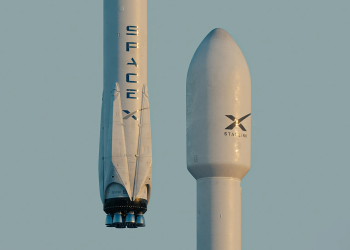
SpaceX is due to fly the 14th test flight of Starship on Monday, 28 September, and for the first time the vehicle is meant to release satellites: 26 next-generation Starlink V3 units. Financial outlets MoneyCheck and Blockonomi have both framed the mission through the share price. For anyone who buys the satellite internet service rather than the stock, the useful question is narrower: what does putting V3 hardware on Starship change for capacity, pricing and availability — and when?
What Monday’s flight changes for Starlink customers
In the short term, almost nothing. Neither report gives a target orbit for the 26 satellites, a commissioning schedule, or a date when any of them would begin carrying customer traffic. Starlink satellites normally spend weeks after separation raising themselves to their operational shell and passing checkout before they are switched into service, so a single flight does not show up as a speed bump on a home terminal the following morning. A subscriber in a congested cell on Monday will still be in a congested cell on Tuesday.
The medium-term point is the launch vehicle, not the batch size. SpaceX has positioned V3 as a substantially higher-capacity satellite than the V2 Mini units Falcon 9 has been lofting, and as a design that depends on Starship’s larger fairing to fly in quantity. Twenty-six units is well below the per-flight numbers the company has discussed for a mature Starship cadence, which is consistent with Monday being a demonstration of the deployment mechanism rather than a capacity delivery. We are not reproducing per-satellite throughput figures here, because neither outlet publishes them and design targets quoted in marketing material are not the same thing as measured in-orbit capacity.
There is a ceiling on this that has nothing to do with rocketry. The Federal Communications Commission’s December 2022 partial grant authorised SpaceX to deploy and operate up to 7,500 second-generation satellites, deferring action on the far larger constellation the company had requested. V3 hardware falls under that Gen2 authorisation rather than the original licence. If Starship works as advertised, the rate at which V3 capacity reaches subscribers becomes a question of regulatory headroom and of in-orbit lifetime, not of launch slots — a constraint neither financial write-up mentions.
Starlink pricing: what actually determines your bill
No source reports any change to Starlink subscription pricing, hardware pricing, plan structure or congestion management tied to this flight, and we found no company announcement of one. That is worth stating plainly, because launch coverage and price coverage get conflated constantly — the “56% upside” in the headlines both outlets ran refers to a share price, not to anything on a customer invoice.
What SpaceX does publish, on its own plans pages, is a tiered structure rather than a single rate:
- Fixed residential service — the standard home tier, tied to a service address and to the capacity of the cell that address sits in.
- A deprioritised consumer variant — offered in selected markets at a lower monthly rate, with traffic deprioritised behind full-price residential users at peak hours.
- Roam — portable service sold in regional and global forms, priced above fixed residential and deprioritised relative to it.
- Priority and Mobile Priority — business and maritime/aviation tiers sold with prioritised data allowances, billed per gigabyte once the allowance is used.
- Direct to Cell — messaging via partner mobile networks, sold by the carrier as part of a phone plan, not as a Starlink subscription.
Hardware is sold separately as a standard dish kit or a smaller, lower-throughput portable kit, and is routinely discounted — sometimes to near zero with a service commitment — in cells where SpaceX has spare capacity to fill. That is the mechanism worth understanding: Starlink prices demand-responsively. The same plan can carry different monthly and hardware pricing in an undersubscribed rural cell than in a saturated metropolitan one, and SpaceX adjusts both without notice. We are deliberately not quoting a dollar figure, because any single number is market-specific, cell-specific and goes stale within weeks; the authoritative price is the one the checkout flow returns for your own service address.
The link between Monday’s launch and that bill is indirect but real. Capacity added to the constellation has historically reached subscribers as relief in congested cells and as promotional hardware pricing in newly opened ones — not as headline rate cuts. If V3 on Starship works, the plausible consumer effect over 2027 is more cells moving out of sold-out status and fewer peak-hour deprioritisation slowdowns, rather than a lower advertised price.
Starlink availability: capacity is only half the gate
The other half is regulatory, and extra satellites do nothing about it. Before SpaceX can sell service in a country it needs an operating or landing-rights authorisation from that country’s telecoms regulator, and in many markets a local gateway arrangement and spectrum coordination as well. Markets sitting in “coming soon” status on SpaceX’s Starlink availability map are, in most cases, waiting on a licence rather than on hardware in orbit — which is why published target dates in that column have slipped repeatedly across several African, South Asian and Southern European markets while the constellation kept growing.
Where launches do matter is the other three statuses. The map distinguishes cells that are available for immediate activation, cells on a waitlist, and cells marked sold out — the last being an explicit statement that SpaceX has more demand in that geography than orbital capacity to serve it. Those are the cells a successful V3 ramp would unlock, and they cluster in exactly the places the service sells best: dense rural corridors in North America, Europe and Australia, and fast-growing markets in sub-Saharan Africa and Latin America where Starlink has taken share quickly enough to saturate its own coverage.
Neither MoneyCheck nor Blockonomi reports a single country-level availability change, waitlist reopening or licensing decision connected to Flight 14. Readers tracking a specific address are better served by the map, checked against their own coordinates, than by either write-up — and the map’s status for a given cell can change without any launch at all, as SpaceX re-balances beam allocation.
The market frame, in brief
The stock angle is real, and it is what both outlets actually wrote about. They put SPCX near $150 on Friday against a mean analyst target of $232.07 — roughly 56% higher — with the shares down about 3% over five sessions on what the outlets describe as broader volatility and questions about capital expenditure. That leaves the price above the $135 IPO level but well below the $225.64 June high, and it follows the stock’s run since July. The Street’s aggregate rating is Moderate Buy: 26 Buy, five Hold, two Sell.
Mizuho’s Brett Linzey reaffirmed Buy at $200, citing a hosting agreement starting 1 December that he said could generate roughly $1.11 billion a month at maximum capacity, and a management pricing target of $30–$50 per watt for 2027. Bernstein’s Douglas Harned is at $248 and ties his case to Starship reusability, treating a fourth-quarter 2026 second-stage recovery demonstration as the inflection point; he forecasts the Connectivity segment, which includes Starlink, producing more than $100 billion in EBITDA by 2031 — a number worth setting against Starlink’s share of SpaceX revenue today, which is measured in single-digit billions per quarter. Morgan Stanley is the most bullish in the sample at $300. Both outlets also cite market observer Shay Boloor drawing an Amazon-to-AWS analogy, while labelling that view speculative.
The connectivity-relevant part of all this is narrow: Harned’s thesis is that reuse is the lever on the cost of placing each Starlink satellite in orbit. That is the only one of these numbers with a mechanical path to a subscriber’s service.
Sourcing: what we verified, and what we cut
The two available reports are near-identical in their facts and figures, disagree on nothing material, and both carry not-financial-advice disclaimers. Neither names a primary document — no SpaceX newsroom post, no regulatory filing, no published Mizuho or Bernstein note — behind the launch date, the hosting agreement or the reuse timeline. Two outlets repeating the same unsourced figure is one source, not two, and we have written it that way. The primary documents we could verify independently are SpaceX’s own launches page for mission timing, its plans and coverage pages for the consumer facts above, and the FCC’s Gen2 order for the 7,500-satellite authorisation.
We also dropped a claim both aggregators carried: a projection attributed to Elon Musk that SpaceX’s AI work would match a named rival and reach GPT-6-equivalent performance within two to three months. The comparison as published is garbled, names no coherent benchmark, and neither outlet offers a measurement basis. Rather than repeat an apparent transcription error into the record, we have left it out and noted its absence.
What to watch next
Three things, in order of relevance to the satellite internet network. Whether the deployment mechanism releases all 26 V3 satellites cleanly, since that — not stage recovery — is the step that unlocks Starship as a Starlink workhorse. Whether SpaceX subsequently confirms how many of the 26 reach their operational shell and enter service, which neither report addresses and which is the only number that converts into capacity. And whether sold-out cells on the coverage map begin reopening in the months after, because that, not a price announcement, is how a working V3 pipeline will first become visible to customers.
The fourth-quarter second-stage recovery attempt sits behind all of it, and is the milestone Bernstein has hung its case on. But a 56% target is a forecast about a share price. Monday’s flight is a test of hardware, and for subscribers the answer arrives in commissioning reports, checkout pages and availability maps over the following weeks — not at the closing bell.
Frequently Asked Questions
Will Starship Flight 14 change my Starlink service or speeds this week?
Nothing in the reporting we reviewed says it will. Neither MoneyCheck nor Blockonomi gives a commissioning timeline for the 26 Starlink V3 satellites, a target orbit, or a date when any of them would begin carrying customer traffic. Newly launched Starlink satellites normally spend weeks raising orbit and passing checkout before they are switched into service, so any capacity effect from a single flight arrives later and gradually, not on launch day. If your cell is congested this week, it will still be congested next week.
Does this launch change Starlink prices or hardware costs?
No. Neither outlet reports any change to Starlink subscription pricing, plan structure, hardware costs or congestion policies tied to Flight 14, and we found no company announcement of one. Starlink’s monthly rate is set per market and, in several countries, per cell — the same plan can carry a different price in a lightly used rural cell than in a saturated metro one. Because those figures move without notice, the authoritative number is the one shown in the checkout flow for your own service address on Starlink’s site, not a figure quoted in launch coverage.
What Starlink plans exist, and which one changes if capacity grows?
SpaceX publishes a consumer tier for fixed home use, a deprioritised lower-cost variant of it in some markets, a portable Roam tier sold in regional and global forms, and business-grade Priority and Mobile Priority tiers with prioritised data allowances. Direct to Cell messaging is sold through partner mobile carriers rather than as a Starlink plan. Added constellation capacity has historically shown up first in the consumer tiers — as fewer deprioritisation slowdowns at peak and as sold-out cells reopening — rather than as a headline price cut.
Will Flight 14 open Starlink service in my country?
Not by itself. Country availability is gated by the national telecoms regulator, not by launch cadence: SpaceX needs a landing-rights or operating licence, and in many markets a local gateway arrangement, before it can sell service there at all. Extra satellites help where the constraint is capacity — cells marked sold out or waitlisted on Starlink’s coverage map — and do nothing where the constraint is a licence. The map is the only status record SpaceX maintains publicly, and its ‘coming soon’ dates have slipped in multiple markets.
Why does 26 satellites matter if Starlink already has thousands in orbit?
Because of what is carrying them, not how many there are. This is billed as the first Starship mission to release satellites, so the significance is demonstrating the deployment mechanism on the larger vehicle. SpaceX has publicly positioned V3 as a higher-capacity design meant to fly on Starship in batches several times this size; Monday is the proof-of-concept step toward that, and both financial write-ups treat it that way.
What did SpaceX do in the wet dress rehearsal before Flight 14?
Teams ran the complete launch sequence on Thursday without igniting the engines, according to MoneyCheck. Blockonomi adds that propellant loading was part of the exercise. Both describe it as validating procedures for Monday’s attempt. Neither cites a SpaceX statement or test report as the source, and SpaceX’s own launches page remains the canonical record for mission timing.
How many Gen2 satellites is SpaceX actually allowed to fly?
The Federal Communications Commission’s December 2022 partial grant authorised SpaceX to deploy and operate up to 7,500 second-generation satellites, deferring action on the remainder of a much larger request. That order is a primary document and is the ceiling that matters for V3 deployment rates: Starship can only lift as many satellites as SpaceX is licensed to operate, so regulatory headroom, not rocket capability, may become the binding constraint on how fast V3 capacity reaches subscribers.
Follow Starlink News on Google. Make us a preferred source to see more of our reporting in Google search results.