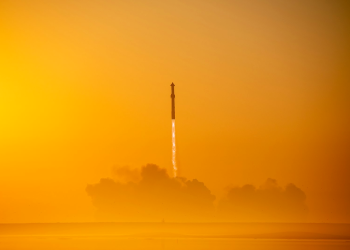
SpaceX flight controllers publicly called off the orbit attempt on Starship’s 14th test flight, then reversed the decision minutes later and pressed on — and the rocket went on to reach Earth orbit for the first time. The launch took place on Monday, 28 September 2026, from SpaceX’s Starbase site in South Texas, with the upper stage releasing 26 Starlink V3 broadband satellites before splashing down in the Pacific.
Key facts
- One of the six engines on Starship’s upper stage, called Ship, went out during liftoff, according to Yahoo.
- SpaceX spokesperson Dan Huot announced the orbit attempt was called off, then flight controllers decided to continue, Yahoo reported.
- The two reports give different liftoff times: Business Insider, published by Yahoo Finance, put it at around 7:46 a.m. Central Time; Yahoo gave 8:48 a.m. EDT (1248 GMT; 7:48 a.m. local Texas time).
- The Super Heavy booster came down for a controlled splashdown in the Gulf of Mexico about seven minutes after liftoff, Yahoo reported.
- Ship fired a single Raptor engine briefly about 25 minutes after liftoff to enter orbit, according to Yahoo. Business Insider reported Starship reached orbit at around 8:15 a.m. Central Time.
- Yahoo reported the 26 Starlink V3 satellites were deployed over a 30-minute stretch starting at about T+34 minutes.
- Elon Musk said on X that all 26 satellites were “operating nominally,” Business Insider reported.
Why it matters
Business Insider reported that launching larger V3 satellites on Starship, which has far greater capacity than SpaceX’s Falcon 9, will allow the company to supersize the Starlink constellation. It also reported that SpaceX has submitted plans to launch 100,000 Starlink satellites in the coming years, up from around 11,000, and that Musk has said the service could supply the majority of the world’s internet in less than a decade.
Satellite internet has become one of the most lucrative parts of SpaceX’s business and was the source of the majority of the company’s revenue last year, according to Business Insider. The outlet reported that SpaceX executives have estimated Starship, which unlike Falcon 9 will be fully reusable, could cut the cost of launching cargo into space by up to 10 times — the reason what cheaper launches could mean for Starlink capacity is being watched so closely. Business Insider tied those goals to the $2 trillion market cap SpaceX secured after a record-breaking public listing in June, saying they hinge on Starship flying regularly.
The engine-out call
Yahoo reported that the engine failure raised doubt about whether SpaceX would attempt orbit at all, and that Huot said: “We are not giving up yet.” Business Insider described a tense few moments on SpaceX’s livestream before the company decided to continue. Mission control then confirmed “Starship is orbital,” Yahoo reported, and Musk posted that the first orbital flight of Starship was successful.
Yahoo also reported that Super Heavy appeared to experience several engine shutdowns during flight, but nothing serious enough to affect its landing.
A mission cut short by nearly seven hours
SpaceX had wanted Ship to complete about six orbits and splash down off the coast of Chile 9 hours and 50 minutes after launch, Yahoo reported, but controllers shaved nearly seven hours off that flight time. Business Insider reported that after deploying the last satellite, SpaceX said Starship would be de-orbited early and splash down in the Pacific after three hours circling the planet.
According to Yahoo, Ship began reentry about two hours and 40 minutes after launch, went subsonic 26 minutes later, and splashed down intact in the northern Pacific three hours and eight minutes after liftoff. It then toppled over and exploded when it hit the waves.
What the 26 satellites were for
Business Insider reported that Flight 14 was the first time the rocket had launched with real, revenue-generating cargo, and that the V3s are the latest version of the low Earth orbit satellites SpaceX uses to beam Starlink around the globe. Yahoo reported that three of the 26 were outfitted with cameras used to scan Ship, with engineers set to study the imagery to see whether they can improve the heat shield that lets the vehicle survive reentry.
Getting to orbit was the primary goal of the test, Yahoo reported, and the fact that Starship reached orbit and deployed its first 26 Starlink V3 satellites separates this flight from the July attempt.
Background: Flight 13 and the V3 vehicle
Yahoo reported that Flight 14 was the third Starship launch to feature Version 3 of the vehicle, which it described as a relatively mature iteration capable of deploying satellites and reaching the moon and Mars. CNN reported that Flight 13, in July, followed an aborted attempt the week before in which several engines failed to ignite, and that SpaceX replaced six engines because of a likely moisture issue. CNN said the July flight ended with a controlled splashdown in the Indian Ocean, which Huot called a “dream scenario,” and that during V3’s first flight in May a series of engine outages caused the rocket to underperform.
What SpaceX has still not demonstrated
Yahoo reported that SpaceX plans to bring both stages down on the launch pad using the tower’s chopstick arms, and that it has not yet tried this with Ship. The outlet added that missions to the moon or Mars will require multiple launches of tanker spacecraft to refuel Ship in Earth orbit, a capability SpaceX has not yet demonstrated, and that life-support systems must still be installed before crewed flights.
Business Insider reported that Musk has said Starship could launch as often as once a day within the next year, and that SpaceX has indicated it aims to launch as many as 1 million satellites functioning as orbital data centres, with Musk betting that training large language models in space will give the company an edge in the AI race.
Frequently Asked Questions
Did the Starlink satellites released on the July Flight 13 test stay in space?
No. CNN reported that SpaceX made contact with all 20 Starlink satellites deployed on Flight 13, but they were not designed to stay up and each burned up in the atmosphere about 20 minutes after leaving the upper stage. Yahoo’s report adds that those satellites were released on a suborbital trajectory.
Why didn’t SpaceX catch the booster with the launch tower’s chopstick arms this time?
Business Insider, published by Yahoo Finance, reported that both the booster and the upper stage were set to splash down at sea instead, an approach that reduced the risk of something going wrong on landing. Yahoo reported that SpaceX has caught Super Heavy with the tower on three test flights so far and has never attempted a tower catch with Ship.
How big is Starship and how much can it carry?
The two sources give slightly different heights: Business Insider described a 400-foot-tall rocket, while Yahoo put it at 407 feet (124 metres). Yahoo, citing SpaceX’s specifications page, said the vehicle can haul more than 110 tons (100 metric tons) to Earth orbit.
What does Starship’s progress mean for NASA’s return to the moon?
Yahoo reported that NASA picked Starship as the first crewed lander for its Artemis programme, with the Ship upper stage due to fly the crewed Artemis III mission to low Earth orbit in mid-2027 and to land astronauts near the moon’s south pole a year later on Artemis IV. Yahoo noted NASA also selected Blue Origin to supply Artemis crewed landers and it is unclear which vehicle will fly Artemis IV. CNN reported NASA hopes to put astronauts on the moon as soon as 2028.
Follow Starlink News on Google. Make us a preferred source to see more of our reporting in Google search results.