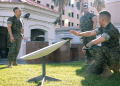
SpaceX’s satellite internet unit Starlink has unveiled Mini 2, a portable dish with a quick-swap battery, USB-C charging and built-in Wi-Fi 6, according to Tesla and SpaceX news site TeslaNorth, which reported the launch on 10 November 2026. Two weeks earlier, on 27 October, technology site notebookcheck reported that PeakDo, a Chinese accessory maker, had put a rival answer on sale: a battery that clips onto the back of the existing Starlink Mini.
Key facts
- Starlink says Mini 2 runs for up to 4.5 hours on its battery and connects in about 60 seconds with a clear view of the sky, per TeslaNorth.
- PeakDo rates its LinkPower Ultra at up to 5.5 hours with a first-generation Starlink Mini drawing an average 20W, per notebookcheck.
- The Ultra costs $329, weighs about 663g, is 22mm thick, holds 27,000mAh and carries an IP65 rating and a built-in fan.
- The Mini 2 kit contains the dish, one battery, a kickstand, a power supply and a USB-C cable; spare batteries are sold separately, at a price Starlink has not published.
- Mini 2 preorders are open by invitation to selected US customers, with no public price, TeslaNorth reports.
Why it matters for portable satellite internet users
Until now, running a Starlink Mini away from mains power meant buying a separate power source. TeslaNorth frames a self-contained battery as useful at a campsite, during a short remote-work session or as a backup connection during an outage — but the group it changes outcomes for most is anyone whose working day is defined by how long the link stays up: field surveyors and site engineers without a generator, journalists and medics working after a storm has taken the grid down, and households in areas where mains power is intermittent rather than absent. For those users the design difference matters more than the runtime figure: with a swap battery, extra hours come from carrying another pack in a bag, not from hauling a larger power station.
The cost of that is the open question. Because Starlink has published neither a Mini 2 price nor a spare-battery price, the running cost of the swap approach cannot yet be worked out. The third-party route can be: on the figures in these two reports, a first-generation Mini at $149 plus a $329 LinkPower Ultra comes to roughly $478 for a dish-and-battery pair whose total a buyer already knows. Each additional hour of runtime on the PeakDo route means another battery in the Ultra’s price class; on Mini 2 it means one spare pack at a figure Starlink has not announced. Until it does, the comparison a buyer actually needs is unavailable.
What Starlink lists for Mini 2
Beyond the battery, TeslaNorth cites Starlink’s specifications for 60W USB-C charging, Wi-Fi 6 coverage of up to 1,800 square feet (167 square metres) and an IP67 environmental rating. The company also describes a thinner enclosure and tougher materials for outdoor use.
TeslaNorth adds two caveats from Starlink’s own disclosure: actual battery runtime and Wi-Fi coverage vary, and the advertised runtime is an upper limit rather than a guarantee. It also notes that trees and other obstructions still matter when choosing where to set up a dish, a problem readers can check with the Starlink app’s obstruction map.
The third-party route: PeakDo’s LinkPower Ultra
The Ultra is the fourth model in PeakDo’s LinkPower range, notebookcheck reports, and the first to add a fan. The fan switches on automatically when the battery reaches 52°C and turns off once it cools to 45°C.
The Ultra also moves to semi-solid-state battery cells. notebookcheck explains that a punctured lithium-ion cell can set off a chain reaction that leads to fire, and says PeakDo claims the new cells improve thermal stability and reduce the risk of electrolyte leakage. Denser cells allowed the company to cut thickness from the 27mm of the LinkPower 3, according to the report.
Power goes to the dish through a magnetic DC connector rated at up to 65W, while a USB-C port can charge other devices at up to 65W, notebookcheck says. Recharging over USB-C runs at 65W by default and up to 100W once enabled in software. The unit adds a 1/4-inch thread for tripods and camera mounts, plus Wi-Fi monitoring through the PeakDo LinkPower app, which the site says shows battery status remotely and can schedule power cycles.
Two runtime claims, measured differently
The headline numbers are not like-for-like. Starlink’s 4.5-hour figure, as reported by TeslaNorth, applies to Mini 2’s own internal battery. PeakDo’s 5.5 hours, per notebookcheck, assumes a first-generation Starlink Mini pulling an average of 20W — and notebookcheck notes it is the same runtime PeakDo quoted for the larger 27,500mAh LinkPower 3. Neither figure has been independently tested in the reports reviewed here.
Prices and timing
US stock, bundles and Amazon
At $329, the Ultra costs $80 more than the LinkPower 3, notebookcheck says. PeakDo was offering $30 off for 10 days at launch, with bundles including a car charger, a mount or both priced between $349 and $389. Initial stock ships from China, with US delivery expected to take seven to 15 days, and PeakDo told US technology site PCMag it planned to submit the product for an Amazon listing in early November.
Starlink availability outside the US
Mini 2 is the tighter constraint here. TeslaNorth says Starlink’s product page states that more customers and countries are coming and offers an availability-notification signup, but lists no launch date for Canada and no pricing beyond the invited US group — so for most of the world the accessory route remains the only one that can be bought today. Our earlier coverage sets out the Starlink Mini 2 preorder details and the shipping and global pricing timetable reported so far.
notebookcheck’s October report had already flagged what was coming: it said SpaceX was developing a second-generation Starlink Mini with its own battery capability and was preparing a holiday sales push for its newest dishes. TeslaNorth’s 10 November report confirms that dish now exists as Mini 2, and says the announcement followed the previous month’s US$149 promotion on the first-generation Mini.
Frequently Asked Questions
Can a Starlink Mini stay online while its battery is charging?
Yes, in both setups. TeslaNorth reports that Mini 2 can stay connected while charging, and notebookcheck says the PeakDo LinkPower Ultra supports pass-through charging that keeps the dish online while the battery itself refills.
Can you take the PeakDo LinkPower Ultra on a plane?
According to notebookcheck, the Ultra’s 27,000mAh pack is rated at 99.9Wh, which it describes as just under the 100Wh limit the US Federal Aviation Administration sets for lithium-ion batteries passengers can carry without airline approval. The report does not address rules set by other aviation regulators.
Does the PeakDo LinkPower Ultra work with Mini 2?
Neither report says it does. notebookcheck describes the Ultra as built for the first-generation Starlink Mini, which it powers through a magnetic DC connector, and PeakDo put the battery on sale two weeks before Starlink revealed Mini 2. Neither company has stated whether the two are compatible.
What did the original Starlink Mini need to run off-grid?
TeslaNorth, citing the first-generation Mini’s specification sheet, says it requires a 100W USB-C power delivery supply of at least 20V/5A, plus Starlink’s USB-C-to-barrel cable accessory. Mini 2 instead ships with its own battery and a USB-C cable in the box.