Sunil Bharti Mittal, founder and chairman of Indian telecom operator Bharti Airtel, said India must keep control of the “kill switch” for satellite communications on its own soil and should not depend on a single country or company for critical connectivity. He made the remarks in an interview with Indian news agency PTI marking the 50th year of Bharti Enterprises, carried on 12 and 13 November 2026 by Indian outlets including The Hindu, Business Standard and Rediff.com.
Key facts
- Mittal’s words to PTI, as quoted by Business Standard: “The kill switch, as we call it, should not be sitting somewhere else.” He added that India must have control over its own space destiny.
- Business Standard notes he did not name a company in that remark.
- Three companies hold satellite communications licences in India, according to both outlets: Bharti-backed Eutelsat OneWeb, Reliance’s Jio Satellite Communications and Elon Musk’s Starlink.
- The Hindu reports that a licence does not by itself permit commercial operations: spectrum assignment and compliance with security requirements are still needed.
- Business Standard reports the government has said all three operators hold provisional spectrum, are at a similar stage, and that final launch depends on security clearance.
- Mittal said India may need different players and that everything should be routed through India, with the equipment and the communications coming down to the ground monitored.
Why it matters
Business Standard explains that whoever runs a satellite network’s control systems and ground gateways can, in principle, disable users or reroute their data. It says governments treat that as a security tool, letting them shut service quickly in a conflict or enforce lawful orders, while a switch held by a foreign operator means military, emergency and civilian users can lose connectivity because of a decision taken elsewhere.
The Hindu adds that the same control determines whether services stay available, how traffic is routed and who can intervene in a security emergency. Both outlets link those requirements directly to who gets to launch satellite broadband in India, and how quickly.
What the “kill switch” covers
Both reports define the term the same way: the ability to disable, throttle or restrict satellite connectivity for a single terminal, a region or an entire network. The Hindu sets out the chain involved — user terminals, satellites in orbit, and ground infrastructure including the gateways that connect satellite traffic to terrestrial networks and the internet.
The argument over where that control should sit has run through Mittal’s recent public comments on Starlink’s entry and local control of the kill switch.
Ukraine as the reference point
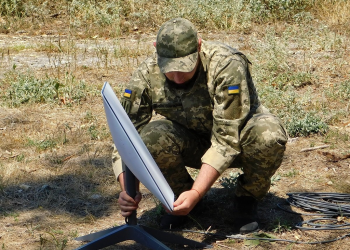
Mittal pointed to Ukraine, saying that if Ukraine is using Starlink, it is also using OneWeb now, according to both outlets. Business Standard reports that last month Ukraine accused Musk’s SpaceX of undermining its ability to defend itself by cutting connectivity speeds, disrupting military operations and rendering some Ukrainian strike and interceptor drones virtually unusable.
The Hindu frames the same war as showing how commercial satellite networks become critical military infrastructure, and the risk of relying on privately controlled systems whose service decisions reach beyond commercial customers. That is the backdrop to the throttling dispute over Ukrainian drones.
On whether government scrutiny of satellite operators is justified, Mittal said it is, arguing that warfare is moving to space and that drones, cyber operations and guided missiles will all be managed from space. He said India will need guardrails — rendered by The Hindu as appropriate safeguards — and must secure itself.
OneWeb says it is waiting on a signal
Mittal said OneWeb’s ground infrastructure has been ready for three years and its satellites have been orbiting over India for five, The Hindu reports, but the company is still waiting for the government’s go-ahead. He said Bharti received the first licence granted by the government, has satisfied all its requirements, and he hopes OneWeb will get the first commercial approval.
He also said Eutelsat OneWeb is building a secure European communications network, citing EU spending of around €14 billion to €15 billion, and that this has drawn greater attention to the company — spending that sits alongside Europe’s push for its own secure satellite network.
The dispute around Starlink’s entry
The Hindu reports that the regulatory contest has become entangled in a public disagreement involving Musk and Reliance Industries chairman Mukesh Ambani. Musk recently accused powerful business interests of trying to block Starlink’s entry into India and preserve what he called a “monopolistic chokehold” on consumers, referring to Ambani as “Prime Minister Ambani” in posts on X.
India’s Ministry of Communications rejected suggestions that the framework or its application is discriminatory, calling such allegations “baseless and misconceived”, The Hindu reports. Government sources have repeated that the rules apply equally to all companies. The Hindu also notes that Reliance and SpaceX signed an agreement in 2025 to explore bringing Starlink services to Indian consumers through Jio’s retail network.
For Mittal, The Hindu reports, the issue goes beyond commercial competition and spectrum: satellite networks are becoming strategic infrastructure with implications for national security, military communications and India’s ability to control critical data flows.
Frequently Asked Questions
Is OneWeb’s service already working inside India?
Mittal told PTI that OneWeb’s service already works in India and that the government occasionally uses its terminals for emergency services, according to Business Standard. He cited economic adviser Sanjeev Sanyal taking a terminal on a boat trip to Oman, saying “he was streaming all the way through”, and said the service is fully available and could be switched on soon.
Which operator says it has priority on Ku-band satellite spectrum in India?
Mittal said OneWeb holds the highest priority on the Ku band and that other operators therefore have to coordinate with it, as reported by Business Standard. He added that satellite spectrum is inherently shared, that “everybody dips into the same spectrum”, and that operators at different orbital heights must coordinate.
Will satellite broadband replace mobile networks, according to Mittal?
No. Mittal said satellite will remain complementary for the foreseeable future because it is very expensive and satellites need replacing every five to six years, Business Standard reported. He said fibre beats radio and radio beats satellite where each is available, but that satellite covers dark spots in deep rural areas, forests, hills, mountains, the high seas and the air.
What is Reliance building of its own in satellite?
The Hindu reported that Reliance is developing its own satellite ambitions, including a proposed low-Earth-orbit constellation of around 1,600 satellites intended to extend connectivity to some 6 lakh villages. It added that Jio’s existing base of more than 524 million customers and its distribution network give it a substantial presence in India’s digital market.