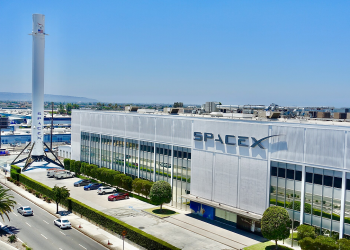
SpaceX’s artificial-intelligence business out-earned Starlink for the first time in the third quarter of 2026, according to results the company released on October 20 and reported by Crypto Briefing on November 27. A reading of the IPO prospectus filed by Anthropic — the US developer of the Claude family of large language models — by the Motley Fool shows the contract behind most of that AI revenue can be ended by either side on 90 days’ notice.
How we sourced this: every figure in this article is relayed from those two outlets, each working from Anthropic’s registration statement and SpaceX’s October 20 release. Starlink News has not reviewed the filing and holds no statement made to it directly. The registration statement is public and searchable by company name on the SEC’s EDGAR system, so the clauses quoted below — including the 90-day termination language — can be checked against the primary document.
Key facts
- The segment SpaceX now calls Super Intelligence, previously labelled AI, posted $7.56 billion in third-quarter revenue, about 52% of the company total, Crypto Briefing reports.
- Starlink, the company’s satellite internet service, brought in $5.25 billion. Total revenue was $14.58 billion, a 161% jump on the same quarter a year earlier.
- Net profit was $4.4 billion, against a $1.1 billion loss a year earlier. Capital expenditure reached $19.6 billion, mainly on expanding AI capacity.
- Anthropic alone accounted for roughly 34.5% of third-quarter revenue, or about $5 billion, through a compute-leasing agreement, according to Crypto Briefing.
What the prospectus says about the SpaceX contract
Once all contracted capacity is being delivered, Anthropic expects to pay SpaceX approximately $3.1 billion a month, the Motley Fool reports from the filing. But after the initial periods end in January and March, either party may terminate with 90 days’ notice.
How Anthropic’s commitments compare
The cloud contracts are the benchmark that makes the SpaceX arrangement look unusual: they lock Anthropic in for years and can only be cancelled if the provider breaches, while the deal supplying a third of SpaceX’s revenue can be walked away from in a quarter. Figures are as read by the Motley Fool from the S-1.
| Counterparty | Commitment | Period | Exit terms |
|---|---|---|---|
| SpaceX (Nvidia GPU compute) | Up to $120.5bn | Into 2029 | Either side, 90 days’ notice after initial periods end in January and March |
| Google Cloud (Alphabet) | At least $114.5bn | April 2026 – July 2033 | Payable regardless of usage; cancellable only on a serious provider violation |
| Amazon infrastructure | At least $110bn | May 2026 – April 2036 | Same shortfall and cancellation terms as Google Cloud |
| Microsoft cloud | At least $44.9bn | November 2026 – May 2033 | Only limited cancellation rights |
| TPU equipment leases | About $161.2bn aggregate rent, excluding interest | Five-year leases | Noncancelable except on default |
| Additional TPU capacity, providers including Google | Estimated $125bn – $150bn | Future payments | Amounts depend on deployment and other conditions |
| AMD (Helios systems) | No fixed commitment; over $20bn expected if the full initial tranche is taken | From 2027 | Scope for a second purchase of roughly the same size |
On the usage shortfalls, the outlet notes that Anthropic generally has to pay the difference if consumption falls below the committed level, subject to contractual adjustments and exceptions.
Where the AI revenue came from
Compute-leasing contracts did most of the work in the quarter, Crypto Briefing reports, using GPU capacity from the Colossus data centres in Memphis that SpaceX took on through its merger with xAI and reconfigured to rent spare chips to outside developers. SpaceX also acquired the coding tool Cursor in August 2026 at a $60 billion valuation, and that product added $608 million in its first weeks under SpaceX ownership. Consumer-facing AI contributed too: more people used the Grok chatbot, and the segment generated $538 million in advertising revenue.
The Alphabet agreement lands next
SpaceX has signed a multi-year cloud services agreement with Alphabet, the parent of Google, worth around $30 billion, Crypto Briefing reports. Under it, Google will pay SpaceX $920 million per month from October 2026 through June 2029, and gets access to about 110,000 Nvidia GPUs in exchange.
What this does and does not say about Starlink
Starlink did not shrink; it was overtaken. Crypto Briefing puts the scale question plainly: “A $5.25 billion business that suddenly looks like the side project is still a $5.25 billion business.” Starlink News already reported the segment split; the prospectus adds the contractual fine print behind it.
For the satellite network itself, the published record is mostly silence. Of the $19.6 billion in capital expenditure, Crypto Briefing reports the bulk went to AI capacity; neither outlet breaks out satellite or ground-station spending, and neither reports any announced change to constellation plans, launch cadence, gateway construction or regional licensing — including Zimbabwe and elsewhere in Africa. The quarter therefore says nothing on the record about rollout speed in either direction: the sources describe where the money came from, not where the dishes and gateways go next.
Nor do they describe a change in pricing. The consumer rate has fallen from $99 a month in 2020 to $55 in 2026, as set out in our report on consumer Starlink pricing — a trajectory established before the AI segment existed. Neither outlet reports any commitment to pass AI profit through to subscribers, and neither describes any cross-subsidy between the two businesses; readers treating this quarter as a signal of cheaper kit would be going beyond what either source supports. The one third-party valuation on the record values the two together: Jefferies has set a $210 price target on the strength of both Starlink and AI.
What to watch
Crypto Briefing lists four things for the next quarter: how much the Alphabet payments lift the Super Intelligence segment, whether Cursor’s contribution holds up over a full quarter, whether Anthropic’s share of revenue shrinks as new customers come online, and Starlink’s growth rate. It names customer concentration as the obvious risk, saying that when a single client accounts for about a third of total revenue, any change in that relationship shows up immediately. SpaceX shares trade under the ticker SPCX, according to the Motley Fool’s listing.
Frequently Asked Questions
Are Amazon and Alphabet also shareholders in Anthropic?
Yes. The Motley Fool reports Amazon invested $13 billion and valued its stake at $190.4 billion at the end of June, while Alphabet has invested at least $13.3 billion since September 2023 and valued its stake at $124.3 billion at the end of the second quarter. Alphabet also holds rights to invest up to $20 billion more in notes or non-voting stock.
Do these contract figures count as revenue for SpaceX?
No. The Motley Fool states that none of the figures tied to the six companies represent immediate revenue or guaranteed profit: infrastructure has to be delivered, costs incurred, and Anthropic must have the money to meet its obligations. How much of the potential sales become real revenue depends on the strength of each agreement.
Does Anthropic’s filing say anything about Starlink itself?
No. The prospectus covers Anthropic’s own compute purchases, including the SpaceX lease; it is not a SpaceX document. Every Starlink figure quoted here comes instead from SpaceX’s own 20 October results release as reported by Crypto Briefing.