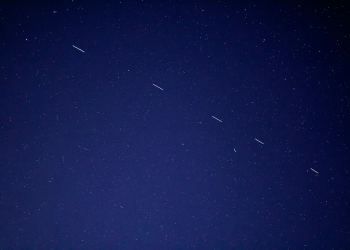
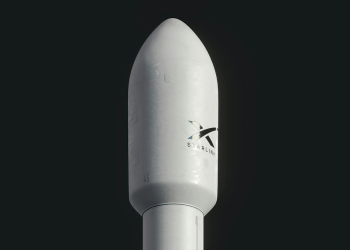
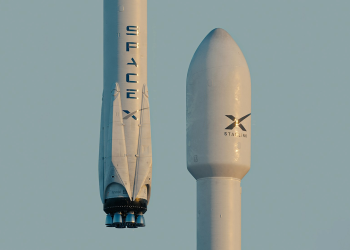
SpaceX flew its 13th Starship test flight in late July 2026, and for the first time the rocket carried the next-generation V3 Starlink satellites that are meant to raise the capacity of the satellite internet service, according to Engadget. The launch went ahead after a couple of delays caused by unfavourable weather, Engadget reported, and the 20 satellites released on the flight never reached orbit.
Key facts
- Engadget reports that Starship deployed 20 next-generation V3 Starlink satellites on the flight, the first Starship mission to carry them.
- SpaceX says each V3 can support up to 1 Tbps of downlink, 10 times what V2 satellites can manage, and 160 Gbps of uplink, an increase of 22 times over V2, per Engadget.
- The satellites remained in suborbital space at the same altitude and trajectory as Starship and were expected to burn up in the atmosphere 20 minutes after deployment, Engadget says.
- This was the second launch of SpaceX’s V3 Starship model, which debuted on the 12th flight test in May, according to Engadget.
- The Super Heavy booster exploded as it crashed into the ocean, while the Starship upper stage splashed down in the Indian Ocean, Engadget reports.
Why it matters
The V3 satellites are the hardware SpaceX is pointing to for a step change in Starlink performance, but Engadget is explicit that customers will not feel those improvements yet, because this was a test flight for the satellites rather than an operational deployment.
That gap between the specification sheet and the constellation in the sky is the thing to watch for anyone comparing a quoted figure with what current Starlink speed tests show. Engadget attributes the 1 Tbps and 160 Gbps numbers to the company, not to measurements in service.
What the satellites were actually testing
On the flight, the V3 satellites extended their solar arrays and antennas, then checked whether they could connect with the rest of the Starlink constellation using their high-capacity lasers, Engadget reported. Those were the objectives; the satellites were not meant to survive.
Because they stayed on Starship’s suborbital path, re-entry followed within minutes of deployment, per Engadget. Our earlier explainer on the Starlink V3 launch timeline, price and availability sets out how this hardware fits into the wider rollout.
Two satellites doubled as inspection cameras
Starship itself was still under test, so SpaceX modified two of the Starlink satellites by fitting cameras that could scan Starship’s heat shield and transmit the images to the ground for analysis, Engadget reported. The outlet describes this as part of the company’s work to make sure the vehicle is ready for more flights.
How the rocket performed
The mission had much the same goals as the previous flight, all aimed at collecting data so that SpaceX can, in Engadget’s words, “continue iteration towards a fully and rapidly reusable design.”
According to Engadget, the Super Heavy booster carried out a directional flip manoeuvre after stage separation and completed the high-thrust portion of the boostback burn with all 33 of its engines. It then hit problems that forced it to end the burn early. When it tried to relight for landing, only a subset of the 33 engines re-ignited, and the booster exploded as it crashed into the ocean.
The Starship stage, meanwhile, mimicked the trajectory of future missions that will return to Starbase, before heading to the Indian Ocean for a splashdown, Engadget reported.
Background: the test was flagged as brief in advance
The short duration of the V3 experiment was signalled before launch. On 13 July 2026, PC Magazine, the US technology publication, previewed the mission under the headline “SpaceX to Briefly Test V3 Starlink Satellites on Next Starship Flight.”
Neither source we reviewed gives a date for when V3 satellites will start carrying customer traffic, a price change tied to the new hardware, or any country-by-country availability effect. We are not going to guess at those. Separately, we have reported that Starship Flight 14 is set to carry 26 Starlink V3s to orbit, which is the next step to follow after the suborbital test described here.
What this does and does not change for users
For subscribers in Zimbabwe, elsewhere in Africa, or any other market, nothing in these two reports points to a change in plans, prices, licensing or coverage as a result of this flight. The sources describe a hardware and vehicle test: satellites that unfolded, attempted laser links, photographed a heat shield and then burned up.
The figures SpaceX quotes for V3 are, per Engadget, the reason the company built it — but they remain company claims about hardware that, on this flight, spent minutes rather than years in space.
Frequently Asked Questions
Did the 20 Starlink V3 satellites from Flight 13 join the constellation?
No. According to Engadget, the satellites stayed in suborbital space on the same altitude and trajectory as Starship, and were expected to re-enter the atmosphere and burn up about 20 minutes after deployment. Their job on this flight was to test deployment and laser links, not to enter service.
How much more capacity does a Starlink V3 satellite have than a V2?
Engadget reports that SpaceX says each V3 can support up to 1 Tbps of downlink, which is 10 times a V2 satellite, and 160 Gbps of uplink, an increase of 22 times over V2. Engadget attributes those figures to the company rather than to measured performance.
Why did two of the satellites carry cameras?
Engadget reports that SpaceX modified two of the Starlink satellites by adding cameras so they could scan Starship’s heat shield and transmit the images to the ground for analysis. Engadget frames this as part of SpaceX’s effort to confirm the vehicle is ready for more flights.
What happened to the Super Heavy booster on Flight 13?
Engadget reports the booster performed a directional flip after stage separation and completed the high-thrust part of its boostback burn with all 33 engines, but then hit problems that forced it to end the burn early. Only a subset of the 33 engines re-ignited for landing, and the booster exploded as it crashed into the ocean.
Follow Starlink News on Google. Make us a preferred source to see more of our reporting in Google search results.