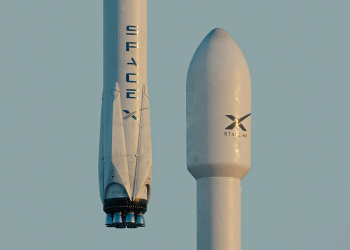
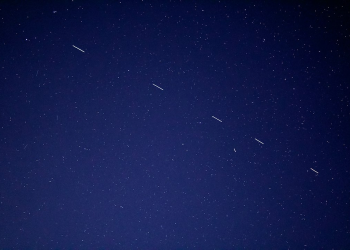
SpaceX, the US rocket and satellite operator, plans to send Starship into Earth orbit for the first time on 22 September, launching from its Starbase site in South Texas, according to reports by New Scientist and TechRepublic. The 14th test flight is also due to release 26 working Starlink V3 satellites — the first operational payload the vehicle has carried, and what New Scientist calls the first commercially useful Starship mission.
Both accounts agree on the shape of the flight and on most of its numbers. Where they differ, usefully, is on what went wrong last time — and that disagreement is set out in full below.
Key facts
- Timing: a 75-minute window opening at 7:15 a.m. CT (12:15 UTC) on 22 September, pending regulatory approval, per TechRepublic. New Scientist gives the same 7.15am CDT time, converted to 1.15pm BST.
- Profile: roughly 275 kilometres (171 miles) altitude, six orbits of Earth and a flight lasting close to 10 hours, in both accounts.
- Ending: the upper stage is to perform a controlled deorbit burn on a single Raptor engine before splashing down in the Pacific Ocean, west of Chile, TechRepublic reports. Super Heavy is not returning to the pad and is aiming for a soft splashdown in the Gulf of Mexico.
- Payload capacity: SpaceX figures cited by TechRepublic put each V3 satellite at 1 Tbps of network capacity. Multiplied across the 26 aboard, that is a calculated 26 Tbps for the flight — simple arithmetic rather than a separate SpaceX-published total. TechRepublic describes the per-flight figure as roughly ten times the bandwidth of one Falcon 9 launch carrying V2 mini satellites.
- Onboard inspection: three of the 26 satellites carry cameras built to photograph Starship’s heat shield in orbit and send the images back to engineers, according to both outlets.
Why it matters: capacity now, coverage and price later
What more capacity per launch actually buys
The number to hold on to is TechRepublic’s comparison, not the raw terabits: one Starship flight is said to deliver about ten times the bandwidth of a single Falcon 9 mission carrying V2 minis. Read the other way round, SpaceX would need on the order of ten dedicated Falcon 9 launches to add what one working Starship adds. That is the whole economic case for the vehicle, and it is why the outlet frames Flight 14 as a Starlink story before it is a rocketry story: if Starship can reliably loft larger batches of higher-capacity satellites, SpaceX can expand and refresh the network faster than Falcon 9 alone allows, and replace ageing hardware without cannibalising launches it needs for paying customers.
The size of the satellites is the constraint doing the work here. Alconcel’s point to New Scientist — that the V3s are physically larger than previous models — is the reason Falcon 9 cannot simply fly more of them per launch. The capacity jump and the need for a bigger rocket are the same fact seen from two ends.
TechRepublic says that matters to organisations weighing satellite connectivity for remote offices, field operations, disaster recovery, transport and backup internet, particularly as SpaceX pushes into mobile service — the same direction in which regulators recently cleared Starlink’s direct-to-mobile service to operate globally. Direct-to-mobile is a capacity-hungry product, which makes a faster satellite pipeline and a broader service menu two halves of the same plan.
What it does not tell subscribers about price or availability
Neither report links this launch to retail pricing or to service opening in any particular country, including anywhere in Africa, and neither predicts when added capacity would show up as a consumer change. Two caveats are worth stating plainly. First, a headline network figure is a ceiling, not a local guarantee: capacity is delivered by whichever satellites are overhead, so what a user experiences depends on how busy their own patch of sky is — a distribution question neither outlet breaks down. Second, Alconcel’s observation that the V3s fly lower than existing Starlink satellites cuts both ways, since lower orbits generally shorten the signal path but give each satellite a smaller footprint, making coverage a function of how many get launched as well as how capable each one is.
The practical test for anyone shopping for service, then, is not the 26 Tbps arithmetic but whether SpaceX’s availability map and plan pages change in their country — and on that, the reporting around Flight 14 is silent. For what is on sale today, see our roundup of current Starlink plans and prices.
From 13 suborbital flights to a first orbit
All 13 previous Starship tests have been, at best, sub-orbital, New Scientist notes, and TechRepublic reports that this was by design — SpaceX kept the vehicle on suborbital trajectories, the outlet says, quoting the company’s stated aim of maximising public safety while allowing for maximum learning. A suborbital trajectory comes down whether or not the engines relight; an orbital one does not, which is why crossing this line changes the risk calculus.
TechRepublic describes the new operating rule that follows from it: flight controllers will commit to the orbital insertion burn only if there is verified hardware redundancy available for the later deorbit burn, so that the upper stage cannot be stranded in a decaying orbit. That single condition is arguably the most consequential line in the flight plan, because it means the mission can be curtailed before it ever reaches orbit.
The payload is also new. Earlier Starship flights carried only dummy test satellites, according to New Scientist; the thousands of V3s SpaceX intends to fly would join the constellation SpaceX has already been licensed to expand.
As background, the magazine explains that Starship comprises an upper stage, also called Starship, and a lower stage called Super Heavy, with SpaceX now testing the third generation of each under what it characterises as a fail-fast, learn-fast strategy. Beyond Starlink, the vehicle is meant to be a central part of NASA’s Artemis moon missions. Flight 14 will be the second since SpaceX’s stock market flotation, an event New Scientist says made founder Elon Musk the world’s first trillionaire; TechRepublic dates that record-setting debut to June and says the company now carries investor expectations to replace its Falcon 9 fleet and scale launch cadence quickly.
What went wrong on Flight 13
The two outlets describe the previous flight’s booster failure differently. They are not necessarily contradictory — one reads as symptom, the other as suspected cause — but the accounts are separate and are presented here as such.
New Scientist’s account: eight of 13 engines
During descent, only eight of the 13 engines meant to slow the Super Heavy booster reignited, the magazine reports, producing a hard splashdown instead of the planned gentle simulated landing on water.
TechRepublic’s account: ice in the centre engines
The outlet attributes an early end to the boostback burn manoeuvre to signs of ice clogging in the three centre engines, and says SpaceX has since applied hardware filtering fixes and software updates in response.
Heat shield changes on Ship 41
Not everything about Flight 13 went badly. Ship 40 survived a water landing in the Indian Ocean in July, TechRepublic reports, and inspecting the recovered vehicle led to several heat shield improvements. Ship 41 is now due to test tile retention upgrades, plasma-resistant seams, curved tile designs and two reused tiles salvaged from that flight — the reason those three satellite-mounted cameras are aboard at all.
What the experts say
Davide Amato of Imperial College London told New Scientist that attempting an orbital test signals confidence inside the company that the rocket will at least survive the trip to orbit and release its satellites, though re-entry — where SpaceX has had problems in recent tests — may be another matter. “In short, they’re making good progress towards introducing Starship as a successful commercial launcher,” he told the magazine, adding that whether it proves revolutionary depends on achieving a high launch cadence and on whether the design is cost-effective.
Alconcel struck a similar note on the payload itself, telling the same outlet that delivering V3 satellites to orbit is a significant step rather than a huge jump in operational complexity for the launch vehicle, and that pairing a proven Starship with the already high-cadence Falcon 9 would boost SpaceX’s commercial capabilities. Between them, the two assessments put the bar in the same place: not this flight, but the tenth one like it.
What is still unconfirmed
SpaceX did not respond to New Scientist’s interview request, the magazine says, and the company’s public account of its Flight 13 fixes is confined to its website. Starlink News also sought comment from SpaceX on the launch window, the V3 deployment sequence and the booster modifications, and had received no response by the time of publication; this report is otherwise based entirely on the two published accounts cited above, and will be updated if the company responds.
Three things remain open going into launch day. The date and window are still subject to regulatory approval, per TechRepublic. Neither outlet reports a published investigation report or formal closure of the Flight 13 anomaly. And neither offers any timetable for when capacity added by V3 satellites would translate into service changes for customers in any specific market — the question most readers of this site will care about most.
Frequently Asked Questions
Will Starship attempt a tower catch or landing on Flight 14?
No. Neither the booster nor the upper stage is due to attempt a controlled landing, New Scientist reports. TechRepublic adds that Super Heavy will not fly back to Starbase at all and is instead targeting a soft splashdown in the Gulf of Mexico, with the upper stage ending its flight in the Pacific west of Chile. TechRepublic frames that as a deliberate trade: on the first orbital attempt, SpaceX is spending the flight’s margins on orbital mechanics and satellite deployment rather than on a recovery spectacle.
How do Starlink V3 satellites differ from the ones already in orbit?
The differences are not just incremental. Leah-Nani Alconcel of the University of Birmingham told New Scientist the V3s fly lower than existing Starlink satellites, carry higher data capacity and are physically larger than previous models. Those three traits pull in different directions: TechRepublic’s figure of 1 Tbps per satellite points to far more throughput per unit, while the extra bulk is precisely why Falcon 9 cannot fly them in the same numbers — which is the argument for using Starship at all. Alconcel noted the size question has a second purpose, since the flight doubles as a check on whether Starship can eventually carry SpaceX’s proposed Starmind data centre spacecraft, which are substantially bigger again.
How many Starship flights have there been in 2026?
Only two so far this year, according to New Scientist, with Flight 14 due to be the third. The magazine sets that against SpaceX’s earlier ambitions: officials had hoped for as many as 25 Starship test flights last year, and five took place. Cadence matters beyond bragging rights — Davide Amato of Imperial College London told the same outlet that whether Starship proves revolutionary depends on achieving a high launch rate and on the design being cost-effective.
Has SpaceX explained what it changed since Flight 13?
Only in broad terms, and not to reporters. New Scientist says SpaceX did not respond to its interview request and points instead to the company’s website, which states that hardware and software modifications were made to address issues from the previous flight. TechRepublic puts more detail on that — hardware filtering fixes and software updates aimed at the booster engine problem — but neither account mentions a published investigation report or a formal regulatory closure of the Flight 13 anomaly. In practice, the first public verification of those fixes will be the boostback burn itself on launch day.
Will Flight 14 make Starlink cheaper or available where it is currently sold out?
Neither New Scientist nor TechRepublic makes that claim, and nothing in either report ties this launch to a price change or to a specific market opening. What the reporting establishes is upstream of the customer: more capacity per launch, if Starship performs. How and when any of it reaches a given country depends on licensing, ground infrastructure and how SpaceX chooses to allocate capacity — none of which is addressed in the coverage of this flight. For what is actually on sale now, see our roundup of current Starlink plans and prices.
Follow Starlink News on Google. Make us a preferred source to see more of our reporting in Google search results.