Editor’s note: the interview at the centre of this piece was published on 16 August 2026 and carried again on 19 August 2026. This article was written on 27 September 2026, roughly six weeks later. In that time we have found no announcement, filing or company statement confirming a Tesla–SpaceX merger, and no response from Tesla, SpaceX or Elon Musk to Gerber’s remarks. What has moved is the operational side: SpaceX’s most recent quarterly figures as we have reported them, a new Wells Fargo subscriber forecast, and a Starship flight targeted for 28 September. Gerber’s valuation figures should therefore be read as an August snapshot, not a live market quote.
Starlink’s build-out is paid for by SpaceX, and SpaceX’s cost of capital is now the subject of a public argument between one of Musk’s longest-standing shareholders and Musk himself. Ross Gerber, co-founder of the US investment firm Gerber Kawasaki and an early Tesla backer, has questioned Musk’s revenue forecast for SpaceX and warned shareholders about a possible merger between the rocket company and the carmaker. He made the comments to the financial news outlet Benzinga, in an interview published by Yahoo Finance.
The interview never uses the word Starlink. That is precisely why it is worth reading carefully from a satellite internet desk: the money being argued over is the money that buys satellites, launches and ground stations, and the one operational demand Gerber puts on Musk — get Starship working — is the same demand the network has been making of SpaceX for two years.
What Gerber told Benzinga — his figures, not verified market data
Every number below is Gerber’s own characterisation as reported by Yahoo Finance. None of it is audited disclosure, and SpaceX does not publish accounts the way a listed operator does.
- Yahoo Finance reports that Musk, on SpaceX’s earnings call, predicted the commercial spaceflight company could report $1 trillion in revenue annually as early as 2029. Gerber said he was sceptical and “not keen on believing” Musk’s timelines.
- By Gerber’s own estimate, Tesla is worth about $1.3 trillion and SpaceX almost $2 trillion. He put SpaceX on a forward price-to-earnings ratio of 80 against roughly 150 for Tesla. These are his figures, offered conversationally; the reports do not source them to filings, consensus data or a named provider.
- On his account, analyst estimates for Tesla have come down after disappointing earnings, while estimates for SpaceX have held steady. The reports give no numbers behind that comparison.
- He said Musk has to get Starship working and Full Self-Driving working while struggling to sell cars, and described Musk as “stuck at this moment”.
- He said Tesla’s sales would trend down if the Iran war ended soon and oil prices fell — a prediction, not an observed result.
A caveat on the SPCX ticker
One version of the report identifies SpaceX by the ticker SPCX and Tesla by TSLA, and Gerber repeatedly refers to “two public companies”. We are flagging that rather than passing it through. Neither version explains when or how SpaceX shares became publicly traded, and nothing in the material reviewed establishes a listing. SpaceX has historically been privately held, with its valuation set by funding rounds and secondary transactions rather than by an exchange. Until that is confirmed by the company or a filing, the prudent reading is that any SpaceX valuation quoted here is a private-market mark and the ticker is an unexplained tag in the source. It matters for the merger argument: the whole dilution and litigation scenario Gerber sketches assumes two sets of listed shareholders with a price to be negotiated between them.
Why this matters for satellite internet, not just for stock screens
Starlink is no longer a side project inside SpaceX. On the most recent figures we have covered, Starlink revenue made up $4.3bn of SpaceX’s $7.8bn quarter — figures that come from SpaceX’s own reported quarterly numbers rather than from the Gerber interview, and which we set out with their sourcing in that separate report. That makes the consumer satellite internet business the majority of group turnover and the most predictable cash line inside it. Anything that changes how SpaceX raises or spends capital therefore lands on the satellite side of the house first.
The rest of this section is our analysis, not a claim from the interview, and no merger has been announced in the reports reviewed. Three channels are worth watching.
Funding. A constellation is a treadmill rather than a one-off build. Low-Earth-orbit satellites of the Starlink class are generally described as having design lives of about five years, which means a meaningful share of the fleet has to be manufactured and launched every year simply to hold service steady — before a single new subscriber is added. A finished cable or fibre plant does not work that way. Gerber’s core warning is that a Tesla–SpaceX combination would leave one side diluted and could see the merged company “revalued much lower” by the market. A lower group valuation and a contested share register are precisely the conditions that make future raises dearer. If capital gets more expensive, the adjustable lines in the budget are the discretionary ones — extra gateway earth stations, spectrum deals, new country licences and market entries — rather than keeping existing subscribers online.
Capital allocation. Gerber’s own alternative to a full merger is to move Tesla’s robots and computational work into SpaceX. That would place a large, long-dated research programme on the same balance sheet that funds satellite production. Equally, a merger that brings in a car business he describes as struggling to sell vehicles would put group cash in direct competition with the constellation. Either way, the satellite internet capital budget stops being ring-fenced by corporate structure and starts competing internally with programmes that generate no subscription revenue.
Pricing and availability. Starlink capacity is local, not national: each cell over the ground has a finite amount of bandwidth, and the company has historically managed congestion by waitlisting or closing sign-ups in busy areas while discounting hardware and offering promotional rates where capacity is spare. Those discounts are a use of cash. A combined entity carrying the valuation Gerber disputes would face heavier pressure to show margin from its one mass-market consumer product, which points towards firmer prices and fewer giveaways rather than cheaper entry. Conversely, if launch economics improve, capacity per cell rises and the commercial case for discounting to fill spare bandwidth strengthens. The direction of consumer pricing, in other words, is downstream of the rocket.
The arithmetic makes the dependency plain. A $4.3bn Starlink quarter annualises to roughly $17bn — our calculation from the quarterly figure, not a company forecast. Getting from there to the subscriber base a bull case assumes means selling service in cells that are currently constrained, and that requires satellites in orbit, not capital raised.
Starship is the line where the finance story meets the network
Towards the end of the interview, Gerber grouped Starship with Full Self-Driving and Tesla’s sales problem as things Musk still has to fix, saying Musk has all of these projects running simultaneously, is “digging holes in the desert”, and “nothing is really working”. The report gives no Starship schedule, test date or technical detail, and Gerber is speaking as an investor rather than an engineer.
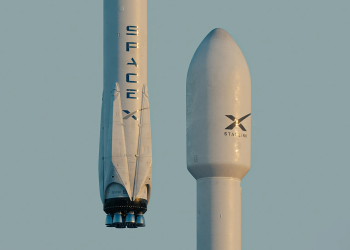
Read from the satellite side, it is the most consequential sentence in the piece. Starship is the intended carrier for the larger Starlink V3 satellites, which means launch cadence, not demand, is the binding constraint on how fast usable capacity reaches congested cells — the cells where sign-ups get waitlisted and where service-quality complaints concentrate. We track that separately, including Starship’s next orbital attempt, targeted for 28 September with Starlink V3 satellites, a date set by SpaceX itself rather than by any analyst. An investor complaining that Starship does not work and a rural household waiting for a waitlist to clear are describing the same bottleneck from opposite ends.
A second voice on the satellite side
Gerber is the only source for the merger argument, and that is a real limitation of this story: there is no comment from Tesla, SpaceX or Musk in either published version, and no independent verification of his valuation or multiple figures. The nearest thing to a counterweight on the satellite internet question comes from equity research rather than from the companies. Wells Fargo analysts, in a note we have covered separately, put Starlink on a path to 47 million subscribers by 2028 — a forecast contained in the bank’s own research note, which is not a public document; our report sets out what it says and where the figure comes from.
Set side by side, the two views are not really in conflict; they describe the same variable from different ends. Wells Fargo’s number is, in effect, a bet that capacity arrives roughly on schedule. Gerber’s warning is that the corporate structure funding that capacity is about to become more expensive and more distracted. Neither the bank nor the shareholder is describing observed subscriber additions in a given month, and neither speaks for SpaceX. We have asked for nothing and been told nothing: no statement from either company appears in the material reviewed, and we will add one if it is issued.
The merger maths, as Gerber describes it
According to Yahoo Finance, Gerber said he was more bullish on the merger idea before it became public than he is now, and called it “a huge conflict” to have two companies trading at different valuations.
He set out the squeeze from both sides. Tesla shareholders, he said, have been loyal to Musk despite making no money for a long time and will want a premium on the price. But if SpaceX bought Tesla at the current price, he said, the deal would be dilutive to SpaceX and its shareholders would be the ones losing out. In his view SpaceX “is a much better investment than Tesla right now”, and in a merger Tesla’s investors “would get the short end of the stick” — a judgement, not a valuation exercise anyone can audit from outside.
On his account, the question ultimately rests with SpaceX’s board, which he described as Musk and close associates, and whether it is willing to be completely diluted in such a transaction. He also predicted litigation, saying two public companies in a deal of that kind get sued because it is a total conflict of interest, one he said Musk created. He added that he thinks it is inevitable, that “a lot of people get hurt”, and that Musk ends up the big winner. He said he feared the combined company would be revalued much lower because it is not worth $4 trillion, calling that valuation a “joke”.
For satellite internet watchers, the litigation prediction is the part with operational teeth. Shareholder actions over conflicted mergers are slow, and they absorb senior management attention, legal spend and disclosure bandwidth at exactly the point a constellation operator needs all three pointed at hardware and launch manifests.
The Tesla half, in brief
Much of the interview is about the carmaker and has no bearing on satellite internet, so we summarise it only for completeness. Gerber said Musk does not want to sell cars to the public because the public does not like him; that he would spend on marketing, reintroduce the Model S, build the $25,000 car and make a truck people would actually drive; that Tesla still builds the best EVs; that “I think Tesla would double if it wasn’t involved with Elon”; and that on Robotaxi “not one cab works”, calling Musk’s claims “delusional”. Those are claims about Tesla’s product strategy and autonomy programme, not about Starlink, and we treat them as context for his credibility as a critic rather than as evidence about the network.
What the sources do and do not cover
Both published versions carry the same Benzinga interview; the 19 August version includes the closing remarks on Starship, the Iran war and oil prices that the earlier text cuts off.
Neither version discusses Starlink service, pricing or availability in any country, gives subscriber numbers, or addresses hardware costs or market rollouts. Neither confirms that a merger has been proposed, agreed or filed. There is no comment from Tesla, SpaceX or Musk in either report, and no independent verification of Gerber’s valuation or multiple figures. Everything attributed to Gerber here is one shareholder’s assessment in a single August interview; the sections headed as analysis are our own reading of how that corporate argument could reach the satellite internet business, and should be read as interpretation rather than reporting. We will update this piece if SpaceX, Tesla or Musk respond, if a merger is formally proposed or filed, if the 28 September Starship attempt changes the launch picture, or if any filing clarifies the SPCX ticker question.
Frequently Asked Questions
Has a Tesla–SpaceX merger actually been announced?
Not in any material we have reviewed. The Benzinga interview published by Yahoo Finance in August 2026 has Ross Gerber reacting to merger talk that he says had become public, and warning about how such a deal would be valued and litigated. Neither report says a merger has been proposed formally, agreed, filed with a regulator or put to shareholders, and we have seen no company statement or filing confirming one as of 27 September 2026. Everything in our piece about consequences for Starlink is conditional analysis built on that unconfirmed possibility, clearly labelled as such.
Why is a mid-August interview being covered in late September?
Because the corporate question it raises — who pays for the constellation, and at what cost of capital — is still open, while the operational half of Gerber’s argument has moved. The interview was published on 16 August 2026 and carried again on 19 August 2026. Since then our own reporting has put Starlink revenue at $4.3bn of a $7.8bn SpaceX quarter, logged a Wells Fargo forecast of 47 million subscribers by 2028, and tracked Starship’s next orbital attempt targeted for 28 September with Starlink V3 satellites. Readers should treat Gerber’s valuation figures as an August snapshot, not a current market quote.
Would a Tesla–SpaceX merger change what Starlink customers pay?
Nothing in the source material says so. The interview deals only with corporate valuation, dilution and litigation risk; it does not mention Starlink subscription prices, hardware costs, availability or market rollouts, and no merger has been announced in the reports we reviewed. Any link between a merger and consumer pricing is our analysis rather than reporting. The mechanism, if one ever exists, is capital: satellite internet is the part of SpaceX that generates recurring consumer cash, so how much capital the group needs and how expensive that capital becomes is the route by which a corporate deal could eventually reach subscriber bills.
Why does Starship matter for Starlink availability?
Starship is the vehicle intended to carry the larger Starlink V3 satellites, which is why Gerber’s line that Musk "has to get Starship working" reads differently on a satellite internet site than on a stock desk. Launch cadence sets how quickly capacity can be added over congested cells, and capacity is what determines whether Starlink can keep selling service in already-busy areas or has to hold sign-ups back. Our separate coverage tracks Starship’s next orbital attempt, targeted for 28 September with Starlink V3 satellites. The Gerber interview itself gives no Starship schedule, test date or technical detail.
Is SpaceX publicly traded, and what is the SPCX ticker in the source?
One version of the Yahoo Finance report tags SpaceX with the ticker SPCX alongside TSLA for Tesla, and Gerber speaks of "two public companies". Neither report explains when or how SpaceX shares became listed, and we could not verify a public listing from the material reviewed. SpaceX has historically been privately held, with its value set by private funding rounds and secondary sales rather than an exchange. Readers should treat the ticker as an unexplained tag in the source, and any quoted SpaceX valuation as a private-market mark rather than a screen price. We will correct the record if a filing or company statement clarifies it.
Who is Ross Gerber and why does his view carry weight?
Yahoo Finance describes Gerber as the co-founder of the investment firm Gerber Kawasaki and one of the early backers of Tesla, and reports that he has publicly criticised Tesla’s pivot towards AI, autonomous driving and humanoid robots. His weight comes from position rather than access: he is a long-standing shareholder voicing shareholder concerns, not an insider describing SpaceX or Starlink operations. He offers no satellite internet data in the interview, and the reports carry no response from Tesla, SpaceX or Musk.
Is Gerber against any combination of Tesla and SpaceX at all?
No. According to Yahoo Finance, Gerber said he would not oppose moving parts of Tesla, such as the robots and the computational work, into SpaceX, arguing that would put the AI and what he called the moon shots in SpaceX while Tesla sells EVs and battery storage. For satellite internet readers that version is not cost-free either: it would load a large, long-dated research programme onto the same balance sheet that funds satellite production, launches and ground infrastructure.
Follow Starlink News on Google. Make us a preferred source to see more of our reporting in Google search results.