SpaceX stretched its lead in satellite internet on Monday, 28 September 2026, when it used its Starship rocket to deploy 26 operational Starlink satellites into orbit 275km above the Earth, according to South African technology publication MyBroadband. The outlet reports that the single mission added 26 terabits per second to a network already carrying a cumulative 450Tbps — an increase of about 5.8% from one flight — while rival Amazon Leo still has no commercial service and no rocket flying.
MyBroadband says that batch delivered roughly the same bandwidth as the V2 Mini satellites launched across ten Falcon 9 missions. Using the outlet’s own cadence figure — a comparable batch every two to three days — ten Falcon 9 flights is about three to four weeks of launching, so Monday’s mission compressed close to a month of constellation growth into one flight (our calculation from the publication’s numbers).
Key facts
- Starlink’s 450Tbps pre-launch capacity is supported by around 13,000 satellites launched since 2019, of which 11,118 are currently in operation and about 1,800 have been deorbited or are non-functional, MyBroadband reports.
- The 26 satellites are similar in number to a single Falcon 9 payload but much larger, with significantly greater data-transmission capacity, according to the publication.
- Starship’s payload capacity is 100–150 tonnes to low Earth orbit, against 22.8 tonnes for Falcon 9 and 63.8 tonnes for Falcon Heavy, per the same report.
- Amazon Leo has fewer than 396 satellites in operation, deployed across 14 successful missions spanning roughly three years up to July 2026.
- Starlink had 13 million subscribers globally by August 2026, MyBroadband reports — above the figure in our earlier reporting on Starlink’s subscriber numbers and falling ARPU.
- Blue Origin’s New Glenn rocket, which Amazon needs to scale its fleet, is only planned to return to flight by December 2026.
What the Starship flight changed
MyBroadband describes the mission — SpaceX’s first successful orbital Starship flight — as a major milestone in the network’s expansion rather than a change in launch cadence. The company still deploys a comparable number of satellites every two to three days on Falcon 9, so the flight adds a second, much heavier delivery route rather than replacing the existing one.
The outlet does not publish a per-satellite throughput figure for the new Starlink V3 hardware, and we are not deriving one. The 26Tbps total and the ten-Falcon-9 equivalence are both MyBroadband’s own numbers, and everything in this report that quantifies the gain rests on them.
Why the satellites were dropped off at 275km
The deployment altitude in MyBroadband’s report — 275km — sits well below the 500km to 600km band the same publication gives for the working constellation. MyBroadband does not explain the gap, and we have not located a SpaceX statement setting out the orbit-raising plan for this batch, so we are treating the two figures as reported rather than reconciling them on the company’s behalf.
For context, and as inference rather than sourced fact: releasing satellites at a low insertion altitude and letting each spacecraft climb to its working shell on onboard electric thrusters is standard practice across large LEO constellations, and it has the side effect that a unit failing its post-launch checks re-enters within weeks instead of lingering at operational height. Either way, until the climb is complete the 26Tbps is capacity on its way into service, not capacity already carrying traffic.
Why it matters
MyBroadband frames the flight as bad news for Amazon’s competing service, because launch capacity is what decides how fast a constellation grows. The publication writes that “almost every day, the company is extending its lead over Amazon Leo.”
On price, the outlet says an edge for Amazon is unlikely, pointing to SpaceX already having a lower effective launch cost and greater economies of scale. That is MyBroadband’s framing, not ours: its argument is that launch economics, rather than retail positioning, will set the Starlink price against Amazon Leo’s over time. The publication does not publish projected tariffs for either service, and neither do we.
Where Amazon Leo stands
Amazon Leo is positioned as the biggest potential rival to Starlink in residential, small-business and direct-to-cell satellite internet, MyBroadband reports, alongside Chinese operator Spacesail. But the service has not launched commercially. Amazon had planned to begin offering services in the United States and other Northern Hemisphere countries by mid-2026, on the assumption that New Glenn — the rocket from Jeff Bezos’s space company Blue Origin — would start deploying Leo satellites in June 2026.
Instead, MyBroadband says the main New Glenn rocket exploded on the launch pad at Cape Canaveral during a hot-fire test in May 2026, destroying the vehicle and severely damaging the launch site. By the time it returns, the publication notes, Starlink will have launched several hundred more satellites. Operator timetables elsewhere have slipped for the same reason, including Amazon Leo in-flight Wi-Fi timelines that stretch to 2028.
There is a regulatory yardstick for that shortfall that sits outside MyBroadband’s reporting. Amazon’s US Federal Communications Commission authorisation covers a 3,236-satellite constellation and carries a milestone requiring half of it — 1,618 satellites — in orbit by 30 July 2026, with the balance by 2029. Fewer than 396 operational satellites, the figure MyBroadband gives, is under a quarter of that half-way mark. The FCC has discretion to extend deployment milestones and has granted extensions to other operators, so the condition measures how far behind the programme is rather than showing the authorisation is about to lapse.
South Africa: licensing, not launches, is the blocker
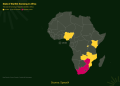
For African readers, the sharper contrast is regulatory. MyBroadband reports that Starlink’s approval in South Africa is stuck in telecoms licensing limbo because the company will not sell or cede 30% of its local entity to a BEE partner, a reference to the country’s black economic empowerment ownership requirements.
That threshold is not an informal expectation. South Africa’s Electronic Communications Act and the licensing regulations administered by the Independent Communications Authority of South Africa require a 30% ownership stake held by historically disadvantaged groups for individual electronic communications network and service licences — the category a national satellite internet service would need.
SpaceX has instead advocated that lawmakers and regulators adopt equity-equivalent investment programmes, or EEIPs, as an alternative compliance route, according to the publication. Such schemes already exist in other South African sectors, where multinationals that will not dilute local ownership fund skills, supplier or infrastructure commitments instead; extending them to telecoms has been the subject of a proposed ministerial policy direction and remains contested.
Amazon has taken a different path. MyBroadband reports that Amazon Leo has opted to work through local telecoms partner Herotel rather than seek its own operating licences, and that Herotel plans to sell Amazon Leo under its Evry product line-up in 2027 — the point at which Amazon expects its constellation to be ready to service South Africa. Some pundits have called that deal a masterstroke, the publication says, while flagging big question marks over a timeline it says would only be achievable if Amazon scaled up its satellite network.
What it means for residential users and the Starlink price question
MyBroadband’s assessment is that in South Africa, at least, Amazon would have the advantage of being the only LEO service available to residential users — unless the obstacles blocking EEIPs in telecoms licensing are removed. On that reading, the operator with far fewer satellites could reach South African homes first, because the barrier is ownership paperwork rather than payload capacity.
For households shopping for satellite internet, that leaves no licensed residential Starlink service and no official local Starlink price, whatever the constellation’s capacity. On MyBroadband’s launch-economics argument, whichever network ends up cheaper over the long run will be decided largely by cost per satellite delivered to orbit. Global pricing pressure is already visible in the subscriber and revenue trend covered in our earlier reporting, where average revenue per user has been falling as the user base grows.
What we could not verify
MyBroadband’s report does not include comment from SpaceX, Amazon or ICASA, and we have not independently confirmed its capacity, satellite-count, launch-cadence or subscriber figures. Nothing in this article attributes a technical claim to SpaceX itself: the 26Tbps figure, the ten-Falcon-9 comparison and the 275km deployment altitude all come from MyBroadband, and the orbit-raising explanation above is flagged as inference. The FCC and South African licensing material is regulatory context drawn from public rules, not corroboration of the launch numbers.
The publication does not address timelines for other African markets, and we are not extrapolating from the South African position to them.
Editor’s note: an earlier Starlink News post put this flight’s capacity gain at about 3%. On MyBroadband’s stated 450Tbps baseline the correct figure is about 5.8%; a correction has been added to that post.
Frequently Asked Questions
How much extra capacity did the Starship flight add to Starlink?
MyBroadband reports the 28 September 2026 mission added 26 terabits per second to a network that already carried a cumulative 450Tbps. On those two figures, 26Tbps is about 5.8% more capacity than the constellation had before the launch, or about 5.5% of the roughly 476Tbps total afterwards. MyBroadband does not state when the new capacity enters commercial service.
Why were the satellites deployed at 275km if Starlink operates at 500–600km?
MyBroadband puts the operational Starlink shell at between 500km and 600km above the Earth’s surface and says the 26 satellites were released at 275km. The publication does not explain the gap, and we have not found a SpaceX statement describing the orbit-raising plan for this specific batch. Releasing satellites low and letting them climb on their own thrusters is standard practice for large low-Earth-orbit constellations, and it means a satellite that fails checkout re-enters quickly instead of lingering as debris — but that is industry-standard inference on our part, not a sourced company statement about this flight.
How much can Starship lift compared with SpaceX’s other rockets?
MyBroadband reports Starship has a payload capacity of 100–150 tonnes for deployments into low Earth orbit. That compares with 22.8 tonnes on the Falcon 9 and 63.8 tonnes on the Falcon Heavy, according to the same report.
How far behind is Amazon Leo on its own licence conditions?
MyBroadband reports Amazon Leo has fewer than 396 satellites in operation after 14 successful missions. Amazon’s US Federal Communications Commission authorisation covers a 3,236-satellite constellation, with a milestone requiring half of them — 1,618 — in orbit by 30 July 2026 and the remainder by 2029. Fewer than 396 satellites is under a quarter of that half-way milestone, though the FCC has discretion to extend deployment deadlines and has done so for other operators.
Can you buy Starlink in South Africa, and what does it cost?
MyBroadband reports Starlink’s South African approval is stuck in telecoms licensing limbo, so there is no official local Starlink price list and no residential service. The publication’s pricing argument is about the future: it says an Amazon price advantage is unlikely because SpaceX already has a lower effective launch cost and greater economies of scale. For current global pricing pressure, see our earlier reporting on Starlink’s 13 million subscribers and falling average revenue per user.
Could Starlink launch in South Africa through a local reseller?
MyBroadband says Starlink has that option, as Amazon Leo does, by working with a local partner that already holds the necessary licences and ownership status. However, the publication reports SpaceX generally only uses resellers for its enterprise products and works directly with customers for its lower-cost residential offerings.
Which other satellite operator has the largest fleet after Starlink?
MyBroadband reports that Starlink’s nearest rival by fleet size is Eutelsat’s OneWeb, with 654 active satellites. It notes OneWeb only offers its internet services to large businesses and enterprises, and names Chinese operator Spacesail as the other contender in consumer-facing satellite internet.
Follow Starlink News on Google. Make us a preferred source to see more of our reporting in Google search results.



![How to Install Starlink: Complete Setup Guide [2026]](https://starlink-news.com/wp-content/uploads/2026/09/how-to-install-starlink-complete-setup-guide-2026-e037a96d-120x86.png)