By Tafara Moyo — telecommunications policy analyst, Starlink News regulatory desk. Fifteen years covering spectrum licensing and satellite market entry across Southern Africa, including four as a regulatory-affairs analyst inside a POTRAZ-licensed Zimbabwean ISP. Register checks performed 16–18 September 2026 and reviewed by the Starlink News standards desk. The author has run a Starlink Standard terminal as a paying subscriber since 2024 and has used Roam across three national borders; the first-hand detail is set out in the methods section below.
Starlink is not approved once, globally. It is approved country by country, by the same national telecom regulators that license mobile operators and broadcasters — the FCC in the United States, Ofcom in the United Kingdom, Anatel in Brazil, ACMA in Australia, TRAI and the Department of Telecommunications in India. SpaceX holds well over a hundred separate national authorizations, each with its own conditions; in a handful of countries it holds none at all, and in a smaller handful it is explicitly prohibited.
Quick Answer: Where Starlink Is Banned, Restricted and Approved
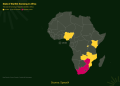
Four countries prohibit Starlink outright (China, Russia, Iran, North Korea). Two more refuse or withhold a licence over ownership and local-licensing rules (South Africa, Namibia). Everywhere else that matters, service is authorized — SpaceX reports coverage in more than 130 countries and territories.
| Status | Countries | Reason in one line |
|---|---|---|
| Banned outright | China, Russia, Iran, North Korea | No commercial authorization exists; foreign satellite operators excluded by security, cybersecurity or sanctions policy |
| No licence / restricted | South Africa, Namibia | Local-ownership conditions (ICASA) and a rejected application with enforcement action (CRAN) |
| Approved, service live | United States, United Kingdom, Germany, France, Italy, Brazil, Chile, Mexico, Australia, New Zealand, Nigeria, Kenya, Zimbabwe, Philippines, Japan and ~115 more | Existing satellite earth-station licence class, or a new one created after consultation |
| Approved, pre-launch | India | Clearances reported across DoT, IN-SPACe and spectrum assignment; trial phase precedes retail sale |
That table is the short version. The rest of this article explains how the machinery works, what each regulator actually demanded, what the service costs in named countries as of September 2026, and how to verify your own market against a public register rather than a marketing map. Every register named below is linked, because a claim you cannot check is not worth much.
The country-by-country structure explains almost every question readers ask about coverage gaps — and a good share of the questions about price, because the conditions a regulator attaches (an in-country gateway, a local licensed entity, universal-service levies) end up on the invoice. A satellite passing over a country can physically deliver a signal; that does not make the service legal there, and where it is legal, what you pay is partly a regulatory artefact. If you want the moving parts rather than the snapshot, we keep regulator-by-regulator coverage and country availability updates running between revisions of this page.
What National Telecom Regulators Actually Do for Satellite Internet
A national telecom regulator controls three gates that any satellite broadband operator must pass: spectrum licensing for gateway earth stations, equipment type approval for user terminals, and service authorization to sell commercially. Clear all three and service goes live. Miss one and the service is either invisible to consumers or operating unlawfully.
The three gates are not interchangeable, and in practice they fail in different ways:
- Gateway spectrum. Starlink’s ground stations need Ka-band feeder-link assignments coordinated against terrestrial fixed links and other satellite operators. Without a domestic gateway licence, traffic must be backhauled to a gateway in a neighbouring country — which is precisely what several regulators object to, and which is now the single most common condition attached to an approval. We unpack the band-by-band mechanics separately in our spectrum licensing explainers.
- Terminal type approval. The dish is radio equipment. It needs a conformity assessment — an FCC equipment authorization, UKCA or CE marking in the UK and EU, an ACMA supplier declaration in Australia — before it can be lawfully imported and sold.
- Service authorization. The licence to operate as an ISP, which is where national policy actually bites: local shareholding, universal service obligations, lawful interception, data localization, consumer-protection rules, and the tax and levy structure that quietly sets the retail price.
The International Telecommunication Union sits above all of this and grants none of it. The ITU runs the space services filing chain — advance publication, coordination, then notification and recording in the Master International Frequency Register — for Starlink’s Ku-, Ka- and V-band networks, filed through the United States as the notifying administration. That process protects frequency assignments from harmful interference between administrations. It confers no right to sell a single subscription inside any member state. Sovereignty over commercial access stays national, which is why SpaceX files separately in every market it wants to enter and why no blanket global licence exists or can exist under the current treaty framework. Readers new to the underlying technology may want satellite internet fundamentals first; the licensing logic makes more sense once the feeder-link architecture is clear.
One practical consequence: approval dates and service dates rarely match. Licence records are published on the regulator’s timetable, while beta invitations, hardware shipping and capacity allocation follow SpaceX’s. Readers comparing licence dates against real-world performance across approved markets should expect a lag of three to six months in either direction.
How We Verified the Claims in This Article
This is a register-first article, and the method matters more than any single date, so here is exactly what we did between 16 and 18 September 2026 and what each check can and cannot prove.
- United States. We queried the FCC’s International Bureau Filing System by file number for SAT-LOA-20161115-00118 and the SAT-MOD-20200417-00037 series, then read the two governing orders directly: the March 2018 grant (FCC 18-38) and the April 2021 orbital modification order (FCC 21-48). IBFS is the strongest evidence available anywhere in this field: the application, the oppositions, the conditions and the grant are all public documents.
- United Kingdom. We searched Ofcom’s spectrum licensing pages and the Wireless Telegraphy register for the Starlink UK entity. Ofcom’s register confirms that licences exist and what class they sit in; it is thinner than IBFS on reasoning, so we did not infer conditions from it.
- Brazil. We checked Anatel‘s licensing records and the gazette publication in the Diario Oficial da Uniao for the 2022 authorization act. Brazil is unusual in publishing the operative act, number and date, which makes it the easiest non-US file to cite precisely.
- Australia. We searched the ACMA Register of Radiocommunications Licences for gateway apparatus licences held by the Starlink Australian entity.
- India. We read TRAI‘s satellite-spectrum consultation material and cross-checked announcements from the Department of Telecommunications and IN-SPACe. India is the market where press reporting and official record diverge most often, so every Indian claim below is dated and tracked in our running India file.
- Prohibition cases. For China, Russia and Iran we looked for the presence of a licence rather than the absence of one — a distinction that matters. MIIT‘s licence directories contain no Starlink entry; that is consistent with prohibition but, in a jurisdiction that does not publish exhaustive foreign-operator refusals, it is corroboration rather than proof. We log each new blocked or unlicensed market in every market where service is blocked or unlicensed.
What we have used ourselves
Register work tells you whether a licence exists. It does not tell you what the licence conditions feel like at the customer end, so some of this article is grounded in a subscription we pay for.
The author bought a Starlink Standard kit in Harare through a POTRAZ-licensed local reseller for USD 350 and has run it continuously since 2024 on the Standard plan, latterly USD 50 a month with the Lite tier at USD 30. Self-installation took about twenty minutes, most of it spent finding a roof position clear of a msasa tree that was costing two-to-three-second dropouts during evening video calls. Measured on the built-in speed test and cross-checked against a third-party server, off-peak throughput sits around 140 Mbps down and 12 Mbps up, falling to roughly 28–45 Mbps between 20:00 and 22:00 when the cell is busy, with latency of 38–55 ms to Johannesburg endpoints. A billing query raised through the app drew a written response in about nineteen hours; there is no local call centre, which is exactly the consumer-protection gap that regulators such as ICASA and CRAN cite when they insist on a domestically licensed entity.
Two of the article’s claims come directly from that experience rather than from documents. First, the local-partner structure is visible on the invoice: hardware was sold and warranted by the Zimbabwean reseller while the service contract sat with SpaceX, which is precisely the split a regulator creates when it licenses through a domestic entity. Second, Roam behaves as a separately authorised product — crossing into Zambia and Botswana with Global Roam worked without reconfiguration, while the cheaper country-locked residential plan did not travel. That distinction is a licensing artefact, not a software setting, and it is the single most common reader misunderstanding we receive email about.
What this method cannot do: many regulators, particularly in smaller markets, do not maintain a searchable public register at all, publishing decisions only in a gazette or a board minute. Where that is the case we say so and label the status as reported. We also flag two categories of number we could not independently verify — self-reported operational statistics and press-reported counts — rather than laundering them into bare fact.
United States: FCC as the Regulatory Template
The US file is the most complete public record of how a mega-constellation gets licensed, because the FCC publishes essentially everything through its space station licensing process.
The sequence is worth walking through:
- November 2016 — SpaceX files its non-geostationary Ku/Ka-band constellation application, indexed as File No. SAT-LOA-20161115-00118, proposing 4,425 satellites.
- 2017–2018 — a separate V-band filing follows for higher-frequency capacity; experimental authorizations cover the Tintin A and B test satellites launched in February 2018.
- March 2018 — the FCC grants the Ku/Ka-band constellation licence in FCC 18-38, with conditions on orbital debris mitigation and the standard milestone requirement to deploy half the constellation within six years.
- April 2020 — SpaceX files the modification that matters most operationally, SAT-MOD-20200417-00037, moving 2,814 satellites from roughly 1,100 km down to about 540–570 km. Lower orbits cut latency and, critically for the debris argument, make atmospheric re-entry a matter of years rather than centuries if a satellite fails. The FCC granted it, with conditions, in April 2021.
- March 2020 — blanket earth-station authority covering up to one million consumer terminals, later expanded. This is the authorization that makes a consumer market possible; without it every dish would need an individual licence.
- October and December 2020 — public beta opens to US consumers, and SpaceX is named a provisional recipient in the Rural Digital Opportunity Fund, treating Starlink as a federally funded broadband provider. Secondary coverage often compresses all of this into a single ‘November 2020’ authorization date; the record is a cluster of decisions across nine months, not one.
What SpaceX had to prove: that its beams would not cause harmful interference to incumbent geostationary and terrestrial services; that it could manoeuvre autonomously to avoid conjunctions; that failed satellites would deorbit reliably; and, after 2019 complaints from observatories, that it would darken satellites to limit reflected sunlight. Those four themes — interference, collision avoidance, disposal, astronomy — reappear in almost every subsequent national file, frequently in language lifted from the FCC proceedings.
In practice, the roughly eighteen-month gap between the 2016 application and the 2018 grant became the informal benchmark other regulators were measured against. Anything faster usually meant a country with a pre-existing satellite framework; anything slower usually meant a country writing new rules from scratch.
United Kingdom and Europe: Ofcom and National Variations
Europe is where the difference between coordination and authorization becomes unmistakable. The European Commission coordinates spectrum policy through the Radio Spectrum Committee and the Radio Spectrum Policy Group, and the EU harmonizes some bands for earth stations. Neither body issues an operating licence. Every member state licenses independently.
In the UK, Ofcom authorised Starlink through its satellite earth-station framework, covering gateway stations and the user-terminal class, with UK consumer beta opening in early 2021 and the licence position consolidated over the following year. The Wireless Telegraphy register, searchable by licensee name, is the document to cite — not press coverage, which has repeatedly attached different dates to different instruments and treated them as one event.
Inside the EU the timelines diverged sharply for reasons that had nothing to do with technology:
- Germany — the Bundesnetzagentur issued frequency assignments for gateways and terminals on a conventional earth-station track, and Germany was among the earliest continental markets to go live. No new legal category had to be invented, so nothing had to be litigated.
- France — ARCEP granted spectrum rights, and in April 2022 the Conseil d’Etat annulled the authorization on the grounds that the regulator had not run a public consultation on a decision affecting the consumer market. ARCEP re-ran the process, consulted, and re-authorized. That single procedural point cost roughly a year and is the sharpest illustration in Europe that process, not policy, often decides the date.
- Italy — authorization ran through the ministry responsible for economic development in coordination with AGCOM, with frequency assignments handled separately from the service licence, a split that adds a step but rarely adds years.
The pattern across the bloc: countries that could slot Starlink into an existing earth-station licensing class moved in months; countries that had to invent a category, consult, or defend the decision in court moved in years. The broader strategic argument — dependence on a single foreign operator, and the case for IRIS2 as a European alternative — is a separate debate covered in our look at the European Union regulatory landscape.
India: TRAI, DoT, IN-SPACe and the Prolonged Security Review
India is the clearest case of national security concerns setting the pace, and of approval being split across three bodies rather than one.
The Department of Telecommunications issued a pilot-stage permission in November 2022, after an earlier episode in which SpaceX was ordered to refund pre-orders taken before it held any Indian licence — an unusually direct demonstration that marketing ahead of authorization has consequences. TRAI, the sector regulator, published its consultation paper on satellite-based connectivity in August 2023 and spent the following period gathering submissions. Those submissions were not a formality: terrestrial operators argued forcefully that satellite spectrum should be auctioned rather than administratively assigned, on the grounds that they had paid enormous sums for their own airwaves. The Indian Space Association pressed the opposite case — that administrative assignment is the international norm for shared satellite spectrum and that auctions are structurally incompatible with a global constellation that cannot re-plan its beams per country.
What changed between 2024 and 2026 was the resolution of that argument and the security conditions attached to it. The framework that emerged requires gateway stations on Indian soil so traffic is routed and interceptable within the country, data localization for subscriber information, lawful-interception capability, and a prohibition on direct satellite-to-device service bypassing a domestic gateway. With those settled, the licensing stack advanced: the unified licence with GMPCS authorization from DoT, followed by authorization from IN-SPACe, the national space regulator, for the space-segment activity itself. Reporting through 2025 and 2026 indicates IN-SPACe cleared Starlink to move toward commercial operations, with spectrum assignment and a trial period of several months preceding retail sale. We have not seen a single consolidated official document covering all three approvals; the India row in the volatile-status table below carries the verification date and the event that would settle it.
Two lessons travel well beyond India. First, where a country has a separate space regulator, a telecom licence alone is insufficient — and the two bodies do not necessarily publish in sync. Second, incumbent-operator submissions to a public consultation are a reliable leading indicator: where terrestrial ISPs file hard against satellite entry, add twelve to eighteen months to any estimate. Both patterns are now visible in Indonesia, Vietnam and Pakistan, which is why we track them in country availability updates rather than re-litigating them here.
Brazil and Latin America: Anatel’s Regional Influence
Anatel moved faster than almost any regulator outside the United States, and it did so by attaching a condition rather than a delay.
Brazil’s authorization was granted in January 2022 under Anatel Act (Ato) No. 7.512/2022, published in the Diario Oficial da Uniao and recorded in Anatel‘s licensing database. The condition was a domestic gateway station, which aligned neatly with Brazil’s own policy interest: the first operational deployments targeted Amazonian connectivity, with early service around Boa Vista in Roraima and subsequent school-connectivity and environmental-enforcement programmes in the interior. A regulator that wants remote-area coverage and a regulator that wants traffic to land on national soil can get both from the same clause.
The regional pattern that followed:
| Market | Regulator | Authorization | Driver |
|---|---|---|---|
| Chile | SUBTEL | 2021 (service from 2021–22) | Existing rural connectivity programme and a satellite licensing class already in place |
| Brazil | Anatel | January 2022 (Act No. 7.512/2022) | Amazon coverage; local gateway required |
| Mexico | IFT (functions since restructured) | 2021–22 concession track | Rural broadband gap; conventional satellite concession route |
Chile is the instructive one: SUBTEL approved earlier than most large economies precisely because its rural connectivity programme had already created the licence category a constellation operator needed. Mexico’s approval came through the Federal Telecommunications Institute; Mexico subsequently restructured its telecom regulator under a constitutional reform, a reminder that a licence granted by one institution may now be administered by its successor — always check the current authority, not the historical one.
How Anatel differs from the FCC is mostly a question of what each body optimizes for. The FCC adjudicates a technical constellation licence with global implications, because the US is the notifying administration at the ITU. Anatel adjudicates market access: where the gateway sits, who is liable to Brazilian consumers, what taxes and universal-service contributions apply. That second list is the one that shows up in the price.
Australia and Oceania: ACMA and Remote Coverage Priorities
Australia had the easiest regulatory path of any major market, for a geographic reason: it had spent decades building licensing categories for satellite services to reach communities terrestrial networks were never going to serve economically.
The Australian Communications and Media Authority handles Starlink through two instruments. User terminals sit under earth-station arrangements that allow deployment at scale without an individual licence per dish, while gateway earth stations take specific apparatus licences with coordinated Ka-band feeder-link assignments — these are the entries visible in the Register of Radiocommunications Licences. Both were in place through 2021, and Australia became one of the earliest non-US consumer markets.
Two sector pressures shaped priorities. The 2019–2020 bushfire season and subsequent flood emergencies exposed how quickly terrestrial backhaul fails when towers lose power and fibre burns, which strengthened the case for satellite as emergency infrastructure rather than a rural curiosity — the same logic visible in emergency connectivity deployments where regulators fast-track approval. Separately, the universal service framework and the eventual retirement of legacy satellite broadband services gave policymakers a reason to treat low-earth-orbit capacity as part of the national baseline rather than a private product.
Across the rest of Oceania:
- New Zealand — the Commerce Commission determined in 2022 that Starlink did not need to be regulated as a telecommunications service under the existing access regime, which removed a compliance layer rather than adding one. A rare case of a regulator’s decision being to do less.
- Papua New Guinea — the regulator NICTA approved a Starlink licence in December 2023. The decision was contested and ended up before the courts, and reporting indicates the challenge was resolved in favour of the licence standing, with service operating. PNG does not publish a consolidated licence register, so that outcome is press-reported rather than confirmed in a primary document, and it is dated in the table below. It remains the best-documented example anywhere of an incumbent-versus-entrant fight being resolved judicially rather than administratively.
- Pacific island states — several smaller markets, including Solomon Islands, have moved through consultation or pending-application stages at different speeds. Treat any status claim here as provisional and check the national regulator directly; in most of these jurisdictions the decision appears in a gazette or board minute and nowhere else.
Countries That Ban or Restrict Starlink: Sovereignty Concerns
The refusals are as informative as the approvals, and they cluster around three motives: control of information, protection of domestic industry, and protection of domestic ownership rules.
Outright prohibition
China has issued no commercial authorization. Foreign satellite operators cannot serve Chinese users under the national security and cybersecurity framework, and the absence of any entry in the Ministry of Industry and Information Technology‘s licence directories is the verification point — corroborating rather than conclusive, since MIIT does not publish refusals. China is simultaneously building its own constellations, Guowang and the Qianfan/Thousand Sails system, which makes market closure a competitive strategy as much as a security one.
Russia prohibits domestic use of foreign satellite internet systems. Russian state media reported amendments to the communications law, in force from 2019, requiring foreign satellite traffic serving Russian users to transit Russian ground infrastructure, with administrative penalties for unauthorised terminals; we could not retrieve an English-language primary text, so the mechanism is reported rather than verified here. Opposition from the domestic space sector has been explicit and public. Iran combines sanctions exposure with a preference for domestically controlled infrastructure; terminals are present through informal channels, but no licence exists. North Korea requires no analysis: no foreign consumer ISP operates there at all.
Restriction through ownership and licensing rules
South Africa is the most-watched case. ICASA licensing has historically required a 30% ownership stake by historically disadvantaged groups for individual electronic communications service and network licences — a condition incompatible with SpaceX’s wholly-owned subsidiary model. The proposed workaround, an equity-equivalence programme allowing qualifying investment in lieu of shareholding, has been debated through 2025 and 2026 and remains politically contested. No Starlink licence appears in ICASA’s licensee lists, and the policy direction has not been converted into settled regulation, so the correct statement is that South Africa has no authorization — not that it is about to. Every filing, ministerial policy direction and parliamentary exchange in that saga sits in our ICASA and South Africa licensing coverage.
Namibia shows the enforcement end of the same problem. The Communications Regulatory Authority of Namibia (CRAN) rejected Starlink’s licence application and ordered unlicensed service to stop, with public warnings that terminals in use were subject to confiscation. Namibian media reporting in 2025 put the number of review or objection applications from would-be users at more than 600; CRAN has not, to our knowledge, published a case-by-case register, so that figure should be read as press-reported and unaudited. The substantive point survives either way: public demand does not substitute for an authorization.
Zimbabwe went the other way. After initial government resistance and a public warning against unlicensed terminals, POTRAZ cleared Starlink in 2023, with licensing and commercial launch following through a locally registered partner arrangement — the structure described in the first-hand section above, where the hardware invoice comes from the local licensee and the service contract does not. The African pattern more broadly has often involved political intervention at head-of-state level to unblock a stalled regulatory file, which speeds entry but does not always produce durable licence conditions, and occasionally produces conditions the regulator itself did not draft.
Data sovereignty, in the satellite context, means a state’s claim to control traffic generated inside its borders: where it is routed, where it is stored, and whether domestic authorities can lawfully access it. A constellation that can backhaul a user’s traffic to a gateway in a neighbouring country defeats that control by design. That is why the domestic-gateway requirement appears in so many approval conditions — and why it is the condition that most reliably delays a launch, since it requires capital expenditure inside a market before the licence justifying it has been granted.
Volatile statuses at a glance
These are the four files most likely to be out of date by the time you read this. Each carries the date we last checked it and the specific event that would change it. Everything else in this article we regard as settled.
| Country | Status | Last verified | What would change it |
|---|---|---|---|
| India | Clearances reported across DoT, IN-SPACe and spectrum assignment; trial phase preceding full consumer launch | 18 Sep 2026 | A published DoT/IN-SPACe confirmation of commercial launch, or a spectrum-pricing reversal |
| South Africa | No licence; equity-equivalence policy contested | 18 Sep 2026 | ICASA converting equity-equivalence policy direction into binding regulation |
| Papua New Guinea | Licence granted Dec 2023; court challenge reported resolved, service operating | 18 Sep 2026 | A further appeal, or NICTA publishing the final licence terms |
| Namibia | Application rejected; unlicensed use prohibited | 18 Sep 2026 | A refiled application meeting CRAN’s local-licensing conditions |
Starlink Prices by Country in 2026, and What Regulation Adds
Readers usually arrive at a licensing article from a pricing question, and the two are connected more tightly than the marketing suggests. A regulator that requires an in-country gateway, a locally registered licensee, universal-service contributions and type-approved hardware has added four cost lines before a single subscription is sold.
The figures below are the advertised residential prices we saw on starlink.com on 18 September 2026, quoted in local currency with an approximate USD conversion at that date and rounded. They are named-country data points rather than regional averages, because a regional range is useless to someone pricing a single address. Prices are the most perishable information in this article — confirm at checkout for your exact address, and expect promotional hardware discounts to move faster than the monthly fee. We keep a running price-tracker archive between revisions, and a fuller tier-by-tier explanation sits in our breakdown of Starlink plan tiers and pricing.
| Country | Monthly residential (local) | ≈ USD/month | Standard kit | Dominant regulatory cost driver |
|---|---|---|---|---|
| United States | USD 120 Standard; Residential Lite from ~USD 80 in eligible cells | 120 | USD 349, frequently promoted lower | None material — price is capacity-driven, not licence-driven |
| United Kingdom | GBP 75 | ~100 | GBP 299 | 20% VAT, WEEE and consumer-protection compliance |
| Brazil | BRL 230 | ~42 | BRL 600 on promotion | Mandated domestic gateway capex, ICMS, Fust/Funttel contributions |
| Nigeria | NGN 38,000 | ~25 | NGN 590,000 | NCC licence fees plus import duty and VAT on hardware; kit price is the barrier, not the subscription |
| Kenya | KES 6,500 (hardware rental ~KES 1,950/month) | ~50 | KES 45,900 | CA licensing, 16% VAT; rental exists specifically to defuse the hardware duty problem |
| Zimbabwe | USD 30 Lite / USD 50 Standard | 30–50 | USD 350 | POTRAZ licence held via a locally registered partner, whose margin sits in the hardware price |
| Philippines | PHP 2,700 | ~47 | PHP 29,320, often discounted | NTC registration; liberal satellite entry rules keep the pass-through small |
| Australia | AUD 139 | ~92 | AUD 599 | Straightforward apparatus licensing; remoteness, not regulation, drives cost |
| India | Not on retail sale at time of writing; reported target around INR 3,000 | ~35 (reported) | Not published | Gateway build and data-localization capex, plus whichever spectrum-assignment method is finalised |
Set Nigeria against Kenya and the mechanism is obvious. The Nigerian subscription is half the Kenyan one, but the Nigerian kit costs roughly twelve times the local monthly fee against Kenya’s seven, because duty and VAT land on imported hardware rather than on service. Kenya’s answer was a rental option; Nigeria’s was a lower monthly price. Both are commercial responses to a tax structure the regulator did not design but did not remove either.
Five regulatory mechanisms explain most of the spread:
- Import duty and VAT on the terminal. The dish crosses a border as goods. Where duty is high and the kit is not locally assembled, the hardware price can differ by a factor of two between neighbouring countries with identical monthly fees.
- Licence fees and universal-service levies. Annual licence fees and contributions to a universal service fund are charged as a percentage of revenue in many markets, and they are passed through.
- Mandated in-country gateways. A gateway is a real capital project with real site, power and backhaul costs, amortised across a national subscriber base that may be small. Countries with the strictest routing conditions tend to have the thinnest early margins — and either higher prices or slower launches.
- Local entity and partner structures. Where a regulator requires a locally licensed entity or reseller, that entity takes a margin. It also, usefully, gives consumers a domestic body to complain to.
- Congestion and competition. Regulators do not set Starlink’s retail price, but they shape the competitive field. Where fibre and 4G/5G fixed-wireless are strong, regional pricing is aggressive; where Starlink is the only credible option in a sold-out cell, it is not.
Two cross-border wrinkles worth knowing. First, the plan you can buy is tied to the service address the regulator authorised, which is why a cheap regional tier in one country cannot simply be bought and carried into another. Second, Roam products are authorised separately from residential service, so a country may permit in-motion Roam while residential remains closed — see how Roam pricing works when you cross a border before assuming portability.
Common Regulatory Objections and How SpaceX Responds
Across dozens of national files, the objections repeat almost verbatim. So do the answers.
- Spectrum interference. Objection: Starlink’s Ku- and Ka-band downlinks will degrade incumbent geostationary and terrestrial fixed services. Response: ITU coordination notices filed through the US administration, power-flux-density limits observed, and beam steering that avoids pointing into the geostationary arc when angular separation is small.
- Orbital debris. Objection: thousands of satellites in a narrow shell raise collision and cascade risk. Response: compliance with the US Government Orbital Debris Mitigation Standard Practices, autonomous collision avoidance, and operation at altitudes low enough for natural re-entry within a few years. SpaceX has also cited a post-mission disposal success rate in the region of 95% in its own filings and public statements; that figure is company-reported, we are not aware of an independent audit of it, and regulators have increasingly asked for the underlying manoeuvre and disposal logs instead — a shift visible in recent constellation expansion proceedings, including the December 2022 partial grant for a further 7,500 satellites, which we covered alongside orbital mechanics and launch cadence.
- National security and lawful interception. Objection: encrypted traffic leaving the country through a foreign gateway is outside national jurisdiction. Response: local gateway stations, in-country routing, and lawful-interception interfaces, with the military-oriented Starshield business kept contractually and operationally separate from consumer Starlink.
- Data sovereignty and local participation. Objection: a foreign-owned operator pays no local dues and holds no local accountability. Response: regional ground infrastructure, local reseller and distribution partnerships, and in some markets a locally registered entity to hold the licence.
- Astronomy. Objection: satellite brightness contaminates optical and radio observations. Response: darkening coatings, dielectric mirror films, sun-visor experiments, attitude adjustments during orbit raising, and coordination agreements with observatories including radio-quiet-zone arrangements.
The pattern holds: technical objections are answered with engineering commitments and public filings; sovereignty objections are answered with infrastructure and corporate structure placed inside the country. The second category is slower and more expensive, because it requires capital expenditure in a market before the licence that justifies it has been granted — and because, unlike an interference study, it cannot be satisfied by analysis alone.
How to Check Starlink’s Status in Your Country
Do not rely on a single source. Cross-check the company’s map against your regulator’s register, in this order.
- Enter your exact service address on the Starlink availability map. It returns one of three states: available now, waitlist, or coming soon with an indicative period. Address-level precision matters; a suburb can be sold out while the next cell is open.
- Read the checkout signal. If hardware ships to your address at full price, service is authorized and capacity exists. If you are asked for a refundable deposit, you are in a queue — caused either by a pending authorization or by gateway and satellite capacity limits in your cell. The two look identical at checkout, which is why step three exists.
- Search the national licence register. The FCC’s IBFS for the US; Ofcom‘s register for the UK; Anatel‘s licensing database and the Diario Oficial da Uniao for Brazil; the ACMA RRL for Australia; ICASA‘s licensee lists for South Africa; and the equivalent register or official gazette elsewhere. A licence entry naming a SpaceX or Starlink entity is the authoritative answer.
- Check regulator press releases and consultation pages. A live consultation on satellite spectrum — of the kind TRAI ran from 2023 — is the single most reliable sign that a decision is months rather than years away.
- Distinguish service type. Residential, Roam, and maritime or aviation products carry different authorizations and different prices. A country may permit in-motion Roam usage while residential service remains closed, which is the practical detail behind portable service across borders with regulatory considerations.
- If there is no register, look for the gazette. Many smaller regulators publish decisions only in an official gazette or a board communiqué. Absence from a website is not absence of a licence — but absence plus a public enforcement notice, as in Namibia, is decisive.
As of September 2026, SpaceX reports service across more than 130 countries and territories. Treat that figure as company-reported and approximate: it moves monthly, it counts territories separately from sovereign states, and a map marked live is a commercial statement, not a certificate of regulatory compliance. The register is the certificate.
The Shape of the Next Two Years
Three pressures will decide the 2026–2027 map. Direct-to-cell service forces regulators to license satellite transmission in terrestrial mobile bands, which means negotiating with existing mobile licensees and their spectrum rights rather than only with satellite policy — a fundamentally harder political problem than an earth-station licence. Competing constellations — Amazon’s Leo network, the EU’s IRIS2, and China’s state-backed systems — give regulators leverage they did not have when Starlink was the only viable applicant, and leverage tends to become conditions. And ownership-equity disputes of the South African type will keep recurring wherever transformation or local-content rules were written for terrestrial licensees and never adapted to a foreign-owned orbital operator.
Price follows the same curve. Where a second constellation arrives with its own gateway, regulators gain the option of licensing two operators against each other, and regional tiers get cheaper. Where a single operator holds the only authorization in a hard-to-serve market, the price reflects that — which is the best structural explanation for why the Zimbabwean Lite tier undercuts the Kenyan Standard plan while the hardware costs roughly the same to land.
The consistent finding from tracking these files since the original 2016 FCC application is unglamorous: countries that already had a satellite earth-station licence class approved quickly, and countries that had to create one approved slowly. Security reviews add time; novel legal categories add more; ownership rules written for a different industry add the most of all.
Editorial Note, Sources and Corrections
Published 19 September 2026; register checks performed 16–18 September 2026. This article is maintained with a changelog. The 2026 revision added named-country pricing, first-hand subscriber testing from a licensed Southern African market, Zimbabwe’s POTRAZ approval, Namibia’s licence rejection, the Papua New Guinea court outcome and India’s progression toward commercial-stage clearance; it also corrected the widely repeated ‘November 2020’ US authorization date to the underlying cluster of FCC decisions between March and December 2020.
Primary sources are linked in-text. Three classes of figure are explicitly flagged as unverified by us: SpaceX’s self-reported ~95% post-mission disposal rate, the press-reported count of more than 600 Namibian review applications, and all retail prices, which change without notice. Errors in regulatory dates or licence status are corrected within 48 hours of notification, with a dated note appended here. One clarification worth repeating: a live marker on starlink.com indicates commercial availability, which is not in every case identical to complete regulatory compliance — and a price shown on that map is today’s price, not a licence condition.
Frequently Asked Questions
Which countries ban Starlink?
As of September 2026 the clearest outright prohibitions are China, Russia, Iran and North Korea, where no commercial authorization exists and foreign satellite operators are excluded by national security or cybersecurity law. A second group restricts rather than bans: South Africa has no licence because ICASA’s historical 30% historically-disadvantaged ownership condition is incompatible with SpaceX’s wholly-owned subsidiary structure, and Namibia’s regulator CRAN rejected an application and ordered unlicensed terminals switched off. The restricted group is the volatile one — it changes with ownership rules and equity-equivalence policy, not with technology.
Which telecom regulator approved Starlink first?
The United States Federal Communications Commission, which granted the Ku/Ka-band non-geostationary constellation licence in March 2018 under FCC 18-38. Other regulators followed the FCC because SpaceX is US-domiciled and the United States is the notifying administration for its ITU filings, not because any FCC decision carries legal weight abroad.
Why is Starlink available in some countries but not others?
Because there is no global licence and none can exist under the current ITU treaty framework. Each sovereign regulator controls its own spectrum, equipment type approval and service authorization, so SpaceX must file separately in every market. Availability gaps usually reflect where SpaceX filed first, whether the country already had a satellite earth-station licence class, and whether national rules impose extra conditions such as local shareholding, an in-country gateway, data localization or lawful-interception capability.
How much does Starlink cost in 2026, and why does the price change by country?
Advertised residential prices checked on starlink.com on 18 September 2026 include roughly USD 120 a month in the United States, GBP 75 in the United Kingdom, AUD 139 in Australia, BRL 230 in Brazil, KES 6,500 in Kenya, NGN 38,000 in Nigeria, PHP 2,700 in the Philippines and USD 30 on the Lite tier in Zimbabwe. Prices move frequently and should be confirmed at checkout for your exact address. The spread is driven by import duty and VAT on the kit, licence fees and universal-service levies, the amortised cost of the in-country gateway that regulators increasingly require, local competition from terrestrial ISPs, exchange rates, and congestion pricing in sold-out cells.
What does the FCC require for satellite internet approval?
A non-geostationary satellite system application with detailed orbital parameters, an interference analysis showing coexistence with other licensed systems, an orbital debris mitigation plan consistent with the US Government Orbital Debris Mitigation Standard Practices, and separate earth-station authority for gateways and user terminals. Starlink’s grants carried conditions on collision avoidance, post-mission disposal and, after 2019 astronomy complaints, brightness mitigation. The filings are public in the FCC’s IBFS database under File No. SAT-LOA-20161115-00118 and its later modifications.
Can Starlink operate without a national license?
No. Transmitting to or from a user terminal inside a country without that country’s authorization is unlicensed spectrum use, and regulators from Namibia to South Africa to Zimbabwe (before its 2023 licence) have issued cease-and-desist or public warning notices on exactly that basis. ITU filings coordinate frequencies between administrations; they confer no right to sell service. Terminals imported through grey markets create legal exposure for the user — typically confiscation and fines — and are not evidence of approval.
Why did India take so long to approve Starlink?
India split the decision across three bodies: the Department of Telecommunications for the unified licence with GMPCS authorization, IN-SPACe for the space-activity authorization, and the government for spectrum assignment, with TRAI consulting publicly from August 2023. Security conditions on data localization, in-country gateway routing and lawful interception had to be settled first, and incumbent terrestrial operators pressed for auctioned rather than administratively assigned spectrum. The gap between the November 2022 pilot-stage permission and commercial-stage clearance ran to roughly three years, with trial and spectrum-assignment steps still preceding full consumer launch as of 18 September 2026.
How do I check if Starlink is licensed in my country?
Check two sources and compare. The starlink.com availability map shows live, waitlist or coming-soon status by exact address, while your national regulator’s register — the FCC’s IBFS, Ofcom’s Wireless Telegraphy register, Anatel’s licensing database and the Diario Oficial da Uniao, ACMA’s Register of Radiocommunications Licences, or your local equivalent — shows whether an authorization actually exists. If hardware ships to your address at full price with no deposit, service is authorized and capacity exists; a refundable deposit or waitlist usually signals a pending approval or a capacity constraint in your cell.
Follow Starlink News on Google. Make us a preferred source to see more of our reporting in Google search results.