By Tendai Marufu, Southern Africa telecoms correspondent, Starlink News. Covering ISP licensing, spectrum policy and last-mile infrastructure in Zimbabwe, Zambia and Botswana since 2011. Earlier reporting by this author is collected at the author archive. Last updated: 19 September 2026.
A note on what this report is and is not. The price figures are Starlink’s own published prices for a Zimbabwean service address, and Starlink adjusts pricing by market without notice, so every figure here is date-stamped. None of it is an audited dataset. Everything below is labelled by source so you can weight it yourself, and the independently checkable material — the regulator, the tax authority, Starlink’s own terms and Ookla’s country index — is linked directly so you can verify it without taking our word for anything.
Starlink is legal in Zimbabwe and has been since POTRAZ issued SpaceX’s satellite arm a Public Network Licence in September 2024. Kits ship to Zimbabwean addresses, Starlink’s Zimbabwe order page lists the Residential plan at $80 per month against a $349 one-time hardware charge (as of September 2026), and there is no licensed local reseller, no mobile-money payment path and no official installer network. Everything else below — ordering, customs, power design for load shedding, performance, the satellite competitors that do not yet exist here, and how satellite internet compares with Liquid, TelOne and Econet — follows from those facts.
- Legal status: Licensed — Public Network Licence, POTRAZ, September 2024. Buying from an unlicensed local vendor is not covered by it.
- What you can actually buy: Residential for a fixed site, Roam for a terminal that travels. The address you enter decides which you are shown.
- Payment: International credit or debit card only — budget for a nostro card and a bank conversation about recurring cross-border billing.
- True entry cost: more than the $349 kit once a mount, a technician and usually a battery are counted. See the budgeting note below.
- Satellite competition: none at consumer level. No rival LEO operator sells a household subscription in Zimbabwe today.
- Biggest single design decision: which circuit you plug the terminal into. Grid-only means no internet during the evening load-shedding block.
How We Verified the Figures in This Report
Satellite internet coverage for African markets is unusually prone to stale numbers being recycled between sites, so here is exactly where each class of figure comes from, how strong it is, and what we could not confirm at all.
- Pricing (published, not audited): Starlink’s published prices for a Zimbabwean service address at starlink.com, as of September 2026. Starlink adjusts pricing by market without notice, so the date stamp matters as much as the number.
- Licensing (independently checkable): POTRAZ licensing announcements and public notices at potraz.gov.zw, plus contemporaneous Zimbabwean press coverage of the licence grant from Techzim and The Herald. POTRAZ’s quarterly sector performance reports are the best public source for Zimbabwean internet penetration and operator data.
- Speeds (published national data): Ookla’s published country data for Zimbabwe at speedtest.net/global-index/zimbabwe, which is the neutral national reference point for direction of travel.
- Power figures (vendor spec plus owner logs): Starlink’s published hardware specification for the Standard kit and consumption figures reported by owners with inline power meters. The two do not agree exactly, so both ends are given rather than a single confident number.
- Competitor pricing (publisher-published): the providers’ own consumer package pages, as published in September 2026, with the source noted per row.
- Customs (guidance only): ZIMRA tariff guidance on telecommunications equipment at zimra.co.zw. Duty is assessed case by case and we deliberately publish no single figure for it.
- What we could not verify: the commercial terms of the POTRAZ licence, which are not public; the identity or location of the gateway stations serving Zimbabwean cells; and any forward-looking claim about local-currency billing.
Is Starlink Legal in Zimbabwe? POTRAZ Licence Status Explained
The Postal and Telecommunications Regulatory Authority of Zimbabwe is the statutory regulator that licenses network operators and service providers under the Postal and Telecommunications Act. Its approval is the gate every carrier passes through, and until that gate opened, a dish pointed at the Zimbabwean sky was an unlicensed terminal regardless of who owned it or how they had paid for it.
It opened in stages. Presidential endorsement of Starlink’s entry came first in 2024, followed by the formal licence grant in September 2024, reported at the time by Zimbabwean technology and business outlets including Techzim and The Herald and covered regionally in the trade press as part of SpaceX’s wider African licensing run. The category granted was a Public Network Licence for satellite services — the authorisation that permits commercial sale of connectivity to the general public, as opposed to a restricted private or corporate network permit. In plain terms, Starlink is a licensed Zimbabwean service provider that happens to deliver its last mile from low Earth orbit rather than from a tower or a trench.
What changed for subscribers on the ground
Before the licence, Zimbabwe ran an active grey market. Kits were registered to addresses in Mozambique, Zambia or Malawi, carried across the border and run on Roam plans, sometimes resold in Harare at two or three times the sticker price. Those imports were never authorised, and POTRAZ has since published notices banning the sale and distribution of Starlink terminals by unlicensed parties. The licence legalised the service; it did not legalise the informal trade that grew up around it. That distinction is worth holding onto before buying a second-hand dish from a WhatsApp group, because a terminal still tied to a foreign account is a support problem you inherit and cannot escalate — there is no Zimbabwean office to walk into, and ownership transfers are handled inside the original account holder’s login.
Where Zimbabwe sits in the regional pattern
Zimbabwe followed a familiar African sequence: grey-market pressure first, then a regulator formalising what was already happening. Nigeria, Malawi, Mozambique, Zambia and Kenya each moved through comparable steps, while South Africa remains the conspicuous holdout over equity-ownership rules. For the wider map of which regulators have signed off and which are still deliberating, see Starlink Availability by Country: Current Rollout Status and Expansion Map. Regional licensing is not an abstraction for Zimbabwean users: it determines where gateway capacity gets built, and gateway placement sets the floor under Zimbabwean latency.
Starlink Zimbabwe Prices in 2026: Plans, Hardware and Payment
Zimbabwean pricing is quoted and charged in United States dollars. The table below records Starlink’s listed prices for a Zimbabwean service address as of the date shown. It is a dated observation, not a published tariff sheet — verify at checkout before budgeting.
| Item | Price (USD) | As of | Notes and confidence |
|---|---|---|---|
| Residential plan | $80 / month | Sep 2026 | Unlimited data; no fair use clause in the published terms. Listed by Starlink. |
| Standard kit (Gen 3) | $349 one-time | Sep 2026 | Dish, Wi-Fi router, cable and basic kickstand included. Listed by Starlink. |
| Pipe adapter | ~$23 | Sep 2026, Starlink store | Accessory pricing moves without notice. Treat as indicative. |
| Shipping | Charged at checkout | Sep 2026 | Varies by destination; shipped from a regional hub. |
| Import duty | Not published here | ZIMRA guidance, Sep 2026 | Assessed case by case on telecommunications equipment. Confirm with ZIMRA, not with a forum post. |
| VAT | Not applied | Sep 2026 | Invoiced by an international billing entity outside Zimbabwe. Not a tax ruling. |
The pricing history is where most confusion starts
Launch pricing in Zimbabwe was lower than it is now. Coverage in 2024 and early 2025 quoted hardware around $350 with a monthly fee near $50, alongside a Starlink Mini option at roughly $200 and a $30 entry plan. Those introductory figures circulated widely and are still copied into listicles today, which makes them the single most common source of confusion for Zimbabwean buyers. If a page quotes $50 per month in 2026 without a date stamp, it is recycling a historical launch tariff rather than reporting the current Residential rate. Plan structures also diverge sharply between markets, so South African tariffs and global Roam pricing are not transferable reference points for a Zimbabwean service address — the plan catalogue offered to you is decided by the address you enter, not by the country you happen to be sitting in.
Payment, forex and the VAT question
Payment is by international credit or debit card. There is no EcoCash, OneMoney or InnBucks integration, no local debit order and no ZWG invoice. In practice Zimbabwean subscribers pay with nostro-funded Visa or Mastercard products issued locally, and the most frequent failure has nothing to do with Starlink: it is a card with no forex allocation left, or an issuing bank that blocks recurring international merchants by default. Authorising recurring cross-border billing with the bank before the first renewal date avoids an entirely avoidable mid-month suspension, which then requires a successful payment to lift. Keep a second card on the account if you can; a single declined renewal on a single card is the most common way a working Zimbabwean installation goes dark.
No local VAT line applies while billing originates outside Zimbabwe. That is a statement about where the billing entity sits rather than a statement of tax law, and it is not a permanent exemption — it is among the first things that would change if local billing arrangements were ever established.
How to Order Starlink in Zimbabwe: Step-by-Step Process
Ordering runs entirely through starlink.com. There is no licensed Zimbabwean reseller holding local stock, so every legitimate kit arrives as a direct shipment against an individual account.
- Create the account. Use an email address that will stay accessible for years: it carries the invoices, the service address and the account recovery path, and there is no local office that can restore it for you.
- Enter a Zimbabwean service address. The address determines the cell the terminal is authorised to operate in and the plan catalogue you are shown. It must be inside Zimbabwe for Residential to be offered.
- Use GPS coordinates for rural sites. Farms, lodges, mines and growth points frequently have no formal street address. Latitude and longitude entered as the service location are accepted, and this is the standard workaround for properties in Nyanga, Binga and the Zambezi Valley.
- Give a separate shipping address if needed. Service address and delivery address do not have to match. Many rural subscribers ship to a Harare, Mutare or Bulawayo office and carry the kit out themselves.
- Pay with an international card. Hardware, shipping and the first month are charged together at checkout.
- Plan for customs before you pay. The kit is classified as telecommunications equipment and import duties may be assessed on arrival. Confirm the current classification and duty rate with ZIMRA rather than relying on forum figures, which go stale quickly and rarely state which tariff line they used.
- Receive the courier delivery. International couriers handle the leg into Zimbabwe, with customs clearance the main variable in how long it takes. A signature is required, so nominate an address attended during business hours.
Residential or Roam?
Residential is the correct choice for a fixed home or office. Roam suits people who genuinely move the terminal across borders — safari operators, overland travellers, cross-border consultants — and trades a higher monthly rate for portability and in-motion options. The trade-offs, regional restrictions and pause-and-resume behaviour are set out in Starlink for Digital Nomads: Portable Internet Across Borders. Choosing Roam simply to sidestep address verification is a false economy: it costs more every month and its network-priority behaviour is different from Residential.
Budgeting Beyond the Kit: What a Rural Installation Involves
Abstract pricing tables hide the true cost of getting a rural site online. Budget beyond the kit: a realistic rural installation carries a mount, a technician visit and often a battery upgrade on top of the hardware price. The site survey also matters more than the hardware, because dropout complaints generally trace back to obstruction or power rather than to a faulty terminal.
Installation Realities: Power, Mounting and Load Shedding
The Standard Gen 3 kit accepts 100–240 V AC, so it runs on Zimbabwean mains without a transformer and sits comfortably within the capacity of the solar and inverter systems already installed in thousands of Zimbabwean homes. The question is not whether it will run, but what it runs on.
Load shedding is the real design constraint
The kit has no internal battery. When the power goes, the dish goes with it unless something is holding the load — and ZETDC‘s published load-shedding schedules have long allocated outages in multi-hour stage blocks that routinely include the evening, with much longer daily cuts reported during the 2024 Kariba low-water period. Designing around that is arithmetic rather than guesswork, provided you are honest about the input range.
Starlink’s published specification puts average consumption for the Standard kit in the 75–100 W band; owners running inline power meters commonly report 50–75 W in steady state with the higher figures appearing during snow-melt or heavy compute load. Both numbers circulate as fact online. Size for the range, not for the flattering end of it:
- Daily energy: roughly 1.5 kWh per day at a 65 W average, rising to about 2.0–2.4 kWh at 85–100 W, for terminal and router alone.
- Small UPS (600–1000 VA): bridges a switchover or a one-hour cut. Not a load-shedding solution.
- 1 kVA inverter, one 12 V 100 Ah lead-acid battery: about 1.2 kWh nominal, roughly 0.6 kWh usable at 50 percent depth of discharge — call it five to eight hours of terminal-only runtime after inverter losses, depending on actual draw. Enough for a typical evening block, not enough to also run a fridge.
- Same bank in lithium (LiFePO4): usable depth roughly doubles, and so does runtime.
- 3 kW hybrid system with 5 kWh storage: runs the terminal indefinitely in normal weather alongside household lighting and laptops.
The practical rule: put the terminal on the inverter or solar circuit, never on a mains-only socket. A connection that dies at 18:00 every evening is functionally not a connection, whatever the speed test says at noon.
Mounting and line of sight
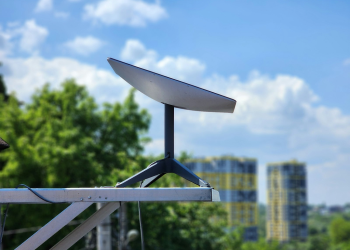
Zimbabwe sits in the southern hemisphere, so the terminal needs a clear view toward the northern sky. Msasa and jacaranda canopies are the usual obstruction, and a dish at ground level under trees will show constant short dropouts that no amount of router fiddling fixes. Roof or gable mounting solves it, and the pipe adapter sold separately fits standard mast pipe. Self-installation is realistic for most households, since the dish self-orients once powered, but Starlink operates no official installer network in Zimbabwe, so a proper roof job usually means an independent satellite or DStv technician. Specify lightning-safe cable routing, a sealed wall entry and a drip loop: the November to March storm season is unforgiving to a cable run flat through a window frame.
Starlink Speeds in Zimbabwe: What Shapes Performance
Readers who want a neutral national reference point for Zimbabwean internet performance can compare Ookla’s published Zimbabwe country data at speedtest.net/global-index/zimbabwe.
Two structural factors explain how the service behaves. First, there is no publicly announced gateway station inside Zimbabwe, so traffic is routed through ground stations in neighbouring countries. That adds a fixed component to latency which no home-side tuning removes. Second, throughput is shared per coverage cell, which means the dominant variable is how many subscribers sit in your cell, not how far you are from town. A farm in Mashonaland West with a handful of active terminals in its cell can comfortably outperform a Harare suburb with several hundred.
The evening slowdown is predictable, so plan around it: schedule large downloads, cloud backups and system updates for the early morning. For latency-sensitive work, low Earth orbit latency is comfortably inside the range for video calls and most remote-desktop sessions, and an order of magnitude better than the legacy geostationary satellite services Zimbabwean businesses used to rely on, which run at 600 ms or worse.
Alternatives to Starlink in Zimbabwe: Terrestrial ISPs and Other Satellites
Starlink is not automatically the right answer. For a household sitting inside a healthy fibre footprint, it usually is not. The figures below are taken from each provider’s own published consumer packages, as published in September 2026; promotional pricing shifts frequently and some packages are billed in USD while others are settled in ZWG at the prevailing rate, so treat these as a starting point and confirm directly with the provider.
| Provider | Typical monthly (USD) | Typical speed | Coverage reality | Source / checked |
|---|---|---|---|---|
| Starlink Residential | $80, plus $349 hardware | 50–150 Mbps | Anywhere with a clear northern sky | Starlink published pricing, Sep 2026 |
| Liquid Home fibre | Entry packages from the mid-$40s; 50–100 Mbps tiers around $90–$120 | 10–100 Mbps | Urban suburbs inside the fibre footprint only | liquidhome.co.zw published packages, Sep 2026 |
| TelOne ADSL and FTTH | ADSL bundles from the mid-$20s; entry fibre from around $40 | 2–10 Mbps on copper, higher on FTTH | Exchange-dependent; ageing copper in many suburbs | telone.co.zw published tariffs, Sep 2026 |
| Econet LTE / fixed wireless | Bundle-dependent; a heavy household typically $40–$70 | 5–50 Mbps | Strong in towns, thin beyond them, contended at peak | econet.co.zw bundle pricing, Sep 2026 |
| Geostationary VSAT (via licensed local providers) | Quote-based; typically well above Starlink per usable GB | 5–30 Mbps, capped | National, including sites Starlink also reaches | Provider quotes and published enterprise packages, Sep 2026 |
Satellite versus satellite: who else could serve Zimbabwe?
Most comparison articles stop at fibre and LTE, which skips the question a serious buyer asks second: is another constellation about to undercut this? On the evidence available in September 2026, no.
| Option | Status for Zimbabwean households (Sep 2026) | What it means for you |
|---|---|---|
| Eutelsat OneWeb (LEO) | Operational over Africa but sold wholesale through enterprise partners, carriers and ISPs rather than direct to consumers; see eutelsat.com | Reachable only as a corporate or carrier contract, usually with a professionally installed terminal and a service level agreement. Not a household purchase. |
| Amazon Leo, formerly Project Kuiper (LEO) | Constellation still deploying; no announced Zimbabwean consumer service and no POTRAZ licence found at the time of writing; see aboutamazon.com | A plausible future second option, not a 2026 purchasing decision. Watch for a POTRAZ licence notice before believing any resale offer. |
| Geostationary VSAT (Intelsat, Yahsat, Avanti and others via licensed local providers) | Available in Zimbabwe for years through licensed distributors | Still credible where a contractual SLA, guaranteed support and a named local account manager matter more than price or latency. Expect 600 ms or worse, tighter allowances and higher per-GB cost. |
| Grey-market LEO kits on foreign accounts | Outside the POTRAZ authorisation; subject of public notices | No warranty path, no support escalation, and the account is not yours. Avoid. |
The practical conclusion is that Zimbabwe currently has a single consumer LEO provider and no imminent price competition from another constellation. Anything that improves the deal in the next eighteen months is more likely to come from terrestrial fibre expansion than from a rival satellite operator.
The decision rule
Where Starlink wins: no dependency on terrestrial infrastructure, availability as soon as the kit lands, consistent triple-digit speeds in well-provisioned cells, and no waiting list for a trench that may never be dug. Where it loses: a $349 entry cost before the first byte moves, full exposure to USD pricing with no ZWG option, no local support desk to escalate to, and no installer network.
So: inside a Liquid or TelOne fibre footprint with stable service, fibre is cheaper per month and lower in latency, and you should take it. Outside it — on farms, at lodges, at mines, at rural schools and clinics, or in suburbs where ADSL has degraded to single-digit megabits — satellite internet is frequently the only route to a usable connection. A meaningful number of Zimbabwean businesses run both, with the dish as automatic failover during fibre cuts and grid outages. That substitution of satellite for an under-delivering fixed-line network is the same dynamic documented in Starlink in Australia: NBN Alternative for Rural and Remote Areas, where remote households left the incumbent rollout for reasons a Zimbabwean farm owner would recognise immediately.
Regulatory Outlook: What to Watch Through 2027
The commercial terms of the POTRAZ licence have not been published, so the most reliable indicator of continuity is the absence of adverse public notices rather than any positive confirmation. Three items are worth tracking.
Data caps and fair use
As published, the Zimbabwean Residential plan carries no data cap and no fair use clause in the terms presented. Starlink has introduced usage tiers and priority structures in other markets as subscriber density rose, so the probability of something similar appearing in Zimbabwe rises with every thousand terminals activated. It would surface in the terms of service first, not on the marketing page — check starlink.com/legal rather than trusting a summary, including this one.
A local gateway station
No Zimbabwean gateway has been publicly announced. Until one exists, traffic keeps routing through ground stations in neighbouring countries and latency keeps its imported floor. A domestic gateway would cut round-trip times and ease regional congestion, but it would also raise questions about lawful interception and domestic data routing that a purely foreign-routed service currently sidesteps — which is one reason it is a regulatory story as much as an engineering one.
Local currency pricing
ZWG pricing would require forex settlement arrangements acceptable to both SpaceX and the Reserve Bank of Zimbabwe, and nothing has been announced. If it ever happens, expect VAT treatment to change in the same moment, because local billing would pull the transaction inside the Zimbabwean tax net and add a line to every invoice.
The Zimbabwean watch list is short: POTRAZ public notices and quarterly sector reports, ZIMRA tariff changes on telecommunications equipment, and the Starlink terms of service page. Three bookmarks cover the entire regulatory surface of this service.
Sources, revisions and corrections
- POTRAZ — licensing announcements, public notices on unlicensed terminal sales, and quarterly sector performance reports.
- Techzim and The Herald — contemporaneous Zimbabwean reporting on the September 2024 licence grant.
- Starlink — availability map, hardware store, listed pricing for a Zimbabwean service address and published hardware specifications; terms of service for plan and fair use conditions.
- ZIMRA — tariff and customs guidance for imported telecommunications equipment. ZETDC — load-shedding schedules and outage notices.
- Ookla Speedtest Global Index, Zimbabwe — national performance reference. Eutelsat OneWeb and Amazon — status of rival constellations.
- Published consumer packages from Liquid Home, TelOne and Econet, as published in September 2026.
- Revisions: pricing figures updated September 2026; methodology, power-draw ranges, satellite-competitor section and external citations added 19 Sep 2026. No corrections have been issued to date; superseded figures are date-stamped here rather than edited away, and readers holding documents that contradict anything above are invited to send them to the newsdesk for review.
Frequently Asked Questions
Is Starlink completely legal in Zimbabwe now?
Yes, as a service bought directly from Starlink. The Postal and Telecommunications Regulatory Authority of Zimbabwe (POTRAZ) granted Starlink a Public Network Licence in September 2024, authorising commercial satellite internet service to Zimbabwean subscribers; the grant was reported at the time by Zimbabwean technology and business press including Techzim and The Herald. The legal route is a subscription opened on starlink.com against a Zimbabwean service address. Kits bought from unlicensed local vendors, or imported and registered to a foreign address, sit outside that authorisation: POTRAZ has issued public notices warning against unlicensed sale and distribution of terminals. Because notices are updated without warning, check potraz.gov.zw directly before buying from any third party rather than relying on this or any other summary.
How much does Starlink cost per month in Zimbabwe dollars?
There is no ZWG price. Starlink bills Zimbabwean subscribers in United States dollars from an international entity. Starlink’s order page for a Zimbabwean service address lists the Residential plan at $80 per month and the Standard Gen 3 kit at $349 one-time, plus shipping (as of September 2026). Starlink changes pricing by market without notice, so confirm at checkout. No local VAT line applies because the billing entity sits outside Zimbabwe. Any local-currency figure quoted by a reseller is that reseller’s own conversion and margin, not an official Starlink tariff.
Can I pay for Starlink using EcoCash or bank transfer?
No. As of September 2026, the Starlink payment page accepts international credit and debit cards only for Zimbabwean accounts. There is no EcoCash, OneMoney, InnBucks or local bank transfer option, and no debit-order arrangement with a Zimbabwean bank. Subscribers generally use a nostro-funded Visa or Mastercard issued locally, or a card on a foreign account. The two most common failure modes are an exhausted forex allocation on the card and a bank block on recurring international merchants; both are resolved with the issuing bank, not with Starlink.
How long does Starlink delivery take to Zimbabwe?
Kits are shipped to Zimbabwe by international courier from a regional hub, and delivery times vary with courier routing. Customs clearance is the main variable. The kit is classified as telecommunications equipment and duty may be assessed on arrival, so confirm the current tariff position with ZIMRA (zimra.co.zw) before ordering rather than at the courier counter. Delivery requires a signature, so nominate an address that is attended on weekdays.
What internet speed can I expect from Starlink in rural Zimbabwe?
Performance depends less on how far you are from a town than on how many subscribers share your coverage cell, because throughput is shared per cell. Latency also carries a fixed component, since there is no publicly announced gateway station inside Zimbabwe and traffic routes through ground stations in neighbouring countries. For a neutral national reference point, compare Ookla’s published Zimbabwe country data at speedtest.net/global-index/zimbabwe. Expect slower results during the 19:00 to 23:00 evening peak than the same site returns during the day.
Do I need a professional installer for Starlink in Zimbabwe?
No. The Standard kit is designed for self-installation, since the dish self-orients once it has power and a clear view of the northern sky. Starlink operates no official installer network in Zimbabwe, so a roof or mast mount normally means hiring an independent satellite or DStv technician in Harare, Bulawayo or the nearest large town. The pipe adapter needed for mast mounting is sold separately and is listed at about $23 in the Starlink store (as of September 2026); accessory pricing changes without notice, so check the store page before budgeting.
Will Starlink keep working during ZESA load shedding?
Only if you power it yourself. The Gen 3 kit has no internal battery. Starlink’s published hardware specification puts average consumption for the Standard kit in the 75 to 100 watt band, while owner power-meter logs commonly report 50 to 75 watts in steady state, so plan for somewhere between 1.5 and 2.4 kWh per day. A 12V 100Ah lead-acid battery on a small inverter gives roughly five to eight usable hours for the terminal alone at 50 percent depth of discharge, depending which end of that draw range you land on; a lithium bank of the same nominal size roughly doubles it. Because ZETDC load-shedding blocks commonly fall across the evening, putting the terminal on the inverter or solar circuit rather than a mains-only socket is the difference between a connection that exists and one that works when the household actually uses it.
Are there alternatives to Starlink satellite internet in Zimbabwe?
No other low Earth orbit operator currently sells a consumer subscription in Zimbabwe. Eutelsat OneWeb sells capacity wholesale through enterprise partners and ISPs rather than direct to households, so it reaches Zimbabwean sites only as a corporate or carrier contract. Amazon’s Leo constellation (formerly Project Kuiper) is still in deployment and has announced no Zimbabwean consumer service or POTRAZ licence at the time of writing. Traditional geostationary VSAT remains available through licensed local providers and still suits sites needing contractual service levels, but it typically runs at 600 ms or worse latency with tighter data allowances. For a household, the realistic comparison in 2026 is Starlink against Liquid, TelOne or Econet, not Starlink against another satellite constellation.
Follow Starlink News on Google. Make us a preferred source to see more of our reporting in Google search results.















Comments 1