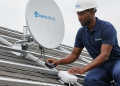
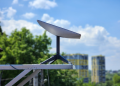
Starlink, the low-Earth-orbit satellite internet service operated by SpaceX, said on Tuesday that rural schools across Argentina had completed their first high-speed internet video call, according to a report published on 23 September by Tesla North. Students and teachers joined the call with Argentina’s Ministry of Human Capital, the government department named in the project, over classroom connections that replaced what the outlet describes as a roughly 30-kilometre trip to get online.
The call is the first visible output of a project that has been announced in stages since July: 6,000 satellite internet kits donated to rural schools, 24 months of the company’s highest-capacity service, and a further year of service paid for by ENACOM, Argentina’s communications regulator.
Key facts
- Starlink announced the video call on Tuesday, Tesla North reported, with the Ministry of Human Capital on the other end of the line.
- Students and teachers at the schools involved previously had to travel about 30 kilometres to get online, according to the same report.
- Tesla North dates the announcement that Starlink would supply 6,000 kits to rural schools nationwide — in partnership with the ministry and ENACOM — to 8 September.
- President Javier Milei, announcing an ENACOM-Starlink agreement in late July, said the company would donate 6,000 complete satellite kits plus 24 months of its highest-capacity service, with priority access of up to five terabytes per month per site, MercoPress reported.
- MercoPress reports that Argentina accounts for about 25% of Starlink’s Latin American operation, with weekly user growth of around 2%.
- No outlet has published a count of how many of the 6,000 schools are actually online.
Why it matters
The number that would settle how far this has gone is the one nobody has published. Starlink and the ministry have confirmed a video call; neither Tesla North, MercoPress nor 24/7 Wall St reports how many of the 6,000 kits are installed, how many are switched on, or when the deployment is due to be complete. Until that figure exists, the honest description is a demonstration inside a programme of 6,000 — not 6,000 schools connected.
What is documented is the size of the commitment. Each site is promised priority access of up to five terabytes a month for 24 months, according to MercoPress. Multiplied across the full 6,000 sites that is a ceiling of 30 petabytes a month — an arithmetic projection by Starlink News from the per-site allowance MercoPress reports, not a figure published by the government or the company, and one that assumes every school is live and every allowance is used. The funded runway is equally finite: 24 months donated plus a further 12 months paid by ENACOM is 36 months of service, after which none of the reports says who pays.
For 24/7 Wall St, the deployment marks Starlink’s move into public-sector education and infrastructure markets, beyond the residential and commercial customers the service was built around. The outlet argues that rural schools out of reach of conventional broadband are exactly the connectivity gap low-Earth-orbit networks are positioned to fill — and, in Argentina, one where satellite internet availability arrives years before fibre or fixed wireless plausibly could.
The timeline, and one unresolved date
Two dates are in circulation for the 6,000-school commitment, and they do not match.
MercoPress, reporting on 26 July, says Milei announced the ENACOM-Starlink agreement on a Sunday during the main event of the 138th International Livestock, Agriculture and Industry Exhibition in Buenos Aires. That announcement already contained the full shape of the deal: 6,000 rural schools with poor internet access or no connection at all, 6,000 donated kits, 24 months of service and the five-terabyte priority allowance.
Tesla North, reporting this week, dates the announcement that Starlink would supply the 6,000 kits to 8 September, in partnership with the Ministry of Human Capital and ENACOM.
The most straightforward reading is that these are two moments in the same project — a July announcement of the agreement by the president, and a September announcement of the supply arrangement involving the ministry — rather than two competing accounts of one event. But neither outlet says so, neither references the other’s date, and no published text of the agreement exists to settle it: MercoPress reported that when Milei made his announcement, neither the agreement itself nor any public statement from the company about its terms had been released. Starlink News has found no agreement text published since, and treats the discrepancy as open rather than resolved.
Musk’s amplification
24/7 Wall St reports that Elon Musk retweeted Milei’s announcement on 27 July 2026 — a date that sits with the MercoPress timeline rather than the September one — and says government and institutional contracts of this scale matter to investors tracking the Starlink business as markers of its geographic reach and its ability to win large public-sector deployments where deregulatory governments move quickly.
What it costs, and what it does not
For the schools themselves the answer is nothing for two years: MercoPress reports the kits and 24 months of service are a donation, with ENACOM covering the third year — subscription, installation, technical support and monitoring — from Argentina’s Universal Service Fund, which is financed by contributions from the telecommunications sector and earmarked for areas commercial providers do not reach. ENACOM sources gave the outlet that funding detail.
None of the three reports gives a current residential Starlink price for Argentina, and Starlink News has not independently verified one, so we are not publishing a figure. Readers comparing what households pay elsewhere in the company’s markets can see how the service is priced and licensed in Zimbabwe, where the service is sold under a POTRAZ licence; Argentine pricing and availability should be checked on the company’s own local order page, which is the only source that tracks it in real time.
Background: why Argentina
MercoPress reports that Starlink accelerated its expansion in Argentina after the current government eased the regulatory framework for satellite services, and that the company now operates across the entire territory. The outlet also notes the political relationship behind the deal: Milei and Musk met in February 2025 in the United States and have kept in frequent contact since, while Tesla has formally incorporated in Argentina and appointed its first manager for Argentina and Uruguay.
MercoPress puts Argentina at about 25% of Starlink’s Latin American operation, growing at roughly 2% of users a week. The outlet offers no comparison country, so the share cannot be ranked against Brazil, Chile or Mexico from that reporting alone. Two rough bearings are available from figures in the same report. Set the 25% share against Milei’s claim of three million Argentine users and it implies a regional base of around 12 million — an inference by Starlink News from two numbers MercoPress presents separately, resting on a user figure the president asserted and SpaceX has not confirmed. And 2% a week compounded, if it held, would double the user base in about 35 weeks; early-market growth rates rarely hold for that long, which is the caveat the figure needs and does not come with.
The growth has a visible cost. MercoPress reports that most Argentine customers are households and that this concentration has produced episodes of saturation in greater Buenos Aires, Córdoba and the Vaca Muerta region. The schools are promised priority access, according to the same report — the two facts sit side by side in the coverage without any outlet, or the company, explaining how 6,000 prioritised sites will interact with congestion elsewhere on the network.
In the same speech, according to MercoPress, Milei projected an expansion of agricultural output and said the country could double its grain harvest, but announced no decisions on export duties.
What else Starlink has switched on
Argentina is the latest stop in what Tesla North calls a busy stretch for the service. The outlet says Starlink recently switched on residential service in the United Arab Emirates, launched Starlink Mobile in Costa Rica, and brought cabin Wi-Fi to Austrian Airlines flights out of Vienna — the in-flight side of the business covered in our guide to Starlink for aviation.
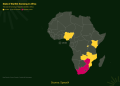
The Argentine schools model — one terminal per building, funded by a regulator — is only one way operators are using low-Earth-orbit capacity to reach rural users. A contrasting approach is a rural backhaul pilot in Nigeria, where Starlink carries traffic for a mobile site instead of connecting each premises directly, so that existing phones rather than new dishes pick up the coverage. None of the three reports on Argentina addresses African markets, and no comparable school programme has been announced in any of them.
Frequently Asked Questions
How many of the 6,000 Argentine schools are connected so far?
None of the three reports reviewed for this article gives a figure. Tesla North reported that rural schools completed a first high-speed video call with the Ministry of Human Capital, but neither it, MercoPress nor 24/7 Wall St says how many of the 6,000 kits have been installed or when the full deployment is due to finish. Starlink News has not seen a published installation count from Starlink or ENACOM.
How much data does each school get?
According to MercoPress, President Javier Milei said the donation covers 24 months of Starlink’s highest-capacity service with priority access of up to five terabytes per month per site. Milei said of that allowance: "Yes, it’s a huge amount. Thank you, Elon." Across all 6,000 sites that works out to a ceiling of 30 petabytes a month — an arithmetic projection by Starlink News from the per-site figure MercoPress reports, not a number either the government or the company has published.
Who pays for the schools’ internet once the donated service ends?
According to MercoPress, Milei said the equipment will stay at the schools when the 24 months of donated service run out, and ENACOM will then cover the cost of the service for an additional year, including the subscription, installation, technical support and monitoring. ENACOM sources told the outlet the money will come from Argentina’s Universal Service Fund, which is made up of contributions from the telecommunications sector and earmarked for extending access to areas commercial providers do not cover. That accounts for 36 months in total; none of the reports says who pays after that.
How many Starlink users does Argentina already have?
Milei said the school project adds to the three million users who, according to him, already use the company’s services in Argentina, MercoPress reported. The figure is the president’s own and Starlink News has not seen it confirmed by SpaceX. The same report says Argentina ranks among the countries with the highest Starlink penetration and accounts for about 25% of the company’s Latin American operation.
Were the terms of the Starlink-ENACOM agreement published?
No. MercoPress reported that at the time of Milei’s announcement, neither the text of the agreement nor any public statement from the company about its terms had been released. Starlink News has not found a published contract since.
Has Starlink had service problems in Argentina?
MercoPress reported that most Argentine customers are households, and that this concentration has led to episodes of saturation in certain areas, naming greater Buenos Aires, Córdoba and the Vaca Muerta region. The schools in the ENACOM project are to receive priority access, according to the same report, though neither MercoPress nor the other outlets link the two points.
Follow Starlink News on Google. Make us a preferred source to see more of our reporting in Google search results.



![Using Your Own Router with Starlink: Bypass Mode [2026]](https://starlink-news.com/wp-content/uploads/2026/09/using-your-own-router-with-starlink-bypass-mode-20-f6c09f95-75x75.png)