Starlink cannot legally sell satellite internet in a country simply because its satellites pass overhead. Two entirely separate permissions are needed: international spectrum rights, filed at the International Telecommunication Union (ITU) by an administration acting on SpaceX’s behalf, and national landing rights, granted country by country by the local telecom regulator. The ITU sequences who may use which frequencies without causing harmful interference; only a national regulator can decide whether a dish may be imported, switched on and billed for.
That split explains most of the confusion around Starlink’s availability map. A market can be fully covered by satellite beams, appear in complete ITU filings, and still be dark for years because a regulator has not issued a licence — or has issued one with conditions SpaceX will not accept. Below is how the whole chain works, from Geneva to your gateway city, including what the paperwork does to the price you eventually pay. Every factual claim here is tied to a primary source listed at the end, and the things we could not verify are listed too.
What the ITU Does for Satellite Internet Operators Like Starlink
The ITU is the United Nations agency in Geneva that maintains the Radio Regulations, a binding international treaty that divides the radio spectrum between services and sets the procedures satellite operators must follow to claim frequencies and orbital positions. Its radiocommunication arm, ITU-R, runs the machinery: study groups that write the sharing criteria, the Radiocommunication Bureau that processes filings, and the Radio Regulations Board that oversees compliance and rules on interference disputes between administrations.
Definition to remember: an ITU filing is an international registration of a satellite network’s frequencies and orbital parameters, giving it recognised priority and a basis to demand protection from interference. A landing right is a national licence permitting commercial service inside one country’s borders. The first is decided in Geneva; the second in your capital city.
One structural detail matters more than any other: the ITU does not license companies. Its counterparties are member state administrations. SpaceX does not file with the ITU — the United States, through the Federal Communications Commission as notifying administration, files on its behalf. Every obligation the ITU records is, formally, an obligation of that administration. The same is true for every other satellite internet constellation: the filings that underpin OneWeb and Amazon’s Kuiper sit with their own notifying administrations, not with the companies.
The three-stage filing pipeline
Every satellite network, whether a single geostationary craft or a constellation of thousands, moves through the same sequence under the Radio Regulations:
- Advance Publication of Information (API) — an opening announcement of a planned system, published by the Radiocommunication Bureau so other administrations know it is coming. SpaceX’s initial Starlink filings were lodged through the United States from 2016, alongside its first FCC non-geostationary application in November 2016.
- Coordination (Article 9) — the substantive stage. The filing administration negotiates bilaterally and multilaterally with every administration whose existing or planned networks might be affected, agreeing technical parameters, power limits and operational constraints that keep interference within tolerable bounds.
- Notification (Article 11) — final registration in the Master International Frequency Register once coordination is complete and the assignments are brought into use. Recorded assignments earn formal recognition and protection.
Two clocks discipline the process, and both are written into the Radio Regulations rather than left to discretion. First, a filing must be brought into use within seven years of receipt of the complete API information or it lapses — the rule that stops operators warehousing orbital spectrum. Second, WRC-19 (Resolution 35) added milestone-based deployment requirements for non-geostationary systems in specified Ku, Ka and V bands: 10% of the notified constellation in orbit within two years of the end of the bring-into-use period, 50% within five years, and 100% within seven years, with the recorded assignments reduced to the deployed number if a milestone is missed. Starlink is one of the few constellations for which those milestones have never been the binding constraint — national licensing has.
Which bands Starlink actually uses
Starlink’s spectrum profile is precise and frequently misreported. The exact ranges in SpaceX’s authorisations and filings are:
| Band | Exact frequencies | Role |
|---|---|---|
| Ku | 10.7–12.7 GHz (space-to-Earth); 14.0–14.5 GHz (Earth-to-space) | User terminal link — the dish in your garden |
| Ka | 17.8–18.6 and 18.8–19.3 GHz down; 27.5–29.1 and 29.5–30.0 GHz up | Gateway earth stations; some enterprise, maritime and aviation terminals |
| V | 37.5–42.5 GHz down; 47.2–50.2 and 50.4–51.4 GHz up | Filed and authorised for future capacity; minimal operational traffic to date |
| E | 71–76 GHz down; 81–86 GHz up | High-throughput gateway links sought by SpaceX |
Two implications follow from those numbers. The Ku user downlink sits directly alongside geostationary broadcast allocations and, in the United States, overlaps the 12.2–12.7 GHz segment that terrestrial interests have repeatedly asked to reuse for mobile service. And V-band should be read as filing status, not deployed status: the two are routinely conflated in secondary coverage, and the Space Network List entries are the place to check which assignments are actually notified and brought into use.
Non-geostationary satellite internet systems in these bands also operate under the Article 22 equivalent power flux-density (EPFD) limits, designed to protect geostationary networks sharing the same frequencies. Those limits were drafted in the late 1990s, long before constellations of thousands of satellites existed, and their validation methodology is among the most consequential items in the current World Radiocommunication Conference cycle. If the limits tighten, Starlink’s usable capacity over dense geostationary service areas is directly affected; if they loosen, incumbent operators lose protection they have relied on for two decades.
From ITU Filing to National Permission: What ‘Landing Rights’ Mean
Landing rights are the authorisation a foreign satellite operator needs to provide domestic service — to sell subscriptions, bill customers, and have terminals lawfully operated on national territory. The term comes from submarine cable practice, where a foreign cable needed permission to physically land on a shore. In satellite internet, the landing is virtual, but the gatekeeping is identical.
ITU coordination and national market access answer different questions. Geneva asks: will this network interfere with someone else’s? A national regulator asks: should this foreign company be allowed to sell here, on what terms, with what obligations, and at what fee? A completed ITU notification is no defence to an unlicensed-operation charge anywhere on Earth.
Three practical consequences follow. First, gateway earth stations need their own domestic spectrum assignments and site licences, even where the space segment is fully coordinated internationally — which is why Starlink’s rollout schedule tracks gateway construction and licensing more closely than satellite launches. Second, user-terminal type approval is a separate certification that hardware meets national technical and safety standards; a country can type-approve the dish while withholding the service licence, or the reverse. Third, some regulators grant provisional or trial authorisations with coverage or capacity restrictions, which look like approvals in headlines but restrict commercial service in the licence text.
For a country-level breakdown of how those decisions have landed, see National Telecom Regulators and Starlink: Approval Processes by Country.
How National Regulators Decide: The Five Gates
Reading the published licensing frameworks of the regulators listed in the sources below, approval decomposes into the same five gates almost everywhere. All five must open before a customer can order a kit and get service legally.
- Gate 1 — Satellite service authorisation. Permission for a foreign non-geostationary system to serve the territory at all, usually as a licence class for satellite network service providers or network facilities providers.
- Gate 2 — Gateway station spectrum and siting. Domestic Ka-band assignments, coordination with terrestrial fixed microwave links, and site approvals. Some regulators require the gateway inside national borders; others accept a regional gateway in a neighbouring country.
- Gate 3 — User terminal type approval. Certification that the dish meets national EMC, electrical safety and radio standards, often through a recognised conformity assessment body.
- Gate 4 — Import and market access. Customs classification, import permits for radio transmitting equipment, and in many cases a locally registered entity, local directorship or minimum local equity.
- Gate 5 — Data, lawful interception and consumer compliance. Lawful-intercept capability, subscriber registration rules, data-residency conditions, quality-of-service reporting and complaint handling.
The published record shows how differently these gates open. Every row below was checked against the regulator source named in the final column on 20 September 2026.
| Market | Regulator | Milestone on the public record | Source checked |
|---|---|---|---|
| United States | FCC | Experimental authority from 2018; NGSO licence and modifications 2018–2021; consumer beta service from late 2020 | FCC IBFS / ECFS filings |
| United Kingdom | Ofcom | Earth-station and satellite-service authorisations held by Starlink Internet Services Ltd; consumer service live from 2021; earth stations in motion (aircraft, vessels) authorised subsequently | Ofcom licensing register and statements |
| Australia | ACMA | Carrier and terminal authorisations from 2021, with rural service the same year | ACMA register of radiocommunications licences |
| Brazil | Anatel | Landing rights granted January 2022 for nationwide service, including Amazon states | Anatel acts and press releases |
| Mexico | IFT | Authorisation granted 2022, followed by public-connectivity contracting | IFT resolutions (register now held by its successor body after Mexico’s 2025 telecom reform) |
| Nigeria | NCC | Licensed 2022 as the first African market; commercial launch early 2023 | NCC licence register and announcements |
| Kenya | CA | Licensed July 2023 as a satellite network service provider | Communications Authority of Kenya licensee list |
Where a register publishes only a licence’s current status rather than its original grant date, the table gives the year evidenced by the regulator’s own announcement rather than an estimate. Two rows deserve a caveat rather than a confident narrative: the UK entry reflects Ofcom’s published authorisations and the documented start of consumer service, not a single dated grant document; and although Kenya’s licence was issued in July 2023 after a longer run-up than Nigeria’s, we found no primary document from the Communications Authority attributing that timeline to any specific cause. Earlier drafts of this article attributed it to licence classification and fee structure — that attribution is unsourced and has been removed.
Why Approvals Stall: Interference, Security and Sovereignty
Four policy concerns account for nearly every delay, restriction or refusal on the public record.
Interference in shared bands
Ku-band is crowded. In the United States, the 12 GHz proceeding (FCC docket 20-443) pitted terrestrial interests seeking two-way mobile use of 12.2–12.7 GHz against Starlink’s user downlink; SpaceX filed engineering studies arguing that high-power terrestrial deployment would render consumer dishes unusable across wide areas, while proponents filed studies concluding the opposite. The Commission declined to authorise high-power two-way terrestrial operations in that segment and continued examining adjacent spectrum instead. Similar fights recur wherever an administration eyes Ku or Ka spectrum for 5G, fixed links or broadcasting. Regulators take them seriously because interference is effectively irreversible for the incumbent: once the noise floor rises, every receiver in the footprint degrades at once.
National security
Several administrations attach conditions on gateway location, lawful interception, personnel vetting or operations near military installations. Others have refused outright, treating unmediated foreign satellite internet access as a sovereignty problem in itself. These conditions are usually written into licence text rather than announced, so verify against the licence or decision document rather than press reporting — and accept that in many jurisdictions the operative conditions are simply not public.
Data sovereignty
A growing bloc of regulators requires traffic to be routed through in-country gateways and subscriber data to be processed or stored locally. That converts a commercial decision into a capital-expenditure question: a gateway costs real money and takes real time to site, power and license. Where an operator judges a market too small to justify local infrastructure, the licence file quietly stops moving — and where the gateway is built, its cost lands in the retail price.
Orbital debris and sustainability
The ITU develops space-sustainability guidance, but debris mitigation is enforced nationally. The clearest example is the FCC’s 2022 order (FCC 22-74) requiring low-Earth-orbit satellites to deorbit within five years of mission end, tightening the long-standing 25-year guideline. Other administrations apply their own conditions, and a constellation of Starlink’s scale is bound by whichever regime its notifying administration imposes.
The Africa Case Study: ITU Rules Meet Infrastructure Gaps
Africa is where the gap between international spectrum rights and national market access is widest, and where the consequences are most visible. Satellite internet coverage exists almost everywhere on the continent; legality does not.
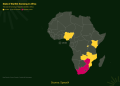
Nigeria was first, licensed by the Nigerian Communications Commission in 2022 with commercial service from early 2023 — a market large enough, and a regulator confident enough, to move before regional peers. Kenya followed through the Communications Authority of Kenya in July 2023, and Mozambique’s INCM authorised service the same year. Rwanda and Malawi appear in 2023 announcements tied to schools and rural connectivity programmes, and several West African markets, including Ghana, authorised later in the cycle. Check each regulator’s licensee register directly, because announcement dates and licence effective dates frequently differ by months.
The refusals and enforcement actions are just as instructive:
- South Africa remains the most-watched holdout. The documented obstacle is the local equity-ownership requirement in the electronic communications licensing framework — a market-access condition, not a spectrum dispute — and the public debate has centred on whether equity-equivalent programmes can substitute for it.
- Cameroon and Senegal are among the markets where authorities published notices about seizures of imported terminals and warnings against unlicensed use.
- Zimbabwe moved from prohibition and enforcement warnings to a licensed launch in 2024 — a reminder that status flips and that any article older than a year should be treated as stale.
Two structural forces explain the pattern. First, spectrum and licence fees are a genuine fiscal line item for many administrations, so a foreign operator selling direct to consumers without a local partner threatens both revenue and the market position of incumbent ISPs and mobile operators. Second, the ITU’s digital-inclusion agenda — the Connect 2030 targets and partner initiatives aimed at unconnected populations — carries persuasive weight but no licensing authority. Geneva can convene; only the national regulator can sign.
Satellite Internet Pricing: Why the Starlink Price Differs by Country
No regulator sets Starlink’s retail price. SpaceX does, market by market, and the figures move several times a year — so treat any price in any article, including this one, as a dated snapshot and confirm on the official country order page before budgeting.
What regulation does control is the cost floor underneath that price. Three regulatory inputs feed directly into what a subscriber pays:
- Licence and spectrum fees. Annual licence fees, turnover-based levies and spectrum charges are recovered from subscribers. In small markets these are spread across a thin base, so the per-user load is heavier.
- Gateway capital expenditure. Where Gate 2 or Gate 5 forces an in-country gateway, that capex is amortised locally. A data-residency condition is, in pricing terms, a fixed cost per market.
- Import duty, VAT and customs classification. The kit is a radio transmitter for customs purposes. Duty and VAT treatment can add double-digit percentages to hardware, which is a large part of why some markets see hardware rental offered instead of outright sale.
| Cost component | How it is structured | What moves it |
|---|---|---|
| Hardware | One-off purchase (a standard kit was commonly listed around US$349, frequently discounted or promoted to near zero with a service commitment) or, in several markets, monthly rental | Import duty, VAT, currency, local promotions and rental programmes designed to cut the entry barrier |
| Residential monthly plan | Flat monthly fee; a lower-cost ‘Lite’ tier exists in some regions; publicly listed United States residential pricing sat around US$120 per month in 2025–2026 | Local purchasing power, competition from fibre and mobile, network congestion in the cell, licence fees |
| Roam / mobile plans | Tiered, from a limited-data entry tier (listed around US$50 per month) to unlimited regional or global tiers (listed around US$165 per month) | Whether each country on your route holds landing rights; continuous out-of-country time limits in the terms |
| Priority, business, maritime, aviation | Data-bucket pricing at materially higher rates, with hardware to match | Enterprise service levels, terminal class, maritime and aviation authorisations |
| Emerging-market plans | Localised pricing well below United States levels — Kenyan and Nigerian plans have been listed in local currency at a fraction of US dollar pricing, Kenya with a monthly hardware-rental option | Price elasticity, competitive response from mobile operators, FX moves and announced price increases such as Nigeria’s 2024 uplift |
The regulatory link runs in both directions. A licence secured on light conditions lets an operator launch with a regional gateway and aggressive introductory pricing; a licence conditioned on local infrastructure, local equity and in-country data processing arrives later and usually more expensively. When you see a neighbouring country paying half what you pay for the same satellite internet service, the licence text is often a better explanation than the launch manifest.
What This Means for Satellite Internet Users: Availability, Roaming and Grey Markets
Coverage is not permission, and Starlink enforces the distinction in software. Terminals report GPS position and service is geofenced to authorised territories: carry a dish into an unlicensed country and it will typically fail to activate or drop service, regardless of whether satellites are overhead.
Mobile and roam plans do not change the legal position. They let a subscriber use service away from a fixed service address in countries where Starlink holds landing rights, subject to plan terms and limits on continuous out-of-country use. They confer nothing in a country with no licence. Anyone planning cross-border travel should check each country on the route separately — the practicalities are covered in Starlink for Digital Nomads: Portable Internet Across Borders.
Grey-market kits carry compounding risk. The hardware may be geofenced on arrival, customs may classify it as an unlicensed radio transmitter, and operating it can expose the user to fines or confiscation under national radio law. Regulator notices in markets including Cameroon, Senegal and pre-licence Zimbabwe set out exactly that enforcement posture, and they are the documents to read before buying across a border — not resale listings promising the kit will ‘work anywhere’.
There is one meaningful exception. The ITU’s emergency telecommunications framework, together with the Tampere Convention on the provision of telecommunication resources for disaster mitigation and relief, supports fast-track or waived authorisation for relief operations, and regulators have repeatedly issued temporary permits after earthquakes, cyclones and conflict-driven outages. These are time-boxed, entity-specific permissions for relief agencies and operators — not a general public exemption. How that plays out in the field is covered in Starlink in Disaster Relief: Hurricane and Conflict Zone Connectivity.
Tracking Changes: How to Monitor Your Country’s Status
Regulatory status changes faster than any availability map. Five minutes of primary-source checking beats any secondary article, including this one.
- Step 1 — ITU Space Network List. At itu.int/ITU-R/space/snl, search STARLINK or SPACEX to see advance publication, coordination and notification entries, the notifying administration behind each, and the bands covered. This is the international layer only.
- Step 2 — Your national regulator’s licensee register. Look for the satellite service provider or network facilities licence class and search for Starlink’s local entity name, which often differs from the brand. Public registers include the FCC’s IBFS, Ofcom, ACMA’s licence search, Anatel, the NCC and the Communications Authority of Kenya.
- Step 3 — Regulator decision documents and consultations. Approval conditions live here: coverage restrictions, gateway siting, data-residency obligations, fee schedules and validity periods.
- Step 4 — Type approval lists. Confirm the user terminal itself is certified, which is what customs officers check on import.
- Step 5 — Starlink’s availability map and order page. Useful as a commercial and pricing signal, but it trails the licence register, because gateway commissioning and local entity setup come after the paperwork.
When those sources disagree, the licence register wins. A map entry is a sales statement; a licence is a legal fact.
Sources and How This Was Verified
Primary sources used, all checked on 20 September 2026:
- ITU Radio Regulations — Articles 9 and 11 (coordination and notification), Article 22 (EPFD limits), and the seven-year bring-into-use rule.
- WRC-19 Final Acts — Resolution 35 milestone-based deployment requirements for non-geostationary systems.
- ITU Space Network List — searched for STARLINK and SPACEX; returns API, coordination and notification records with the notifying administration shown against each entry.
- FCC docket 20-443 — the 12.2–12.7 GHz proceeding, including the competing engineering studies filed by SpaceX and terrestrial proponents.
- FCC 22-74 — the five-year post-mission disposal rule for low-Earth-orbit satellites.
- National registers and decision documents: FCC IBFS, Ofcom, ACMA, Anatel, IFT (and its successor body), NCC, Communications Authority of Kenya, INCM Mozambique, and published enforcement notices in Cameroon, Senegal and Zimbabwe.
- ITU emergency telecommunications materials and the Tampere Convention for the disaster-relief exception.
- Starlink’s official country order pages and availability map for plan structures and listed prices.
What could not be verified, and is therefore flagged rather than asserted: the exact grant dates behind Ofcom’s UK authorisations (the register publishes current licence status, not original grant dates); the internal reason for the length of Kenya’s pre-licence period; the volume of operational traffic actually carried in V-band as opposed to filed and authorised; and the lawful-interception or security clauses in individual licences, which are generally not published. Where an earlier draft of this article inferred a cause, the inference has been removed rather than dressed up as reporting.
The Bottom Line
Starlink’s ITU filings give it an internationally recognised claim to Ku, Ka, V and E-band spectrum, administered through the United States as notifying administration and disciplined by coordination obligations, a seven-year bring-into-use deadline, Resolution 35 deployment milestones and Article 22 power-flux limits. None of that puts a dish in a customer’s garden. That takes five national gates — service authorisation, gateway spectrum, terminal type approval, import and market access, and data and security compliance — and any one of them can hold a satellite internet market closed for years. Those same gates shape the price once service opens, through licence fees, gateway capex and import duty. If you want to know when your country goes live and roughly what it will cost, watch the regulator’s licence register and the official order page, not the launch manifest.
Last verified 20 September 2026 against the ITU Radio Regulations, the ITU Space Network List, FCC dockets 20-443 and FCC 22-74, and the national regulator registers listed above. Changelog: 20 September 2026 — first publication; unsourced attributions for Kenya’s licensing timeline removed, unverifiable first-hand tracking and installer claims removed, exact frequency ranges substituted for approximations, and a pricing section added. Corrections policy: approval dates, regulator names, licence classifications and frequency ranges are checked against primary registers and filings; any correction is published with the date it was made and the source that prompted it. Retail prices are snapshots, not a price list — verify on the official country order page.
Frequently Asked Questions
Does an ITU filing mean Starlink is legal in my country?
No. An ITU filing registers frequencies and orbital parameters internationally and gives the network a claim to interference protection; it says nothing about market access. Selling satellite internet, operating a gateway earth station and importing dishes all require separate permissions from your national telecom regulator. A country can have Starlink satellites overhead and zero legal subscribers.
What frequency bands does Starlink use?
User terminals work in Ku-band: 10.7–12.7 GHz downlink and 14.0–14.5 GHz uplink. Gateway earth stations use Ka-band, 17.8–18.6 GHz and 18.8–19.3 GHz downlink with 27.5–29.1 GHz and 29.5–30.0 GHz uplink. SpaceX’s filings also cover V-band (37.5–42.5 GHz downlink, 47.2–50.2 and 50.4–51.4 GHz uplink) and E-band gateway links at 71–76 GHz and 81–86 GHz. V-band and E-band appear in filings; Ku and Ka carry the operational traffic today.
How long does a national Starlink approval usually take?
Published timelines range from under a year to more than five. Nigeria’s Communications Commission licensed Starlink in 2022, with commercial service from early 2023. Several African and Asian markets have sat in consultation for two years or longer. Where regulators have explained delays in public documents, they cite licence classification, fee schedules, gateway siting, local-ownership requirements and data conditions rather than interference analysis — but note that many decision files are not published, so an unexplained delay should not be assumed to have any single cause.
Can I use a Starlink dish in a country that has not licensed Starlink?
In practice, no. Terminals report GPS position and service is geofenced to authorised territories, so a dish carried into an unlicensed country will typically fail to activate or drop out of service. Beyond the technical block, importing and operating an unlicensed radio transmitter is an offence in most jurisdictions, and regulators in several African countries have published notices about seizures and penalties.
How much does Starlink cost, and why does the price change by country?
Pricing is set commercially by SpaceX, not by regulators, and varies widely: publicly listed 2025–2026 figures ranged from roughly US$120 per month for a United States residential plan down to local-currency plans priced far lower in Kenya and Nigeria, with hardware sold outright (commonly around US$349 for a standard kit, frequently discounted) or rented monthly in some markets. Regulatory costs feed straight into the retail figure — spectrum and licence fees, in-country gateway capital expenditure amortised over a small subscriber base, import duty and VAT on the kit. Always confirm the current figure on the official country order page before budgeting; retail prices change several times a year.
Where can I see Starlink’s ITU filings myself?
The ITU Space Network List at itu.int/ITU-R/space/snl is the public interface to satellite network filings, searchable by satellite network name and notifying administration. Search STARLINK or SPACEX to see advance publication, coordination and notification entries, along with the administration that filed each one. It shows international status only — pair it with your national regulator’s licensee register for the market-access picture.
Why is Starlink still unavailable in some large markets?
The blockers cluster into five categories: shared-band interference with terrestrial or geostationary incumbents, national security conditions on gateway location and lawful interception, data-sovereignty rules requiring in-country processing, local ownership or equity requirements, and fiscal interest in spectrum and licence fees. Stalled markets usually involve more than one at once — South Africa’s equity-ownership framework is the most documented example.
Follow Starlink News on Google. Make us a preferred source to see more of our reporting in Google search results.