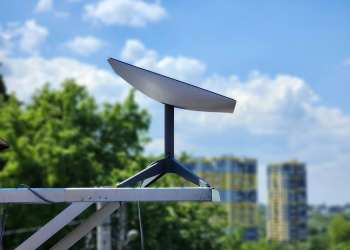
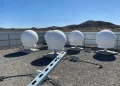
Telecoms infrastructure service provider Infratel has launched a pilot at a rural NuRAN Wireless site in Nigeria to evaluate Starlink’s low Earth orbit (LEO) satellite service as a backhaul option, Nigeria Communications Week reported on 24 September 2026. NuRAN Wireless, the Québec-headquartered rural telecommunications infrastructure company that owns the site, announced the test on 22 September through ACCESS Newswire.
Both accounts describe a single-site test with a much larger ambition attached to it: NuRAN says that if the arrangement works, it wants to repeat it across a portfolio it puts at more than 5,000 contracted sites. Everything beyond the pilot itself is, at this stage, a stated intention.
Key facts
- Backhaul is the link that carries traffic from a mobile site back into the core network; the pilot puts satellite internet capacity — Starlink’s — into that role at one selected NuRAN node in Nigeria.
- NuRAN calls it the company’s first LEO integration anywhere in its network, and a first-of-its-kind pilot for its business.
- The Starlink service is licensed and obtained through a third-party service provider arrangement. NuRAN states it has no direct contractual or commercial relationship with Starlink or SpaceX in connection with the pilot.
- The test is designed to validate performance, reliability, integration and cost efficiency at commercial scale.
- NuRAN Wireless trades as NASDAQ:NUR and FSE:1RN.
- No results, start date, duration, site name or capacity figures have been published by either company.
Why it matters
NuRAN’s pitch: backhaul sets the ceiling on rural revenue
NuRAN frames backhaul capacity as the constraint on what a rural tower can earn. In its announcement, the company says every additional megabit delivered to a NuRAN tower is a megabit it can monetise.
It also argues that the services it wants to sell next depend on that transport. Higher-capacity 4G, plus applications such as local content caching, edge compute, AI-enabled services and energy management, all require reliable data transport suited to remote markets, according to the company.
Management goes further in the same statement: where terrestrial backhaul is constrained, costly or unavailable, it says licensed LEO satellite service can transform the performance, scalability and profitability of NuRAN’s owned rural infrastructure, turning hard-to-reach sites into high-value nodes.
Those are the companies’ own forward-looking claims, issued through a newswire announcement rather than tested in public. Neither source publishes throughput, latency, availability or cost-per-megabit data from the site, and no independent party has verified the profitability or transformation language. Read the capacity-and-economics case as positioning for investors and prospective operator customers until pilot numbers appear.
Not the same business as selling dishes to households
The pilot also puts Starlink in an unfamiliar position in Africa. Here it is an input bought by an infrastructure company and resold as mobile coverage, not a subscription sold to an end user. That is a different use of the network from Starlink’s record in African consumer markets, where the service is sold dish-by-dish to households — and it means the people served by the tower need no dish, no terminal and no Starlink account of their own.
What the pilot is meant to prove
The pilot integrates NuRAN’s rural solution with high-capacity LEO connectivity. Beyond raw throughput, NuRAN says it wants to see whether LEO backhaul can accelerate 4G migration and unlock potential new revenue lines at selected rural sites, naming edge AI, local compute and NuEnergy-related services.
The four tests NuRAN has set itself
The company lists four things the trial is meant to validate — performance, reliability, integration and cost efficiency at commercial scale. The last of those is the one that decides whether the model travels: a satellite link that clears the technical bar but costs more per megabit than the revenue it enables would not survive being copied 5,000 times. Neither source states what cost level NuRAN is aiming at, or how it compares with the microwave links the company already runs.
Francis Létourneau, director and chief executive of NuRAN Wireless, said in the statement that backhaul is the key that unlocks the company’s next phase of growth, and that integrating Starlink service obtained through third-party providers with NuRAN’s own rural solution could be a step change for the business. “We have always said Starlink service is an opportunity for NuRAN, not a threat,” he said in the ACCESS Newswire announcement — a line that reads as an answer to the standing question of whether LEO satellite service competes with rural mobile networks or feeds them.
Where the blueprint could travel
Both reports describe the same next step. If the pilot works, NuRAN intends to treat it as a repeatable, copy-and-paste blueprint across markets where Starlink service is licensed and reachable through third-party service providers.
The licensing map is the gating factor
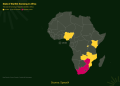
The announcement names the countries that decide how far the model can spread:
- Recently licensed: the Democratic Republic of the Congo, Côte d’Ivoire and Benin.
- Licensing in process: Cameroon, where Nigeria Communications Week says NuRAN has already deployed rural connectivity solutions.
Nigeria Communications Week reports the same list of countries where Starlink is legally available via licensed partners. NuRAN says it intends to become one of Africa’s most significant enterprise users of LEO satellite connectivity through third-party service providers across markets where it has more than 5,000 sites under contract — while adding that any scale-up is subject to the availability of suitable service-provider arrangements.
That is a double dependency, and it is worth stating plainly: the model needs both a national licence and a willing third-party provider inside that market. Either one missing stops the copy-and-paste. The map is also moving, as rival low Earth orbit operators plan their own African entries — competition that, on NuRAN’s own logic, would matter mainly as a second source of wholesale capacity rather than as a threat.
What the sources do not explain
Neither report states Starlink’s licensing status in Nigeria itself, and neither explains why Nigeria hosts the pilot while the named roll-out markets are elsewhere. Nor does either say whether the third-party provider arrangement used in Nigeria could be replicated by the same intermediary in the other countries listed.
Background on the companies
NuRAN Wireless describes itself as a rural telecommunications infrastructure company connecting remote and underserved communities across Africa, and says it is evolving from a Network-as-a-Service provider toward a full-stack digital infrastructure platform. It says it combines telecoms engineering, low-power wireless technology, renewable-energy-enabled infrastructure, site selection and field operations to address the economics of rural mobile coverage, and is developing plans to add modular edge compute nodes at select built sites.
Under the Network-as-a-Service model set out in its announcement, NuRAN finances, builds, owns, operates and maintains 2G, 3G and 4G infrastructure for mobile network operators moving beyond urban markets. Nigeria Communications Week reports it has worked with telcos including Orange and MTN, and that it expanded into Côte d’Ivoire in June 2026.
Infratel is described in both reports as a telecoms infrastructure service provider and a long-time NuRAN partner, with Tunji Alabi as managing director. Neither report details the commercial terms between the two companies for the pilot. Nigeria Communications Week attributed the disclosure of the pilot to NuRAN Wireless. Starlink News first reported the plan on 22 September, when NuRAN issued the announcement.
What is not yet known
Neither source gives a start date or duration for the pilot, the location or name of the selected site, the identity of the third-party Starlink service provider, the capacity or cost figures involved, or the mobile operator served by the site.
No results have been published. NuRAN’s statements about capacity, economics and revenue potential are the company’s own expectations rather than measured outcomes, and both reports rest on the same 22 September newswire announcement rather than on independent testing.
What would settle the open questions
Three disclosures would turn the announcement into a verifiable case: published throughput and availability figures from the site, a cost-per-megabit comparison against NuRAN’s existing microwave and TV white space links, and the naming of the licensed third-party provider so the arrangement can be checked against each market’s licensing position. Starlink News will report on any pilot results NuRAN or Infratel release.
Frequently Asked Questions
Which backhaul technologies will NuRAN keep using alongside Starlink?
The ACCESS Newswire announcement says NuRAN expects to continue using terrestrial transmission technologies, including microwave and TV white space, where line of sight and local conditions support their deployment. It says licensed LEO satellite service is intended for locations where terrestrial backhaul is constrained, costly or unavailable. NuRAN describes this as a flexible, capital-efficient “best tool for the job” model.
How big is NuRAN’s site portfolio in Africa?
NuRAN says it has more than 5,000 sites under contract, of which a portion have been built and are operating today. The company’s announcement describes a Network-as-a-Service model under which it finances, builds, owns, operates and maintains 2G, 3G and 4G mobile network infrastructure for mobile network operators expanding outside urban markets. The announcement does not break out how many of those 5,000 sites are live.
Which mobile operators does NuRAN work with?
Nigeria Communications Week reports that NuRAN has installed rural connectivity solutions for telcos including Orange and MTN. The same report says NuRAN expanded into Côte d’Ivoire in June 2026 and has also deployed rural connectivity solutions in Cameroon, where Starlink is still going through the licensing process. Neither report names the operator served by the site hosting the pilot.
Does NuRAN have a contract with SpaceX?
No. NuRAN states in the ACCESS Newswire announcement that it has no direct contractual or commercial relationship with Starlink or SpaceX in connection with the pilot. The Starlink service being tested is licensed and obtained through a third-party service provider arrangement, and NuRAN says any expansion of the model depends on suitable service-provider arrangements being available in each market.
What did Infratel say about the pilot?
In the ACCESS Newswire statement, Infratel managing director Tunji Alabi said the company values its long-standing relationship with NuRAN and the chance to support the evaluation of advanced connectivity solutions in Nigeria. He said licensed Starlink service made available through third-party service provider arrangements offers a compelling way to bring LEO satellite backhaul into live commercial networks, and that the initiative can meaningfully accelerate higher-capacity connectivity to underserved communities.
What would show the pilot has worked?
NuRAN says the test is designed to validate performance, reliability, integration and cost efficiency at commercial scale, and that a successful result would make the set-up a repeatable blueprint for other markets. Because neither source publishes target figures, thresholds or a timeline, there is no public benchmark against which the outcome can be measured yet.
Follow Starlink News on Google. Make us a preferred source to see more of our reporting in Google search results.