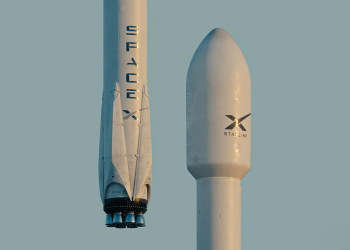
SpaceX flew Starship to orbit for the first time on Monday, 28 September, launching from its Starbase complex near Brownsville, Texas, and releasing 26 next-generation Starlink V3 satellites despite an engine that shut down early in the climb. Within a day it had become a stock story. Citi, the US bank, told clients the mission is a step toward SpaceX shares reaching $900 or more — reported by MarketWatch and relayed to us by investinglive.
For Starlink subscribers, the number that matters is not $900. It is 26 — the first batch of a satellite generation SpaceX says carries up to 10 times the data of the units it has been launching for years.
Sourcing note: the primary reporting behind this piece is Reuters (the flight profile and the splashdown), MarketWatch (Citi’s note) and FactSet (consensus forecasts). We reached all three through secondary aggregators — Proto Thema, investinglive, Oneindia and tomorrowsworldtoday — and have not seen Citi’s or Deutsche Bank’s research notes, or a SpaceX statement, directly.
Key facts
- This was Flight 14. All 13 earlier flights since 2023 stayed suborbital (Oneindia).
- The 26 V3 satellites were released one by one at about 269 km. Musk later said all had deployed and were operating normally (Oneindia).
- It was Starship’s first operational, revenue-generating payload (Oneindia).
- The mission was planned for about 10 hours and six orbits. It was cut to roughly three (Reuters, via Proto Thema).
- The programme has cost more than $15 billion to date (Oneindia, Proto Thema).
- Around two million people watched the launch on X (Proto Thema).
What it means for Starlink customers
The consumer story underneath the valuation story is capacity. SpaceX says each V3 satellite can handle up to 10 times more data than the V2 mini satellites it currently launches on Falcon 9. Falcon 9 carries 20 to 30 V2 minis per flight (Oneindia, Proto Thema).
Estimate — our calculation, not a sourced figure. Taking SpaceX’s “up to 10 times” claim at face value, Monday’s 26 V3 satellites are the rough equivalent of 260 V2 minis, or about ten Falcon 9 loads. A future Starship carrying the 60 V3 satellites Musk has described would be worth closer to 600, or twenty-plus Falcon 9 loads, in one launch. No analyst quoted in the coverage published this sum. “Up to 10 times” is a manufacturer’s ceiling, not a measured average, and none of the reports addressed the ground stations, spectrum or backhaul needed to deliver that throughput to users. Treat it as an order of magnitude only.
What the coverage does not offer is the thing subscribers ask about first. No source we found said Starlink prices would fall, that congestion charges would be dropped, or that sold-out cells would reopen in any named country because of this flight. Cheaper capacity for SpaceX is not the same as cheaper Starlink for customers, and only the first half of that equation has been reported — the argument set out in our earlier piece on why the cost of putting capacity in orbit could fall.
The only customer-facing timeline in the reporting is narrow. Tomorrowsworldtoday reports the 26 satellites must complete on-orbit checks and raise their altitudes before they carry traffic. Proto Thema reports Musk is aiming for Starship to enter regular service by the end of this year. Until the launch cadence is routine, the satellite internet market sees no change at all.
What the banks said
Citi described launch capability as the “foundational competitive advantage” that enables SpaceX’s other businesses — wording relayed by investinglive. The bank said the flight brings the company closer to unlocking the full valuation of its artificial-intelligence and connectivity units.
Near-term price targets
These are far lower than $900 and cluster tightly. Citi has $200 for the end of the year. RBC has $225. UBS rates the stock a buy at $210.
The 2030–2031 case
Citi’s $900 figure implies a valuation of about $12 trillion, more than twice the size of Nvidia today, according to investinglive. It rests on very fast growth: revenue of around $485 billion in 2030 and EBITDA of around $360 billion, against consensus of roughly $410 billion and $310 billion, then about $1 trillion in revenue for 2031 — in line with a prediction from Musk. Set against FactSet’s consensus of roughly $44 billion in 2026 sales, that is an elevenfold rise in four years. Starship is not expected to generate most of it directly, but to enable it by carrying dozens of advanced Starlink and AI satellites, with SpaceX aiming to launch thousands of rockets a year from a planned spaceport in Louisiana.
What the share price actually did
Investinglive reported that SpaceX shares, under the ticker SPCX, rose about 2.5% on Tuesday against a market capitalisation of around $2 trillion. Proto Thema reports the company listed in a record-breaking IPO in June, which made it the sixth-most valuable company in the United States. We could not independently verify the ticker, the intraday move or the capitalisation, so the $2 trillion should be read as investinglive’s figure rather than a confirmed close. Investinglive’s own reading was that a modest gain suggests investors treated the launch as a confidence boost rather than a re-rating — a point that also ran through the recent unlock of SpaceX shares.
The engine that quit
One Raptor vacuum engine shut down early and shaped everything that followed, including the shortened mission. The accounts differ in detail. Oneindia says one of Starship’s three engines shut down soon after separation from the Super Heavy booster. Tomorrowsworldtoday says a vacuum engine quit during the climb and the vehicle burned its remaining five engines longer to make up the lost thrust.
SpaceX spokesman Dan Huot told the live broadcast that orbit was off. “The team decided not to attempt orbital insertion,” he said, per Proto Thema. Engineers then reversed that call after concluding a burn was still possible. Tomorrowsworldtoday reports the three sea-level engines checked out healthy and a single burn put Starship into orbit. The booster fired 33 Raptor 3 engines on ascent and 31 on the boostback burn, which was deliberately designed to burn off remaining liquid oxygen and test the booster’s limits. Our flight-by-flight account of the engine failure has the full sequence.
The anomaly is also the analysts’ main reservation. Deutsche Bank said SpaceX must establish what is behind the booster’s engine issues and find the root cause of the early vacuum-engine shutdown — a fault that nearly ended the orbital attempt, according to investinglive. UBS expects at least one more Starship flight before the end of the year, and thinks SpaceX will try to catch the vehicle with the launch tower’s chopstick arms on the next mission. UBS called that catch key to rapid reusability, and reusability is what the entire capacity argument depends on.
What happened at splashdown
Two vehicles came down in two oceans, which is why three outlets appear to describe three endings.
The Super Heavy booster splashed down in the Gulf. Tomorrowsworldtoday reports the team then deliberately triggered the flight termination system to prove the safety hardware works.
The Starship upper stage came down in the Pacific and was destroyed. That is Reuters’ account, carried by Proto Thema, and it is the best-sourced version available to us. Oneindia’s description — the upper stage engulfed in flames at touchdown and falling onto its side — fits the same event. We have found no SpaceX statement confirming either ending.
What the V3 satellites add
Beyond raw throughput, Proto Thema reports that analysts put Monday’s V3 batch at hundreds of millions of dollars in projected revenue for the Starlink division, based on the extra customer capacity it adds. That is the mechanism linking a test flight to a $900 price target. The satellites are the product, Starship is the delivery system, and V3 is the first generation sized for a rocket that had never flown an operational payload until this week.
The context is a programme that has run late. Musk once predicted Starship would reach orbit in 2022 and launch satellites in 2023, Proto Thema reports, and wrote on X on Sunday that the vehicle is two to three years from flying every hour. NASA is counting on a version of Starship for its Artemis Moon missions. Oneindia’s conclusion is blunter: SpaceX now has to turn a breakthrough into a dependable launch system.
Frequently Asked Questions
Will this launch make Starlink cheaper or available in more countries?
No source we reviewed said retail Starlink prices would fall or that new markets would open because of this flight. Two separate things are being discussed: what it costs SpaceX to put capacity in orbit, and what it charges subscribers. Only the first has been reported. SpaceX says each V3 satellite can carry up to 10 times the data of the V2 mini units Falcon 9 launches today, and analysts cited by Proto Thema value Monday’s batch at hundreds of millions of dollars in projected Starlink revenue from the extra customer capacity. More capacity over a region is normally what lets an operator lift speeds, reopen sold-out cells and add subscribers — but no source has attached a date, a country or a price to that.
When will the 26 new satellites start carrying customer traffic?
Not immediately. Tomorrowsworldtoday reports SpaceX made contact with each satellite after deployment using laser links, ground stations and user terminals, and that the satellites must run on-orbit checks and raise their altitudes before they begin serving customers. No source we found gave an in-service date.
How many Starlink V3 satellites does SpaceX want on each Starship launch?
Elon Musk has said the plan is about 60 V3 satellites per launch once Starship enters regular service, according to Oneindia. Proto Thema reports he is now targeting regular service by the end of this year. Falcon 9 currently carries 20 to 30 V2 mini satellites per flight.
What happened to the rocket at the end of the flight?
Two vehicles came down in two oceans, which explains why the accounts sound contradictory. The Super Heavy booster splashed down in the Gulf; Tomorrowsworldtoday reports the team then deliberately triggered the flight termination system to prove the safety hardware works. The Starship upper stage came down in the Pacific and was destroyed, according to Reuters as carried by Proto Thema — the best-sourced account available to us. Oneindia’s description of the upper stage in flames and falling on its side is consistent with that. SpaceX has not issued a statement we have seen confirming either ending.
What does Wall Street expect SpaceX to earn this year?
FactSet consensus, as cited by investinglive, has analysts expecting roughly $44 billion in 2026 sales and about $21 billion in EBITDA, an adjusted profit measure that excludes certain costs. Citi’s long-term forecasts sit far above those figures.
Follow Starlink News on Google. Make us a preferred source to see more of our reporting in Google search results.