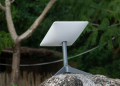
PeakDo, a Chinese accessory maker that builds power banks for SpaceX’s smallest satellite dish, has put its third-generation Starlink Mini battery on sale. The LinkPower 3 was reported as available to buy in July 2026 by notebookcheck, months after The Verge reviewed the LinkPower 2 from a converted van in the Pyrenees.
Key facts
- The headline new feature is Wi-Fi control and monitoring alongside Bluetooth and the on-device smart display; PeakDo says Wi-Fi gives better range and lets owners check the battery from anywhere with an internet connection.
- Ports carry over: a magnetic DC input that takes the original Starlink Mini adapter, a standard DC input, and a two-way USB-C port rated 65W out and 100W in.
- PeakDo cites an IP65 dust and water resistance rating, magnetic plates for heat dissipation and tripod support.
- notebookcheck judged the changes so small that “LinkPower 2 Plus is a more fitting name.”
How the three models compare
| Model | Price | Claimed runtime | Cell | Independently tested runtime |
|---|---|---|---|---|
| LinkPower 1 | $119 at launch; still sold at $159 (The Verge) | 4.5+ hours (notebookcheck) | 99Wh / 27,500mAh | About an hour less than the LinkPower 2 (The Verge, tested the previous summer) |
| LinkPower 2 | $219 at launch (The Verge); $217.55 on Amazon in July 2026 (notebookcheck) | 5+ hours | 99Wh / 27,500mAh | About 5 hours 30 minutes (The Verge) |
| LinkPower 3 | $289 list, discounted to $249 in July 2026 (notebookcheck) | 5.5+ hours | 99Wh / 27,500mAh | Not yet tested |
The cell is unchanged across all three generations, notebookcheck reports.
Why it matters
Where Starlink availability has already arrived, the remaining limit on using a Mini away from a building is power. The Verge ran its LinkPower 2 test from a converted van, including on the dashboard while crossing remote mountain passes — the kind of off-grid satellite internet use the packs are built for, alongside campsites, disaster relief posts and rural sites with no grid connection.
The terms attached to that portability are a separate cost, and Starlink News has covered them, including South Africa’s 30-day roaming cut and the licensing argument sharpened by Nigeria’s 98,642 Starlink users. None of the four reports on the LinkPower line give African prices or distributors.
What the hardware does
The battery slots into the back of the Starlink Mini like a standard SpaceX mount and connects with a short DC-to-DC barrel cable, The Verge reports, which is what makes the dish genuinely wireless.
Cooling in these units is passive. Geeky Gadgets describes a full metal heat sink on the LinkPower 2 to limit overheating during long sessions, while notebookcheck lists magnetic plates for faster heat dissipation on the LinkPower 3.
Bypass and breakaway
Both the LinkPower 2 and 3 include a bypass mode, which notebookcheck describes as the Starlink Mini drawing power from the external source while the pack itself charges. The Verge says this reduces wear on the battery and keeps temperatures down without detaching it each time. The LinkPower 2 also added a breakaway magnetic charging dongle in the box, which The Verge says could save a dish from a fall if the cable is snagged.
What testing showed
On a sunny day, The Verge attached a small folding solar panel producing a steady 7.3W to the USB-C input and pushed the Starlink Mini past seven hours. The reviewer’s dish averaged about 18W in rural locations, and vehicle USB-C jacks supplying 28W offset that on the dashboard.
Charging speeds differed by port in that test: USB-C fastest, then 57W over the DC barrel jack and 55W over the magnetic dongle.
The LinkPower 2 figure in the table above is the only independently measured runtime in any of the four reports. PeakDo’s 5.5+ hours for the LinkPower 3 is a manufacturer claim against an unchanged cell.
Prices and dates do not line up
The four reports disagree. The conflicts, and how Starlink News weighs them:
- LinkPower 2 price. The Verge gives $219 at launch in March. notebookcheck cites $217.55 on Amazon in July. Four months apart, those read as the same price rather than a contradiction.
- LinkPower 3 price. notebookcheck lists $289 and calls the $249 discounted price “$20 more” than the LinkPower 2. Treat $289 as list and $249 as a July street price that may since have moved.
- Launch date. notebookcheck dates the LinkPower 2 to April 2026. Geeky Gadgets had published a feature on it on 1 March, and The Verge’s review ran on 21 March.
- First-generation runtime. Geeky Gadgets says four hours. notebookcheck says over four hours in one place and 4.5+ hours in its comparison, which matches PeakDo’s own spec sheet; the flat four hours reads as a rounded figure.
notebookcheck’s July report is the most recent of the four, so its numbers are the better guide. Check the seller before quoting any price here.
The Verge’s verdict was to buy the cheaper first-generation unit unless a reader specifically needs the extra hour, the breakaway dongle or bypass. notebookcheck notes PeakDo charges extra for accessories such as a car charger and suction mounts.
The Mini 2 question
notebookcheck cautions that the LinkPower range probably will not suit the upcoming Starlink Mini 2, which it says is rumoured to carry a built-in battery. PC Magazine reported on 20 July 2026 that a “Mini 2” dish with a built-in battery had appeared in Starlink firmware. SpaceX has announced no such product in any of these four reports, and firmware references are not a release date.
Limits of this report
Neither PeakDo nor SpaceX was contacted for comment on LinkPower 3 pricing or the Mini 2 firmware reference, and none of the four outlets was approached about the inconsistencies in their figures. Everything above comes from published secondary reporting, and the discrepancies are weighed by recency rather than resolved by the manufacturer.
Frequently Asked Questions
Can I run a Starlink Mini from an ordinary USB-C power bank instead?
Not from a small one. The Verge reports that without a LinkPower battery attached, the Starlink Mini must be plugged into an AC jack or a power bank capable of 100W (20V/5A), citing Starlink’s own warning that the dish “will not work with USB PD ratings of 65W or lower.” With the LinkPower attached, The Verge says the dish can be topped up from weaker sources such as a vehicle USB jack, an old power bank or a solar panel.
How long does the LinkPower 3 take to recharge?
PeakDo has not published a recharge time for the LinkPower 3. The Verge measured the mechanically similar LinkPower 2 at about one hour and forty minutes on its default 65W USB-C setting, with a faster rate available in expert mode that The Verge says could degrade the battery’s lifespan.
Is the LinkPower safe to leave on the dish while driving?
The Verge’s reviewer found the connection firm but would not trust it on the roof of a moving vehicle without a cage. The IP65 rating cited by PeakDo covers a rain shower when stationary, and does not apply while charging cables leave the ports exposed. None of the four reports tests roof mounting in motion.
Does the LinkPower add much weight to the Starlink Mini?
The Verge measured the LinkPower 2 at 667g (1.47lb) on top of the Starlink Mini’s 1.1kg (2.43lb), describing the combination as solid but still manageable with one hand. The reviewer also screwed a magnet bought separately into the battery’s tripod mount to stop it blowing off a van roof.