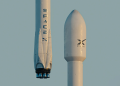
SpaceX’s next-generation Starship rocket reached orbit for the first time on Monday 28 September 2026, launching from the company’s Starbase complex along the Gulf of Mexico near Brownsville and then releasing 26 next-generation Starlink broadband satellites, according to Times LIVE and Free Malaysia Today. The uncrewed flight was the 14th test of the vehicle and carried Starship’s first orbital payload, both outlets reported.
Key facts
- The vehicle is 40 storeys tall and comprises a Super Heavy booster topped by the Starship upper stage, both reports said.
- The Super Heavy booster lofted the upper stage into space, then returned for an engine-controlled splashdown in Gulf waters, following hard landings on two previous missions.
- Starship deployed the 26 satellites one by one at a planned altitude of roughly 269km.
- The flight was expected to complete six Earth orbits during a 10-hour voyage, Starship’s longest yet.
- All 13 of Starship’s previous test flights, since 2023, were limited to suborbital space, in a development campaign that has cost SpaceX more than $15bn to date.
Why it matters
Ten times the data of a V2 mini
The satellites aboard were SpaceX’s new V3 Starlink models, the highest-capacity hardware yet flown for its satellite internet constellation. The company says each can handle 10 times more data than the V2 mini-satellites it has been flying on its workhorse Falcon 9 rocket, according to both reports.
Two estimates of what the payload is worth
Free Malaysia Today put the launch’s value at hundreds of millions of dollars in projected revenue for SpaceX’s Starlink unit, citing analyst estimates based on the network’s added customer capacity, and described this as underscoring Starship’s fundamental role in serving the company’s profit nucleus. Times LIVE described the payload as potentially worth millions of dollars. The two figures measure different things — forecast revenue from the capacity the satellites unlock, against the hardware itself — and neither outlet reconciled them. Starlink News has reported separately on Starlink’s reported ARPU and a capex shift toward AI.
An engine out, then a call reversed
Upon reaching space, one of Starship’s three main engines shut down earlier than planned, both outlets reported. SpaceX spokesperson Dan Huot announced on the company’s live stream that the craft would be unable to reach orbit, saying: “The team has made the call not to commit to orbit.”
Huot reversed course minutes later, after an update from engineers confirmed the craft could still attempt an engine firing to boost it into orbit, which Starship then did, according to both reports.
A benchmark four years late
Reaching orbit is a primary benchmark for any new rocket designed to deliver payloads to space, and it has been a long-delayed feat for Starship, both outlets said. Musk once predicted orbit would be achieved in 2022, to be followed by satellite deployments in 2023.
Musk has said he envisions ultimately flying hundreds or thousands of Starships a year, a launch pace the reports describe as unprecedented in the space industry.
What rides on the rocket
SpaceX went public in June with a record-shattering initial public offering that made it the sixth-biggest US company by value and turned Musk into the world’s first trillionaire, both outlets reported, with the company valued at $2-trillion as of the Friday close before the launch. Much of that valuation rests on Starship, designed as the world’s first fully reusable spacecraft: investors wiped about $100bn off SpaceX’s market value when test flight 13 was aborted at the last second in July.
The reports say the silver-coloured, multi-finned rocketship will be key to Musk’s ambitions of slashing launch costs, vastly expanding the Starlink business and deploying thousands of orbital AI data centres to space — an AI thread that also runs through Starlink revenue underpinning SpaceX’s $40bn GPU debt deal.
Beyond Starlink: the moon
Starship is also set to play a pivotal role in NASA’s Artemis programme, which aims to return astronauts to the moon’s surface for the first time since 1972 and build a long-term lunar presence as a stepping stone to eventual human exploration of Mars, both outlets reported.
What the reports do not cover
Neither source addressed Starlink’s consumer pricing, licensing or availability in any specific market, including Zimbabwe and the rest of Africa; their commercial framing stops at added network capacity and projected revenue for the Starlink unit. Readers tracking those angles will find them elsewhere, including in Africa’s licence debate and our Starlink pricing and availability coverage.
Frequently Asked Questions
What was planned for Starship’s return to Earth on this flight?
Times LIVE reported that one critical objective was surviving the return flight, beginning with a deorbital firing of one Raptor engine in space and precise angling of the vehicle for atmospheric re-entry. The final descent was designed to end with a thruster manoeuvre flipping the vehicle vertically so it hit the sea nose-up. Both outlets said no recovery of the spacecraft was planned on this flight, contrary to Musk’s previous hopes, while future missions call for a similar touchdown on land in Texas.
What did the reports leave unresolved?
The outcome of the flight. Both Times LIVE and Free Malaysia Today published on 28 September 2026, while the voyage was still expected to run about 10 hours and end with a splashdown in the Pacific Ocean west of Chile. Neither report records whether that splashdown went to plan.
Why does SpaceX need Starship to launch Starlink satellites?
Starship was built to launch Starlink satellites more frequently and to carry future NASA missions to the moon, both outlets reported. Free Malaysia Today said Musk wants to launch the higher-capacity V3s in batches of 60 per launch once Starship is in routine operation, a goal he now aims to reach late this year, compared with the 20 or 30 V2 mini-satellites SpaceX has been launching at a time on Falcon 9.