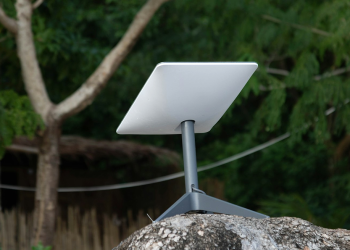
A senior Iranian official has said satellite internet infrastructure “can become a legitimate military target” if it is used as a tool of war — the sharpest language yet in Tehran’s campaign against Starlink, SpaceX’s low-Earth-orbit broadband service. The remark came from Mohammad Amin Aghamiri, secretary of the Supreme Council of Cyberspace and head of the National Cyberspace Center, speaking on Monday at a conference on online businesses organized by Iran’s cyber police, according to Iran International.
The documented part of that campaign is on the ground: police say they have seized 997 Starlink devices and arrested 163 people this Iranian year, and Iran’s most recent internet blackout ran 88 days. Aghamiri’s other headline claim — that authorities disabled Starlink terminals during January’s protests — arrived with no technical detail and no independent confirmation.
A note on sourcing: the quotations and figures below come from Iran International, a London-based Persian-language broadcaster that reports critically on the Islamic Republic. Tehran has designated it a terrorist organisation, and press investigations have linked its funding to Saudi-based investors. No Iranian state outlet, wire service or government statement publishing the same seizure and arrest totals could be found, and SpaceX has not commented, so the numbers rest on a single interested source.
Key facts
- Hossein Rahimi, head of Iran’s Economic Security Police, has said police seized 997 Starlink devices and related equipment during the first four months of the current Iranian year, which began in mid-March, and arrested 163 people over their import and distribution.
- Iran’s Foreign Ministry summoned Norway’s ambassador on Sunday to protest continued Starlink operations in the country.
- Internet access was cut after the 40-day war began in late February 2026 and the restrictions lasted 88 days, which Iran International describes as the longest digital blackout in the world.
- SpaceX does not list Iran among the markets where Starlink is licensed on its public availability map, so the terminals police are seizing reached the country outside any authorized channel.
- Aghamiri called satellite internet and Starlink potential threats, said the Islamic Republic was technically prepared to counter them, and claimed authorities had succeeded in disabling Starlink terminals during the January 2026 protests, which he referred to as a “coup.”
Unpacking the military-target claim
The phrase Aghamiri used is a term of art from the laws of armed conflict, but per the outlet’s account he did not spell out what it would mean in practice. He did not say whether he was describing user terminals inside Iran, the satellites overhead, or ground infrastructure in third countries, and no legal reasoning or specific capability accompanied the warning.
The disabling claim turns on the same ambiguity: knocking out a terminal on the ground — through jamming, signal detection or seizure — is a very different proposition from acting against an orbital network, and the statement does not distinguish between them. Iran International notes that officials and state media have repeatedly characterised anti-government protests as riots or attempted coups and blamed foreign actors, including the United States and Israel.
Not the first state to use this language
The rhetoric has precedent. At a UN General Assembly disarmament committee meeting in October 2022, Russian foreign ministry official Konstantin Vorontsov said commercial satellites used for military purposes could become “a legitimate target for retaliation,” as Reuters reported at the time, in remarks aimed largely at Western constellations supporting Ukraine. SpaceX has itself acknowledged Starlink’s wartime use there: company president Gwynne Shotwell said in February 2023 that SpaceX had curbed Ukraine’s use of the service for drone operations, according to Reuters.
Iran is the second state to float the targeting idea publicly, and in both cases it came from a podium rather than a formal legal filing or doctrine document.
Officials concede the controls don’t reach it
“The final nail in the coffin of cyberspace governance”
The bluntest admission came from inside the Communications Ministry. Mohammad Hafez Hakami, deputy minister for technology, innovation and international affairs, said on September 30 that “the spread of Starlink drives the final nail into the coffin of cyberspace governance,” the broadcaster quoted him as saying, adding that the service is a new tool of evasion that is fundamentally no longer based on Iran’s own network. That unease extends to direct-to-cell services.
Why cutting the network no longer disconnects users
Internet and cybersecurity expert Davoud Sajjadi told the same outlet on October 1 that Starlink lets users bypass filtering and other state control mechanisms, and that connecting outside those systems has made the technology a growing worry for officials. The structural problem is simple: satellite links run independently of domestic networks, so pulling conventional infrastructure no longer guarantees users are offline. Hakami’s stated fallback is cruder — if the current trend continues, he said, authorities would be forced to cut electricity during the next crisis.
What this means for SpaceX and other satellite ISPs
No SpaceX comment on Aghamiri’s remarks had been made public at the time of writing. The company has little commercial exposure in Iran to lose, since it sells nothing there; the practical pressure falls instead on users, importers and distributors, which is exactly where the seizure and arrest figures land. That is the pattern other operators should expect: a state that cannot reach the constellation goes after the kit and the people carrying it.
The backstory explains why there is nothing else to reach for. After the 2022 Woman, Life, Freedom protests, the US Treasury broadened the internet services available to Iranians under General License D-2, and Elon Musk said publicly that he was activating Starlink for Iranians. A service that arrived through a sanctions carve-out and informal imports, rather than a licence, has no local entity to fine, no spectrum award to revoke and no retail storefront to close — which leaves rhetoric, enforcement and diplomacy as the available levers.
Availability: why Iran has no Starlink price
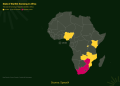
Iran now sits at one end of a widening split in how satellite broadband arrives in a country. Elsewhere the gatekeeping is a licensing question rather than a policing one, with regulators rather than telcos deciding access in African markets: approvals are published and hardware and subscription prices are listed on SpaceX’s own site before a single kit is sold. Iran has no entry on that price list, and the police statements quantify devices confiscated rather than what they were worth, so there is no official or law-enforcement figure for what a smuggled terminal and its service cost inside the country. Resale prices circulating in Persian-language forums could not be verified for this report, and neither Iranian officials nor Iran International put a number on the grey market — which means the only reliable cost of owning a Starlink kit in Iran is the legal risk attached to it.
Enforcement and the shutdown record
Seizures, arrests and the Norway channel
Rahimi has said efforts to stop imports and distribution intensified after the 12-day Israel-Iran war of June 2025, and on the diplomatic track Tehran is pressing Oslo over how the network is registered internationally.
A record of shutdowns
Internet restrictions themselves are long-standing. Iran International’s report lists a sweeping shutdown during the November 2019 protests and further cuts or curbs since, including during the Woman, Life, Freedom uprising, the 12-day war and the January 2026 protests. Concerns about Starlink have grown alongside an increased US military presence in the region, worsening economic conditions and domestic discontent, the report says, with the latest warnings arriving as the cost-of-living crisis deepens and the prospect of renewed public protests rises.
Frequently Asked Questions
Why is Iran directing its complaints at Norway?
Norway is the country through which the Starlink network is registered with the International Telecommunication Union, according to Iran International. Iranian authorities argue that this makes Oslo responsible for preventing what they call unauthorized operations inside Iran, and the Foreign Ministry asked Norway to halt the service there.
What is direct-to-cell, and why do Iranian officials mention it?
Direct-to-cell technology lets mobile phones connect straight to satellites without relying on conventional telecommunications towers, as Iran International explains. Communications Ministry deputy minister Mohammad Hafez Hakami warned that the expansion of Starlink and direct-to-cell could render mechanisms such as device registration and user identification ineffective, the outlet reported.
Has Iran had a policy for dealing with Starlink?
Hakami said those concerned about Starlink had been warning about it for two years without a single line of policy being developed, according to Iran International.
Did Starlink come up at the United Nations this year?
Yes. Iran International reported that Israeli Prime Minister Benjamin Netanyahu held up a Starlink device during his September 24 address to the United Nations General Assembly while discussing access to information in Iran, saying the device allows people to access truth and exercise freedom of speech.
Follow Starlink News on Google. Make us a preferred source to see more of our reporting in Google search results.