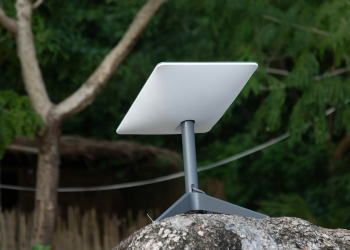
Bureau 1440, the Russian company building the country’s low-Earth-orbit satellite internet system Rassvet, has unveiled three subscriber terminals for the network. The Kyiv-based Ukrainian defence outlet Militarnyi (Мілітарний) reported the line-up on 6 October 2026, describing the 1440.ULTRA, the 1440.ZEMLYA and the 1440.MINI as equivalents to the user terminals SpaceX sells with Starlink. Two were shown as devices; the third exists only as a concept.
Key facts
- 1440.ULTRA — a mass-produced terminal the company says offers maximum performance, with data transfer speeds of up to 700 Mbit/s.
- 1440.ZEMLYA — a terminal for rail transport, which the company says will keep service running on rolling stock travelling at up to 400 km/h.
- 1440.MINI — a concept for a compact device with a target data rate of about 100 Mbit/s, for a small number of users.
- Rassvet — 16 satellites launched in March 2026 and another 16 in July, according to Militarnyi.
Why it matters
Rassvet has been in the news this month as a political object rather than a product. Starlink News has reported that Ukraine has asked the United States to sanction Rassvet, and that Russia’s Dmitry Medvedev warned that blocking Rassvet would put Starlink satellites at risk. The terminal line-up is the first sight of the hardware end of that system, and Militarnyi frames each device against an existing SpaceX product rather than treating them as a separate category of equipment.
The outlet adds one caveat of its own: given the terminals’ specifications, it writes, such hardware could potentially be installed on Russian strike drones for attacks on Ukraine. It cites no Bureau 1440 statement on military use and reports no such deployment, so that remains the outlet’s assessment rather than a documented fact. Kyiv has satellite plans of its own — Starlink News has reported President Volodymyr Zelensky saying Ukraine is building its own Starlink analogue.
How the three terminals compare to Starlink
Of the devices already presented, the 1440.ULTRA is the closest equivalent to the Starlink Standard terminal in purpose, specifications and dimensions, according to Militarnyi. The outlet puts the 1440.ZEMLYA closest to the Starlink Performance terminal and says the compact 1440.MINI is conceptually equivalent to the Starlink Mini.
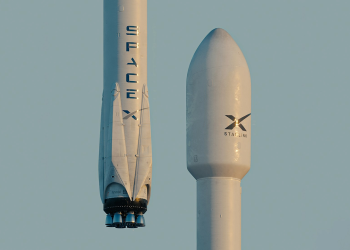
SpaceX’s own published specifications give that mapping some numbers. At the time of writing the company lists peak downloads of up to about 220 Mbit/s for the Standard dish, up to roughly 500 Mbit/s for Performance hardware and up to about 100 Mbit/s for the 1.1 kg Mini, with US hardware prices of $349 for a Standard kit and $499 for a Mini; real-world speeds vary by market and network congestion. On those figures the 700 Mbit/s Bureau 1440 claims for the ULTRA would exceed anything SpaceX publishes for the three products Militarnyi compares it with. Starlink also flies thousands of satellites, against Rassvet’s 32.
Neither SpaceX nor Bureau 1440 has published a response to the comparison, and every detail of the terminals themselves traces back to the single Militarnyi report.
Stated use cases
Bureau 1440 says the ULTRA is designed to provide connectivity for industrial enterprises, remote areas, infrastructure facilities and equipment, and the MINI for portable use by rescue teams, emergency service crews and other mobile scenarios.
Where the Rassvet constellation stands
Bureau 1440 is currently actively deploying Rassvet, Militarnyi reports. The company says the link between satellites and ground terminals uses 5G NTN, the 3GPP standards work that extends mobile 5G to non-terrestrial networks, while laser communication carries data between the satellites themselves.
What is not in the report
The report gives no prices, no commercial launch date and no subscriber numbers for Rassvet, and nothing in it points to sales outside Russia. Readers in Zimbabwe and the rest of Africa weighing satellite internet options should treat Rassvet as a domestic Russian deployment on the evidence published so far. The speeds attached to the ULTRA and the MINI are the company’s own figures as relayed by Militarnyi, not measured results, and no independent testing of any of the three terminals has been reported.
Frequently Asked Questions
What is 5G NTN, the standard Bureau 1440 says Rassvet uses?
5G NTN stands for non-terrestrial networks. It is the 3GPP standards work that extends mobile 5G specifications to satellites and other airborne platforms, so an operator can reuse 5G protocols over a space link instead of building a proprietary air interface. Bureau 1440 says Rassvet uses it for the connection between its satellites and user terminals, according to Militarnyi.
How fast is the link between Rassvet satellites themselves?
Bureau 1440 said the constellation uses laser communication between spacecraft, according to Militarnyi. During testing the company reported transmitting data between satellites over distances of up to 1,000 km at speeds of up to 10 Gbit/s.
How long did the newest Rassvet satellite take to reach its working orbit?
Militarnyi reported that in late September the first Rassvet satellite from the second batch entered its operational orbit at an altitude of about 500 km. That came 68 days after its launch.
Follow Starlink News on Google. Make us a preferred source to see more of our reporting in Google search results.