Starlink News reported on 3 October that India’s Digital Communications Commission had cleared a 5% spectrum usage charge for satellite broadband operators including Starlink, Eutelsat OneWeb and Jio Satellite. The same decision, according to Mint, also discarded the two measures the sector regulator had designed to push satellite internet towards rural India. This follow-up deals with what was thrown out, and with what the surviving charges imply for the cost of a connection.
What the commission decided against
- Rejected: a charge of 500 rupees per subscriber per year for serving urban areas. An unnamed official told Mint the Department of Telecommunications took the view that a disincentive-led model could create implementation problems because it would have been hard to differentiate between rural and urban areas.
- Rejected: a subsidy for each fixed satellite user terminal installed in a rural area, funded either through a direct benefit transfer or through the Digital Bharat Nidhi. This went back to the regulator as part of a back reference on satellite spectrum assignment, according to the report.
- Approved instead: a geographic incentive — one percentage point off the 5% charge for operators serving users in government-notified hard-to-connect areas.
- Left in place: an annual licence fee of 8% of adjusted gross revenue, and spectrum assigned administratively, without an auction, for five years.
- Still pending: the remaining departmental approval process, plus security and other regulatory clearances before commercial launch, Mint said.
“The idea is that the incentives should be based on areas where LEO/MEO (low-Earth orbit/medium-Earth orbit) satellites work better than regular technologies, like border regions, hilly areas, and islands,” one official told Mint. Areas to be notified would include places where satellite connectivity offers an advantage over traditional mobile networks, a second official told the outlet.
What the charges mean for a customer’s bill
What operators pay
Every figure in the decision is pegged to adjusted gross revenue, or AGR — the operator’s revenue from licensed services after a set of permitted deductions, and the standard base on which Indian telecom licence fees and spectrum charges are calculated. By our own arithmetic on the two rates Mint reports, stacking the approved spectrum charge on the existing licence fee puts roughly 13% of an operator’s qualifying Indian revenue in the state’s hands before any other cost, falling to about 12% in notified hard-to-connect areas where the one-point reduction applies. Mint does not present a combined figure; the addition is ours.
What this means for rural and urban households
Those are levies on company revenue, not line items on a subscriber’s invoice. No retail Starlink price for India has been announced in any of the reporting this article relies on — neither a monthly subscription nor a hardware price — so anyone searching for an Indian tariff today will find none, and the levies above are the only published numbers bearing on it.
The rejections, though, bite at the two points a household actually feels. The 500-rupee urban charge works out, on our calculation, at about 42 rupees a month for each urban subscriber — a flat per-user cost that an operator could have recovered through pricing, and a deliberate nudge towards rural sign-ups. The terminal subsidy would have cut the upfront price of the dish itself, typically the largest single payment a new satellite customer makes. With both gone, a rural household faces the full hardware cost, and operators carry no extra charge for concentrating on cities.
Why the regulator wanted the urban fee
Mint said it first reported on 17 November 2025 that the government wanted to levy one percentage point less than 5% of AGR where a certain share of a company’s satellite internet users lived in hard-to-connect areas, and that the department sought the regulator’s views at the time. The newspaper’s account gives those dates without years; the sequence places them in late 2025, ahead of the commission’s decision.
In its response the following month, in December 2025, the Telecom Regulatory Authority of India argued that the rural-urban bifurcation is well established in the Indian telecom framework and provides a reliable basis for implementation and compliance monitoring, according to the report. Given the higher purchasing power and data consumption of urban subscribers, it warned, non-geostationary satellite orbit providers may focus more on urban areas, potentially undermining the goal of bridging the digital divide. The 500-rupee charge, on its reasoning, would have made rural expansion the cheaper commercial choice. The regulator recommended 4% of AGR as the spectrum charge rather than 5%.
That recommendation on the terms and conditions for assigning satellite spectrum, where the 4% figure and both rural measures originate, is a public document carried among TRAI’s published recommendations and can be read in full. The department’s counter-decision cannot: no notification setting out the rejections has been issued, and the back reference to the regulator has not been made public. Every reason given above for the rejections is therefore the account of officials and industry executives whom one newspaper did not name, and this article goes no further than relaying it.
‘A rich users’ service’
Satya N. Gupta, a former principal advisor at the Telecom Regulatory Authority of India, told Mint that satellite internet “is being projected as a rich users’ service.” The government, he said, should recover the cost of managing the spectrum and no more, treating it as operational expenditure recovery rather than a profit-earning exercise. He added that satellite communications can never be affordable to remote and rural masses, and that bridging the divide through what he called an expensive medium would require a very high level of subsidy — the kind of subsidy the department has now declined to attach to each terminal.
The wider picture
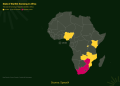
India’s route — administrative assignment at a fixed revenue share, with no auction and no rural earmark — sits at one end of the range of approaches Starlink is meeting. In much of Africa the constraint has not been the price of spectrum at all but national authorisation itself, where regulators rather than telcos sit in Starlink’s path and licences are withheld, delayed or made conditional on local shareholding. Measured against that, a known percentage of revenue is a cost an operator can model.
For Eutelsat OneWeb, one of the three operators named in the decision, the Indian terms land while its parent presses ahead with Eutelsat’s constellation build-out.
Frequently Asked Questions
Was there a minimum annual spectrum charge in the regulator’s proposal?
Yes. Mint reported that the Telecom Regulatory Authority of India had attached a floor to its recommended 4% charge: a minimum of 3,500 rupees per MHz per year. The report does not say whether that floor survived into the 5% decision.
What is the Digital Bharat Nidhi?
It is India’s statutory fund for extending telecom service to areas the market does not reach, created to bridge the urban-rural digital divide. It was one of the two routes the regulator proposed for funding rural satellite terminals, the other being a direct benefit transfer, according to Mint.
Has the Department of Telecommunications confirmed any of this publicly?
Not in the reporting this article relies on. Mint said the queries it emailed to the department on the Tuesday evening before publication went unanswered.
Can the five-year spectrum assignment be extended?
Mint’s sources said there is an option to extend it by a further two years. The report does not say what happens at the end of that period, or on what terms an extension would be granted.
Follow Starlink News on Google. Make us a preferred source to see more of our reporting in Google search results.