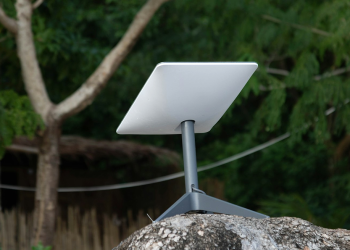
Eutelsat, the Franco-British satellite operator that merged with OneWeb, said on 10 September 2026 that it will replenish and expand its OneWeb low Earth orbit network through 2034 after signing a deal with Airbus for 229 additional satellites. The order represents an investment of €1 billion ($1.16 billion), Reuters reported via Yahoo Finance, and is aimed squarely at challenging Elon Musk’s Starlink.
Key facts
- The 229 satellites are additional to 440 Airbus-built satellites Eutelsat ordered in 2024 and 2025, with deliveries of those earlier orders expected to begin in the fourth quarter of 2026, per Reuters.
- At a separate announcement at the Paris space summit on the same day, Eutelsat said it had booked two Ariane launch missions to carry OneWeb satellites in 2027 and 2028.
- Reuters said the new satellites are intended to ensure service continuity until the commercial deployment of IRIS², the European Union’s planned secure communications constellation, expected to enter service around the end of the decade.
Why it matters
Reuters described Eutelsat as strategically important to the French and British governments because it operates the only low Earth orbit satellite network outside Starlink, providing secure communications and broadband internet services. Other European firms are pushing in the same direction: Nokia and Iceye have set out plans for sovereign satellite communications to cut their reliance on Starlink.
What Eutelsat has committed
Reuters said the agreement extends Eutelsat’s low Earth orbit fleet roadmap beyond previous plans, under which the company expected to spend about €2 billion to procure and launch the 440 satellites by 2030. The expansion follows a period of financial strain: Eutelsat raised roughly €5 billion to weather the pressure stemming from its $3.4 billion merger with OneWeb.
OneWeb currently comprises more than 600 satellites, Reuters said, and chief executive Jean-François Fallacher told the agency in March that Eutelsat expected its fleet to exceed 1,000 “very soon”.
How the scale compares
Starlink has more than 11,000 satellites in orbit, according to Reuters — up from the more than 8,000 cited by eNCA in October 2025 and the more than 6,000 that Starlink claimed in 2024, when EWN reported it was serving 2.6 million customers.
Reuters explained that OneWeb requires far fewer satellites to provide global coverage because its satellites operate at a higher altitude and the company focuses on government, enterprise and telecom customers rather than mass-market consumers. That is the sharpest difference between the two networks. Starlink’s consumer satellite internet business has grown to 12 million users and average revenue per user of about $66 a month, as reported on this site in September 2026 — a retail price point Eutelsat is not trying to match, because none of the three reports reviewed here describe a consumer tariff for OneWeb at all.
Background: IRIS², the EU constellation signed in December 2024
The EU’s flagship constellation project formally took off on 16 December 2024, when the bloc signed a 12-year concession contract for its implementation, EWN reported. The system is a public-private partnership serving both governments and private clients, with an estimated budget of €10.6 billion ($11.1 billion), and is intended to allow secure communications for military, defence and diplomatic purposes. EWN also listed surveillance, connectivity in natural disaster-hit areas and commercial broadband access among its other potential uses.
European Commission vice president Henna Virkkunen said: “This cutting-edge constellation will protect our critical infrastructures, connect our most remote areas and increase Europe’s strategic autonomy.” EU commissioner for defence and space Andrius Kubilius called the signing the launch of a vision of a stronger, more connected and more resilient Europe. IRIS² is the EU’s third large space project, after the Galileo satellite navigation system and the Copernicus Earth monitoring constellation, EWN said.
The sources disagree on satellite numbers and dates
EWN described IRIS² in December 2024 as a multi-orbital network of almost 300 satellites, fully operational by 2030. eNCA put the figure at 300 in October 2025, also citing 2030. Reuters in September 2026 described a constellation of 348 satellites entering service around the end of the decade. EU officials told EWN that while IRIS² counts on a lower number of satellites, its multi-orbital design puts it on par with a constellation of about 1,000 Starlink satellites in terms of performance.
Background: Bromo, the manufacturing merger announced in October 2025
eNCA reported that Airbus, Thales and Italy’s Leonardo agreed in October 2025 to merge their satellite operations into a venture called Bromo, saying they aimed to strengthen Europe’s strategic autonomy in space, a sector underpinning telecommunications, navigation, earth observation, science, exploration and national security. Financial details were not disclosed, but annual revenues for the new group were estimated at €6.5 billion based on current operations, with an order backlog representing over three years of projected sales.
The venture would be headquartered in Toulouse and, if approved by regulators, operational in 2027, with Airbus owning 35 percent and Thales and Leonardo 32.5 percent each. Thales said separately that an initial €100 million ($116 million) engineering contract with satellite operators for IRIS² would allow it to halt planned job cuts in its space operations. French finance minister Roland Lescure called the deal excellent news.
What the reports do not cover
None of the three reports give availability dates, consumer pricing or licensing terms for OneWeb or IRIS² in Africa. The only African detail in the sources is a note in EWN’s December 2024 report that the South African government was considering amending BEE rules to allow Starlink to operate there — a licensing question that keeps putting regulators rather than telcos at the centre of African satellite access. Readers in Zimbabwe should not read these European announcements as a signal on local service or price.
Frequently Asked Questions
Which companies are building IRIS² for the European Union?
The EU signed the concession with SpaceRISE, a consortium led by France’s Eutelsat, Spain’s Hispasat and Luxembourg’s SES, according to EWN. Other named partners are OHB, Airbus Defence and Space, Telespazio, Deutsche Telekom, Orange and Hisdesat.
How is IRIS² being paid for?
EWN reported that more than half of the project’s budget will be footed by the EU itself. A further €4.1 billion comes from private investment and €550 million from the European Space Agency.
Where will IRIS² be controlled from?
EWN reported that the IRIS² earth-based infrastructure will be located exclusively in Europe. Control centres are planned for Luxembourg, France and Italy.
Does the Airbus-Thales-Leonardo merger include rockets?
No. eNCA reported that the merged satellite business would not include space launchers such as Airbus’s Ariane rockets, which, unlike the Falcon launchers of Musk’s SpaceX, are not reusable.
Follow Starlink News on Google. Make us a preferred source to see more of our reporting in Google search results.