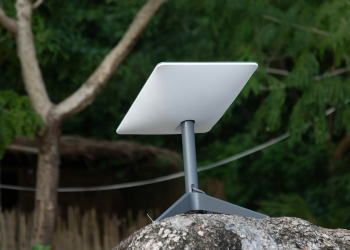
SpaceX’s satellite broadband unit Starlink has built 20 gateway sites in India, containing hundreds of antennas, and has designed the network so that Indian users’ data stays inside the country. Lauren Dreyer, vice-president of Starlink Business Operations at SpaceX, disclosed the figures at India Mobile Congress 2026, ET CIO reports.
Dreyer said the company had established “controls at every layer for India” and was keeping Indian user data within India, according to Moneycontrol, which dated her remarks to Wednesday in a report published on October 6. ET CIO carried the comments on October 7, as did lapaasvoice, a secondary industry outlet whose longer interpretation of the Indian rules is set out separately below. lapaasvoice cautions that the gateway and antenna figures are company claims from Dreyer’s address, not independently audited network measurements.
Key facts
- 20 gateway sites built in India, comprising hundreds of antennas, per Dreyer’s remarks reported by ET CIO.
- Dreyer said Starlink has worked with Indian regulators, industry stakeholders and operators for the past five years, ET CIO reports.
- Moneycontrol reports the Indian government has granted licences to three satellite communication companies, Starlink included, but that they still need spectrum and security clearance to start services.
- lapaasvoice reports Starlink has signed agreements with Bharti Airtel and Reliance Jio, two of India’s largest telecom companies.
Why it matters
Read side by side, the two news reports describe sequencing rather than a launch: ET CIO’s account covers finished hardware and five years of regulatory engagement, while Moneycontrol’s covers licences in hand and clearances still missing. That gap is what this piece follows, as does Starlink says it built its India setup to meet security rules.
lapaasvoice argues the build gives Starlink a head start, because the company will not need to begin constructing an Indian ground network after final approval, and describes it as being in a state of technical readiness without complete commercial authorisation. That is the outlet’s interpretation, not something ET CIO or Moneycontrol reports.
What the Indian rules require
lapaasvoice, summarising the Department of Telecommunications’ GMPCS framework, says satellite operators must establish the required satellite earth-station gateway in India and comply with security conditions covering privacy, lawful interception and the routing of Indian traffic. On its account, domestic traffic must not be hauled or routed through locations outside India; the network operation, maintenance and control facilities associated with satellite gateways and user terminals must be located in India; and monitoring and lawful-interception capability must be available inside the country. Neither ET CIO nor Moneycontrol sets out those conditions, so they rest on this single secondary source.
The requirement bites hardest on satellite operators, lapaasvoice says, because the link between a customer’s terminal and the wider internet can otherwise pass through satellites and ground stations in several countries.
How far the data claim goes
lapaasvoice reads Dreyer’s statement as a commitment to Indian traffic localisation and regulatory compliance, rather than a claim that no information associated with an Indian Starlink customer can ever interact with an overseas corporate system. The distinction matters, it says, because satellite networks remain globally interconnected even where domestic user traffic must stay on national infrastructure.
What is still outstanding, including price and availability
Dreyer told the conference the company is waiting for the government’s remaining work to be completed, lapaasvoice reports, citing recent industry reporting that security clearance is the key open issue, with questions over Starlink’s foreign direct investment structure and spectrum assignment forming part of the final regulatory process.
None of the three reports gives a Starlink price for India, a tariff plan or a date for consumer availability: the gateways exist, but ordering and activation wait on the clearances Moneycontrol describes. The charges Starlink will carry have been settled piecemeal in recent days, with a 5% spectrum charge cleared for Starlink, OneWeb and Jio and, in a separate decision, India rejected an urban fee and a rural dish subsidy.
Where Starlink says it fits in India
On lapaasvoice’s account, Starlink is not necessarily trying to replace India’s mobile networks — already among the world’s largest, with extensive 4G and 5G coverage and rapidly expanding fibre — but to serve places where fibre, towers or other terrestrial infrastructure are difficult or expensive to deploy, naming remote mountains, islands, border areas, forests and sparsely populated regions. The outlet says the Airtel and Jio agreements, alongside relationships with state governments, could help integrate satellite connectivity into existing distribution ecosystems.
The wider SpaceX pitch
ET CIO reports that Dreyer also set out SpaceX’s broader technology push, covering reusable Falcon 9 rockets and the next-generation Starship launch vehicle, which she said “just reached orbit.” She said that with SpaceX AI the company is building AI compute at enormous scale, first on Earth and in future in orbit to fully harness the power of the sun, while Starlink provides high-speed connectivity to places traditional infrastructure has been unable to reach. On India itself, ET CIO quotes her saying what the country has achieved digitally is extraordinary.
Frequently Asked Questions
What exactly is a Starlink gateway site?
According to lapaasvoice, a Starlink gateway is a ground station that connects the satellite network to terrestrial communications infrastructure, acting as a bridge between the space-based network and India’s terrestrial internet. The same secondary report says building gateways inside India lets Starlink comply with domestic routing requirements while giving it a local network footprint.
When did Starlink receive its Indian licence?
lapaasvoice reports that the Department of Telecommunications granted Starlink Satellite Communications Private Limited a Unified Licence with GMPCS, Commercial VSAT CUG and ISP-A authorisations on June 6, 2025, and that Starlink subsequently received IN-SPACe authorisation for its first-generation constellation over India in July 2025, citing contemporary reporting. Neither ET CIO nor Moneycontrol gives those dates.
Which other companies hold GMPCS authorisation in India?
lapaasvoice says the Department of Telecommunications’ current GMPCS information lists Starlink alongside Jio Satellite Communications and OneWeb India.
Follow Starlink News on Google. Make us a preferred source to see more of our reporting in Google search results.