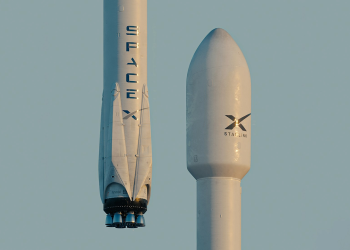
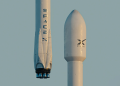
SpaceX has released video of its Starship rocket releasing 26 Starlink V3 internet satellites in orbit, filmed during the vehicle’s 14th flight from the company’s Starbase site in South Texas. Stuff South Africa, reporting on 29 September 2026, said the mission had flown the previous day after a short delay and was the first Starship flight to properly attempt orbital insertion, with both the satellite deployment and the vehicle’s descent caught on video.
Key facts
- The flight: Starship 14, launched from Starbase in South Texas, placed the roughly 50-metre vehicle into a path around the planet for the first time, according to Stuff.
- The payload: all 26 Starlink V3 satellites were deployed without issue. Stuff cited a Starlink post saying the team “has made contact with all 26 satellites”.
- Orbit: deployment took place at an altitude of 275km, per heise online, the German technology news site.
- Plan versus outcome: SpaceX had planned six orbits over a flight of nearly 10 hours ending in the Pacific west of Chile; Stuff reported the mission was cut short, with a deorbit burn about three hours after reaching orbit.
- Capacity: each V3 satellite offers 1 Tbit/s, adding 26 Tbit/s in one launch, heise online reported.
- A first: two heat-shield tiles from the previous Starship were reinstalled on this vehicle, SpaceX’s first instance of tile reuse.
Why it matters
SpaceX chief financial officer Bret Johnsen called the launch a “massive milestone” and said it would be the first revenue-generating Starship flight since the company listed on NASDAQ in June, according to 헤럴드경제. The same report said Musk posted on X that Starlink V3 would provide “more than 100 times the bandwidth” of the current constellation of about 11,000 satellites already in orbit.
heise online put the comparison differently, saying a V3 satellite carries ten times the capacity of the V2 Mini satellites launched on Falcon 9. For how that capacity jump is being handled by authorities rather than operators on this continent, see our earlier report on V3 and African regulators.
What the footage shows
Stuff said the deployment of all 26 satellites was captured on video, as was the vehicle’s return. After the deorbit burn and reentry, the rocket performed a controlled descent and touched down on the Pacific, then settled, sank and exploded.
Each V3 satellite weighs 2,000kg, according to 헤럴드경제, which said the flight marked the first time the new generation entered actual orbit. SpaceX has also outlined the next generation beyond V3.
Booster and reuse
heise online reported before the flight that neither the booster nor the upper stage would land on land, with the first stage due to splash down in the Gulf of Mexico. 헤럴드경제 said SpaceX also planned to test the booster’s launch, separation, boostback burn and splashdown procedures.
What changed after the July flight
On the 13th flight in July, Starship lifted off from Starbase at 5:51 p.m. local time on a Friday, MyBroadband reported. Around six minutes in, the Super Heavy booster came down off the Gulf of Mexico but did not light all of its engines as planned, leading to a faster-than-expected splashdown. 헤럴드경제 was more specific: only 8 of the 13 engines required for the pre-splashdown relight ignited, resulting in a hard landing, and SpaceX has since improved engine filtering hardware and reignition software.
heise online reported that icing was detected on three booster engines during that July flight, prompting hardware modifications and software changes tested on the 14th mission. MyBroadband said SpaceX again skipped the midair catch it achieved on a 2024 mission.
That July vehicle came down in the Indian Ocean in what SpaceX communications manager Dan Huot called on the livestream the “softest splashdown we have ever had with the Starship”, before it erupted into flames. heise online said the rocket was recovered from the Indian Ocean after more than three weeks, which is how the two reused heat-shield tiles became available.
The money behind it
SpaceX has invested more than $15 billion in Starship development, both MyBroadband and 헤럴드경제 reported, and 헤럴드경제 said the company plans to spend at least $100 billion more building a dedicated launch facility in Louisiana. The same outlet reported second-quarter sales of $7.81 billion, up 91.9 percent year-on-year and above market expectations.
Share prices moved against the launch news in both periods covered by the sources. MyBroadband said shares closed 3 percent lower on the day of the July flight and were down about 25 percent over the previous month, below their $135 IPO price. 헤럴드경제 said shares closed down 3.2 percent at $143.49 on the day the September flight was announced, attributing the fall to investor caution over launch risk.
Jeffrey Blodgett, an analyst at Pivotal Research Group, wrote in a recent customer note cited by 헤럴드경제 that whether the investment in SpaceX pays off “depends almost entirely on making Starship fully reusable”.
Frequently Asked Questions
Did the Starlink satellites released on the July Starship flight stay in orbit?
The sources disagree. MyBroadband reported that Starship deployed 20 Starlink satellites on that flight and that SpaceX later said they communicated with the broader network and downloaded data, while heise online described the July deployment as simulated, with the satellites burning up in the atmosphere as planned.
Will SpaceX try to catch Starship on the next flight?
Musk said at an event in September that Flight 14 would be the last mission before SpaceX attempts to catch the ship for the first time, according to 헤럴드경제. Stuff South Africa noted the catch has only been demonstrated with the Super Heavy booster, and said it is probable that more orbital tests come before a Starship is caught and reused.
When does SpaceX expect Starship to be fully reusable?
The two statements in the sources differ. MyBroadband reported in July that Musk had predicted Starship would be fully reusable before the end of the year; 헤럴드경제 reported in September that Musk said it was “very likely” the company would achieve full reusability and rapid relaunch by 2027.
Is SpaceX still selling dedicated Falcon launches to other satellite operators?
MyBroadband, citing Bloomberg, reported that SpaceX has stopped taking reservations from satellite operators for dedicated rides to orbit beyond 2028 on its Falcon rockets, which it said underscores the need for Starship to work as advertised. The same report said SpaceX holds roughly $4 billion of NASA contracts for Starship to land astronauts on the moon as soon as 2028.
Follow Starlink News on Google. Make us a preferred source to see more of our reporting in Google search results.