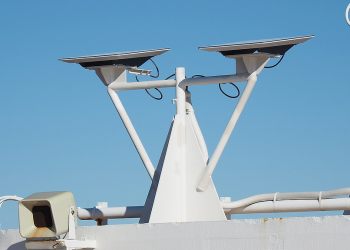
Ukraine’s long-range drone units have begun moving some of their satellite data links off SpaceX’s Starlink and Starshield networks and onto hardware from the Israeli-Italian HiSKY system, according to Russian and Ukrainian reports summarised by the Kyiv Post on 9 November. The shift followed a mid-October Starlink satellite internet restriction that stopped SpaceX terminals working above 160 kph (100 mph). Separately, Ukraine’s Ministry of Defence signed a letter of intent with Finland’s Nokia and ICEYE on 22 October to build satellite communications Kyiv itself controls.
Key facts
- Ukrainian media reports cited by the Kyiv Post say the Armed Forces of Ukraine began fitting drones with HiSKY’s smallest and cheapest terminal, a 6-kilogram (13-pound) unit called the Sirius 16×16 Ku, in mid-October.
- The Ukrainian research group DP Defpulse says the links move 2 Mbps in concentrated beams that hop between geostationary satellites, making them almost impossible to jam.
- The same report puts Starlink and Starshield at 50–250+ Mbps, which DP Defpulse says is the only way to fly a long-range drone visually.
- Nokia, the Finnish telecom equipment maker, and ICEYE, a Finnish satellite builder, signed a letter of intent with Ukraine’s defence ministry to explore space cooperation, per CNBC.
- Use of HiSKY by Ukrainian forces is not fully confirmed; DP Defpulse calls it highly probable.
Why it matters
The episode is the clearest case yet of a government swapping a commercial satellite network for a less capable one purely because of who holds the off switch. It also sets a benchmark for what a sovereign replacement costs in performance: on DP Defpulse’s figures, the HiSKY link carries a fraction of Starlink’s throughput.
The lesson travels beyond the front line, because the constellation that grounded Ukrainian drones is the same one that sells satellite internet to households, farms, ships and remote businesses. What changed in October was not a contract or a price list but a configuration setting, applied in a single market without notice. Anyone whose connectivity rests on one operator should know which performance limits that operator can impose unilaterally, what the service agreement actually guarantees, and what the fallback is when it cannot be negotiated.
For critical traffic, that is now a procurement question rather than a hypothetical — the dispute began with the speed cap that cut drone links.
What the reports claim
Claims about HiSKY first surfaced in Russian military media in late October, the Kyiv Post reports. Russian military analyst Konstantin Malofeev said in an Oct. 30 report that a HiSKY-equipped drone cannot be jammed because the system automatically hops between commercial satellites when the signal degrades, and that the switch let Ukrainian operators run uninterrupted swarm attacks on Russian oil refineries.
The Russia-associated Coordination Center for the Assistance of New Russia said in an Oct. 29 video on RuTube that it had confirmed information on the change. Its director, Aleksandr Liubimov, described the equipment as European rather than Musk-owned and said Ukraine was testing it in Russian border regions with a view to wider use.
Serhiy “Flash” Beskresnikov, a Ukrainian military communications expert and adviser to President Volodymyr Zelensky on military electronics, told Euromaidan Press he would neither confirm nor deny the Russian reports, adding that the technology is nothing unique. DP Defpulse notes the lower-capacity link can still pass course corrections in flight, allowing individual drones in a strike package to be redirected to a precise target.
How the Starlink satellite internet cap unfolded
Musk-owned companies imposed the 160 kph cap on SpaceX-associated terminals in Ukraine on or about Oct. 14, the Kyiv Post reports. Zelensky and other Ukrainian officials said dozens of million-dollar drones fell out of the sky on the first day; the cap also disabled high-speed Ukrainian interceptor drones used against Shahed-type jet-propelled attack drones, the Iranian-designed munitions Russia launches in nightly waves.
Accounts of who ordered it conflict. Musk said the White House told SpaceX to act, White House officials said it was Musk’s idea, and Zelensky blamed President Donald Trump. Both Mint and CNBC reported on 23 October that Trump said he would call Musk to get the limits lifted.
The sources also differ on when service returned. CNBC and Mint reported the restrictions were still in force as of Friday 23 October, while the Kyiv Post says international reaction and a congressional order to SpaceX helped restore Starlink and Starshield service to Ukrainian units by Oct. 24. Hearings in the congressional investigation into the speed limit begin in January, the Kyiv Post reports, with lawmakers pressing Musk over the Ukraine row from both parties.
This report treats the Kyiv Post’s Oct. 24 restoration as the operative timeline, because it postdates the CNBC and Mint accounts rather than contradicting them. Who ordered the cap remains unresolved on the public record, and may stay that way until the January hearings.
The sovereign alternative Kyiv is trying to build
Nokia and ICEYE announced a collaboration earlier in October on secure, sovereign, high-performance broadband systems in low Earth orbit for governments, covering defence, border security, emergency services and disaster response, and giving buyers ownership of satellites, ground segment and terminals, Nokia said in the statement reported by Mint. The Ukraine letter of intent was signed during the Finnish prime minister’s visit.
“We must all rely on capabilities that we can control,” Zelenskyy said in a statement quoted by CNBC. ICEYE chief executive and co-founder Rafal Modrzewski said his company has a record of delivering sovereign missions at speed and has supported Ukraine since 2022; CNBC notes ICEYE and its US subsidiary run a low-Earth-orbit radar imaging network that Ukraine uses for intelligence and operational planning. Zelenskyy separately announced a partnership with Norway on air defence and communications as a Starshield alternative, and other vendors pitching Starlink substitutes to Kyiv have since emerged.
Chad Anderson, founder and chief executive of venture firm Space Capital, told CNBC an alternative could be two to three years away and that matching Starlink’s scale is a longer road, with launch rather than capital now the constraint; he said Pentagon contracting documents name SpaceX as the only provider able to meet some needs through 2026. Virginia Burger, a senior defence policy analyst at the Project on Government Oversight, told CNBC there is no drop-in replacement today, just as combat shifts further towards unmanned systems that need high-speed internet.
Money has been chasing that gap since the invasion. Research by Anderson cited by CNBC puts venture and private equity investment in Starlink and Starshield alternatives at about $8 billion since Russia’s February 2022 attack, roughly $3.9 billion of it in potential Starlink competitors, mostly the satellite operators Spacesail and China SatNet. In Europe, Mint, citing a Financial Times report, says Deutsche Telekom, Orange, Telefónica and Vodafone are considering their own satellite mobile services to cut reliance on providers based outside the European Union.
CNBC lists Amazon’s Leo, France’s Eutelsat and Blue Origin’s unlaunched TeraWave among coming rivals, with the EU’s IRIS² constellation not expected to start launching until 2029.
Frequently Asked Questions
Who is paying for HiSKY’s UK operation?
The Kyiv Post, citing corporate information and a UK government statement, reports that HiSKY is an Israeli company with a British subsidiary, hiSkySat Ltd., which runs a research centre at Harwell in Oxfordshire. The UK Space Agency is funding the project with £9 million, about $12 million, allocated through the European Space Agency.
How many satellites does SpaceX have in orbit?
CNBC reports that SpaceX has around 11,000 satellites in orbit, according to data tracked by astronomer Jonathan McDowell.