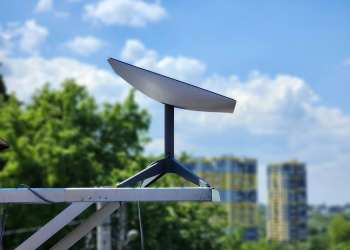
Russian strikes on Kyiv over the two days from 23 September 2026 hit several data centres and internet providers, disrupting service for around 100,000 households in the capital and Kyiv Oblast, the Kyiv Independent reported. On the evening of 23 September, a fire broke out at a Starlink ground station at Wola Krobowska in Poland’s Masovian Voivodeship — a site that Polish Deputy Prime Minister and Digital Affairs Minister Krzysztof Gawkowski said acts as an internet hub carrying traffic through Poland, including to Ukraine.
Two incidents, no established link
The two events fell inside the same 48-hour window, and both bear on how Ukraine stays online: the terrestrial fibre, exchange points and data centres that serve households in Kyiv, and a piece of ground infrastructure tied to the satellite internet service Ukrainian forces use at the front. They are separate incidents with separate investigations. No source cited in this report connects them, Polish investigators have published no finding tying the fire to the strikes, and the Kyiv Independent does not assert a common cause. They are reported here together as a matter of timing and subject, not as evidence of coordination.
Key facts
- Ukraine’s Digital Transformation Ministry said around 100,000 households in Kyiv and Kyiv Oblast had internet problems after the 23 September drone attack, with specialists assessing damage and restoring service, per the Kyiv Independent.
- Providers reporting direct damage included UTELS, Pavutyna, Crazy Network, Etherlink, hosting company MiroHost and hosting company CityHost.
- Crazy Network said a strike damaged a central internet traffic exchange in Kyiv, disrupting internet and telephone services in the capital and in Vinnytsia and Khmelnytskyi oblasts.
- The Polish station is operated by Exatel, the state-owned telecommunications company, and serves as an internet hub carrying traffic through Poland, including to Ukraine, Gawkowski said.
- Gawkowski said on 24 September the fire may have been an attempt to disrupt the station’s operations; Prime Minister Donald Tusk said the same day it was too early to call it sabotage or an accident, Polish news agency PAP reported.
- No confirmed loss of Starlink service is reported in any of the accounts available, and the investigation into the fire has produced no published findings.
Inside the Kyiv outage: what broke, and why it spread
The Kyiv Independent reports that Moscow is widening its target set from energy and telecommunications networks to the data centres and exchange points that move traffic. The outlet’s account shows the practical difference in who is affected: Crazy Network said damage to a single central traffic exchange in Kyiv disrupted internet and telephone services not only in the capital but in Vinnytsia and Khmelnytskyi oblasts, hundreds of kilometres from the damaged site.
The providers and data centres hit
UTELS reported damage to a Kyiv data centre housing its core equipment, leaving it without power, while Pavutyna said one of its data centres was hit, causing outages for some customers, according to the Kyiv Independent.
The disruption ran into 24 September. Kyiv-based provider Etherlink said an attack damaged its main network node, knocking some customers offline and forcing the company to relocate the core of its network. MiroHost said the data centre in Ukraine that housed its infrastructure was destroyed, and CityHost said equipment it stored at a Kyiv data centre had been destroyed, disrupting some of its services. MiroHost founder Oleksandr Olshansky told Ukrainian tech outlet dev.ua that around 90-95% of the company’s customers sit on infrastructure outside Ukraine and were unaffected; the report does not say when that infrastructure was moved abroad.
Why operators read this as a new phase
Anatolii Frolenkov, a representative of the 1-IX internet exchange point, told the Kyiv Independent: “This is the beginning of a phase where, since September, they have started taking it out systematically.” He said attacks on Ukraine’s communications infrastructure are not new, pointing to earlier strikes on energy and telecommunications networks, but that the recent escalation against data centres and communication nodes marks a shift in intensity. In Frolenkov’s account, the targets that changed are the data centres and communication nodes themselves, rather than the power and telecoms networks that carry them.
The Starlink ground station fire in Poland
What Polish officials have said
Gawkowski said on 24 September that there were indications the fire may have been an attempt to disrupt the station’s operations, suggested Russia could be behind it, and described the incident as potentially part of Moscow’s hybrid warfare. Tusk, the same day, said the circumstances “do not look good” but cautioned against early conclusions, telling reporters it was too early to determine whether this was sabotage or an accident, per PAP. The Kyiv Independent noted at the time that Polish authorities had not concluded their investigation.
Polish officials subsequently hardened that wording and described the fire as an act of sabotage. Readers should note the sourcing on that point: it rests on statements reported in our own follow-up coverage rather than on the Kyiv Independent report underpinning the rest of this article, and no investigative findings, technical report or official cause of the fire has been published in full. Exatel, the site’s operator, is not quoted in any of the accounts available.
Why a ground station in Poland matters to Ukraine
A satellite internet network is not purely in orbit. User traffic goes up to the constellation and has to come back down somewhere, at fixed ground sites that hand it to terrestrial fibre. Gawkowski’s description of the Wola Krobowska facility — an Exatel-operated internet hub moving traffic through Poland, including towards Ukraine — places it in that role, and he said a disruption there could affect internet access for the Ukrainian military, potentially depriving Ukrainian forces of communications at the front.
None of the available reporting quantifies that dependence: there is no published figure for how much Ukraine-bound traffic crosses this site, and no operator statement on whether it was rerouted. What the reporting does establish is location and framing. The site sits in Poland, a NATO member, and Gawkowski placed the incident in the category of hybrid warfare rather than of a wartime strike on Ukrainian soil — the same category Denmark’s military intelligence service used the same week when it warned of intensified Russian sabotage against Western critical infrastructure, per the Kyiv Independent.
How Ukrainian forces use Starlink
Starlink, the satellite internet service operated by Elon Musk’s SpaceX, allows high-speed communications between combat positions and command posts, the Kyiv Independent reports. It adds that when mounted on drones, Starlink provides an almost unjammable connection that is not constrained by the limits of traditional radio antennas.
Over 2026, Ukrainian forces have found increasing success with Starlink-linked drones operating over occupied territory, the outlet says, particularly in the “middle-strike” band it defines as 50 to 200 kilometres from the front line, where Russian logistics routes have been devastated by Ukrainian attacks. That dependence on a commercially owned network has repeatedly raised questions about who controls the service — including a July 2025 Reuters report that Musk ordered coverage cut in areas including Kherson during Ukraine’s late-2022 advance, which SpaceX called inaccurate.
What to watch next
- Whether Polish investigators publish a formal cause for the Wola Krobowska fire, and whether Exatel issues any statement on traffic routed through the site.
- How quickly Kyiv providers restore service, and whether more Ukrainian hosting companies report moving infrastructure abroad, as MiroHost’s customer split suggests many already have.
- Whether further strikes hit exchange points rather than last-mile networks, which is the pattern Frolenkov says began in September.
- Denmark’s military intelligence service warned on 24 September that Russia is likely to intensify hybrid attacks against the West and NATO, citing sabotage and destructive cyber operations against critical infrastructure, per the Kyiv Independent — the frame Polish officials are already applying to the ground station fire.
Frequently Asked Questions
How did Polish officials’ language about the Starlink ground station fire change over time?
It shifted within roughly 24 hours. The fire broke out on the evening of 23 September 2026 at Wola Krobowska in Masovian Voivodeship. On 24 September, Digital Affairs Minister Krzysztof Gawkowski said there were indications the fire may have been an attempt to disrupt the station’s operations and suggested Russia could be behind it, framing the incident as potentially part of Moscow’s hybrid warfare. Later the same day, Prime Minister Donald Tusk said the circumstances did not look good but that it was too early to say whether this was sabotage or an accident, Polish news agency PAP reported. The Kyiv Independent noted at that point that the investigation had not concluded. Polish officials subsequently used firmer wording and described the fire as an act of sabotage, a development covered in our own follow-up report rather than in the Kyiv Independent account this article is based on. No formal investigative findings have been published.
What could a disruption at the Wola Krobowska ground station actually affect?
Gawkowski described the site as an internet hub carrying traffic through Poland, including to Ukraine, and said a disruption there could affect internet access for the Ukrainian military and potentially deprive Ukrainian forces of communications at the front. That is a statement of potential consequence rather than a report of what happened: the Kyiv Independent’s account does not record any confirmed loss of satellite internet service arising from the fire, and it does not say how much of the traffic bound for Ukraine passes through this particular site or what redundancy exists elsewhere. No statement from the station’s operator, state-owned telecommunications company Exatel, is quoted in the accounts available.
Did the fire or the Kyiv strikes change Starlink availability or pricing for ordinary customers?
Nothing in the reporting says so. The sources describe damage to Ukrainian data centres, internet providers and a traffic exchange point in Kyiv, and a fire at a ground station in Poland; none of them report a consumer-facing Starlink outage, a change in where the service is sold, or any change in subscription or hardware pricing. The Kyiv Independent’s coverage of Starlink in this story concerns military use at the front, not the commercial consumer service.
Were hosting customers outside Ukraine affected by the destroyed data centre?
Mostly not, according to the Kyiv Independent’s account. MiroHost founder Oleksandr Olshansky told Ukrainian tech outlet dev.ua that around 90-95% of the hosting provider’s customers use infrastructure outside Ukraine and were unaffected, even though the data centre in Ukraine that housed the company’s own infrastructure was destroyed. The report does not say when or why that infrastructure came to sit abroad.
What is the "middle-strike" range the Kyiv Independent refers to?
The Kyiv Independent describes the middle-strike range as 50 to 200 kilometres from the front line. It reported that Ukrainian forces have had increasing success over 2026 using Starlink-enabled drones in that band, where Russian logistics routes have been devastated by Ukrainian attacks.
Why are internet exchange points a bigger target than individual providers?
An exchange point is where multiple networks hand traffic to each other, so damage there can spread beyond the operator that owns the building. Crazy Network said a strike damaged a central internet traffic exchange in Kyiv and that the result was disruption to internet and telephone services not only in the capital but in Vinnytsia and Khmelnytskyi oblasts, according to the Kyiv Independent.
Follow Starlink News on Google. Make us a preferred source to see more of our reporting in Google search results.