Elon Musk has praised the Starlink-powered train-tracking system on Greece’s railways, writing “Starlink saves lives” in a post on X dated 15 November, according to Greek City Times. The outlet, citing the Greek news site Skai.gr, said the post referred to railway.gov.gr, a live train-tracking platform run by the national rail operator OSE that has been operating for about a year.
Key facts
- Musk’s post on X was dated 15 November, per Greek City Times.
- All 134 locomotives on the network carry a satellite positioning receiver, a Starlink terminal and a camera.
- Positions are corrected to roughly five centimetres using HEPOS, the Greek Cadastre’s network of permanent reference stations.
- Starlink carries the data to a 24-hour Operations Centre in Acharnes, including from mountain and gorge sections where there is no mobile signal.
- The centre is alerted automatically if two trains are on the same track on a collision course.
- The system also monitors speeding and, per Skai.gr, uses artificial intelligence to analyse radio communications between trains and control.
- It was formally presented on 10 November at the former depot in Piraeus.
Why it matters
The role described for Starlink here is not passenger Wi-Fi. The same satellite internet service SpaceX mostly sells as consumer broadband is acting as a backhaul link for safety-critical telemetry: the Greek outlet, relaying Skai.gr, said it carries train data from sections of the network where mobile coverage does not reach, feeding a staffed operations centre rather than onboard devices.
Skai.gr describes the platform as an extra layer of safety that sits alongside signalling, remote control and the European Train Control System (ETCS), the EU’s standard train protection and signalling system. On that description, the tracking platform supplements existing rail safety systems rather than replacing them.
What is on board the trains
Equipment on each locomotive
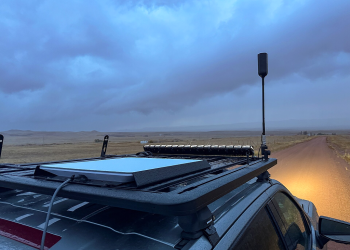
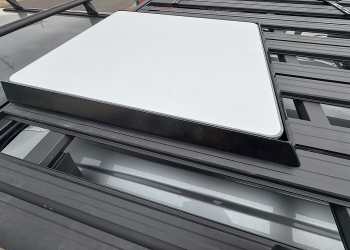
Each of the 134 locomotives is fitted with three pieces of equipment: a satellite positioning receiver, a Starlink terminal and a camera. That is one of the clearer published examples of transport operators fitting Starlink terminals to their fleets, though in this case the terminals serve the operator’s control room rather than travellers.
Why plain GPS is not enough
Standard GPS can be out by up to 15 metres, according to that account, which is not precise enough to tell which of two parallel tracks a train is on. Positions are therefore corrected against HEPOS, the Greek Cadastre’s reference-station network, bringing accuracy to about five centimetres — the difference between knowing roughly where a train is and knowing which rails it is standing on.
The Acharnes operations centre
The data ends up at a 24-hour Operations Centre in Acharnes. Two functions were singled out in the account: an automatic alert when two trains are on the same track on a collision course, and monitoring of speeding. Artificial intelligence is also used to analyse radio communications between trains and control, Skai.gr said.
Coverage of the mountain and gorge sections is the part the report ties directly to satellite. Those stretches have no mobile signal, so the Starlink link is what gets their data back to Acharnes — the same gap-filling role that has driven uptake on a network SpaceX says now carries 13.6 million subscriptions.
How the project was presented
The system was formally presented on 10 November at the former depot in Piraeus. The prime minister attended and called it “an image from the future,” Skai.gr reported. Neither the prime minister nor any other official present is named in the coverage.
Musk’s comment came five days later. Musk has used his own account to comment on public-safety connectivity before, and in this case his post ran to three words.
What the report does not establish
Greek City Times states plainly that the claims about the system’s accuracy and its AI analysis of radio traffic come from the Skai.gr report and have not been independently verified. No OSE statement, SpaceX statement or official Greek government document is quoted in the coverage.
Nor does the coverage say which Starlink service tier OSE buys, so the published prices for the consumer and mobility plans say nothing useful about what this deployment costs. There is no figure for the terminals, the monthly service, or any wider commercial arrangement with SpaceX beyond supplying connectivity.
The report also contains no figures on how many alerts the Acharnes centre has issued since the platform opened, no incident the system is credited with preventing, and no detail on how the links perform in bad weather or during outages. Readers should treat the described capabilities as the operator’s and Skai.gr’s account, not as independently tested results.
There is nothing in the source about Starlink availability or licensing outside Greece, and no indication that the OSE arrangement is being replicated by any other rail operator.
Frequently Asked Questions
Can members of the public view the Greek train map themselves?
Yes. Greek City Times, citing Skai.gr, reported that the public has been able to use railway.gov.gr since February 2026. The page shows the real-time position of every train on the network.
Who paid for the Greek train-tracking system?
The system was funded by a donation from 26 board members of the Union of Greek Shipowners, Greek City Times reported, citing Skai.gr. The report does not give a figure for the donation.
Did Elon Musk or SpaceX build the Greek platform?
No. Greek City Times reported that railway.gov.gr is run by OSE, the national rail operator, and that Musk’s involvement was a post on X praising it. Starlink’s role described in the report is carrying the data, not operating the platform.