Starlink said on 17 September that it will deliver the next generation of its Starlink Mobile service with au, the mobile brand of Japanese carrier KDDI, in a partnership the company says will “enable 5G speeds from space.” The post followed KDDI’s own English-language newsroom release of 15 September, which describes what the carrier calls Asia’s first Starlink Mobile V2 service agreement, signed with SpaceX on 10 August 2026.
This report is based on those two documents — KDDI’s release and Starlink’s post — which are the only primary accounts of the deal. Where a detail appears in only one of them, it is marked below. Both are statements by parties to the agreement; no independent regulatory filing or third-party technical disclosure about the Japanese service has been published.
Key facts
- Who: SpaceX’s Starlink and au, the mobile brand of KDDI, one of Japan’s major national mobile operators alongside NTT Docomo, SoftBank and Rakuten Mobile.
- What: a Starlink Mobile V2 service agreement, signed 10 August 2026 and publicised in mid-September.
- The upgrade (Starlink’s framing): the V2 satellite network expands on V1 with 100 times the data density, enabling native calls, high-speed apps and streaming.
- Timing (KDDI’s framing): native voice, streaming, browsing and high-speed apps targeted by the end of 2027. No launch date has been set.
- Where it is aimed: out-of-coverage areas — mountains, remote islands and coastal waters where au’s towers do not reach.
- Not published: V2 retail pricing, throughput, latency, coverage detail, compatible-handset lists, or any date firmer than the end-of-2027 target.
What changes between V1 and V2
The service running in Japan today is the first-generation layer, branded au Starlink Direct. KDDI has marketed it since 2025 as a nationwide safety net for areas its terrestrial network cannot reach, and it delivers messaging and light data when a compatible phone has a clear view of open sky. It does not carry voice calls. V2 is the layer meant to close that gap.
| Capability | au Starlink Direct (V1, live today) | Starlink Mobile V2 (targeted) |
|---|---|---|
| Status in Japan | Commercial since 2025 | Agreement signed 10 Aug 2026; no launch date |
| Messaging | Yes | Yes |
| Native voice calls | No | Targeted by end-2027 |
| Browsing, streaming, high-speed apps | No — light data only | Targeted by end-2027 |
| Device required | Ordinary compatible handset, clear view of sky | Ordinary handset; no special device described |
| Retail price | Positioned as an included capability | Not published |
| Published throughput / latency | None | None |
Sources: KDDI newsroom release, 15 September 2026; Starlink post, 17 September 2026.
The capabilities KDDI lists are precisely the ones the first generation cannot support, which is why the carrier frames the agreement as a service upgrade on an existing product rather than the launch of a new one. Customers who already use au Starlink Direct would, on that framing, gain capability on the handset they already carry — but neither company has said whether every phone certified for V1 will work on V2.
Why it matters
Direct-to-phone satellite service has so far been a thin layer everywhere it operates: text messages, emergency alerts and a trickle of app data. The upgraded tier is the step meant to turn that into something a customer would recognise as ordinary mobile service, and Japan is now the first named market in Asia for it.
Japan is also an unusually good test case for the pitch. It is a mountainous archipelago of thousands of islands with a large coastal fishing and shipping economy and a disaster-response culture built around typhoons and earthquakes — exactly the terrain where terrestrial towers stop and where a satellite layer that carries voice, rather than text alone, changes what a phone is good for.
What the 100x claim does and does not tell us
Starlink’s figure — 100 times the data density of the current generation — is a capacity measure over a given area, not a speed any single handset will see. A satellite carrying far more capacity still divides it among every phone inside a beam’s footprint, and that footprint is measured in thousands of square kilometres rather than the few square kilometres a terrestrial cell covers. Neither company translated the figure into megabits per second, and neither published a latency or coverage number for Japan.
That is the central missing number, and there is a second one behind it: neither the KDDI release nor Starlink’s post says how many second-generation satellites must be in orbit before the Japanese service can go live, or how many are flying now. A service agreement can be signed in a day; a constellation cannot. Until either company publishes a satellite count or a deployment schedule tied to the Japanese launch, the carrier’s target date rests on a build-out neither party has quantified in public.
What SpaceX said
Gwynne Shotwell, SpaceX’s president and chief operating officer, is quoted in the KDDI announcement describing the agreement as the next chapter of next-generation mobile broadband with the carrier. The quote appears in the carrier’s own release rather than in an interview, transcript or briefing open to questions, so it carries the weight of a prepared corporate statement. Starlink’s post added the 5G-speeds framing and the data-density figure but no date of its own, leaving KDDI’s goal as the only timing on the record.
Pricing still open
KDDI has not published V2 retail pricing, and that leaves the commercial question wide open: whether the satellite tier arrives as a bundled tariff feature, a paid monthly add-on, a per-use charge, or a benefit reserved for higher-end plans. The distinction matters for how many people actually use it. The first-generation au Starlink Direct layer was positioned as an included capability rather than a separately sold product, but nothing in either announcement says the same will apply to the upgraded service — and a tier that carries streaming and voice consumes far more network capacity than one that carries text.
The phone product also sits entirely apart from the published Starlink plans and prices for dish-based service, which are set by SpaceX directly rather than by a carrier.
How the carrier deals compare
The Japan agreement follows a template SpaceX has now repeated in several markets: a national mobile operator signs, a messaging-grade service goes live on the first-generation satellites, and the higher-capacity tier is promised at a later date.
| Market / operator | Service live today | V2 status |
|---|---|---|
| United States — T-Mobile | Commercial direct-to-cell messaging since 2025 (SpaceX’s first carrier partner) | Not launched; no native voice or streaming |
| Panama — +Móvil | Messaging live on the first-generation layer | Described as a later stage |
| Hungary and Albania — 4iG | Named partner | V2 broadband flagged as a later stage |
| Japan — au (KDDI) | au Starlink Direct: messaging and light data since 2025 | Agreement signed 10 Aug 2026; end-2027 target |
Sources: KDDI release and Starlink post for the Japan row; the remaining markets are drawn from the operator announcements tracked in our wider Starlink Mobile rollout coverage.
Read across the rows, one thing stands out: no operator anywhere has yet demonstrated the second-generation tier in commercial service. T-Mobile, three years into the partnership, still runs the same messaging-grade layer au does. Japan’s target is therefore consistent with a technology waiting on satellites rather than on contracts — and it means the first carrier to publish a real throughput figure, wherever that happens, will be the first genuine evidence that the upgrade works as advertised.
Not the dish business
It is worth being precise about what this product is not. Starlink Mobile is a carrier phone service sold through au on handsets customers already own. It is not a terminal, not a dish, and not a change to Starlink’s residential satellite internet business in Japan or anywhere else. The two lines use different hardware, different spectrum arrangements and, in most countries, different licences: direct-to-phone service generally runs on a mobile operator’s own licensed spectrum, which is why SpaceX needs a carrier partner in each market at all, while fixed satellite internet is authorised to SpaceX directly. SpaceX’s aviation and maritime Starlink products are a third, separate line and are unaffected by the au agreement.
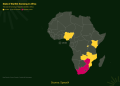
That separation is why a phone deal in one country says nothing about approvals in another. No African operator appears in any of the announcements around the au agreement, and no rival Japanese carrier is mentioned either. Readers tracking what is actually cleared where — for dishes and for phones — can consult our country-by-country licensing picture.
What to watch next
Three disclosures would settle most of the open questions: a KDDI pricing announcement for the V2 tier, a Starlink statement attaching a firmer date or a satellite count to the Japanese service, and the first published throughput figure from any carrier running the second-generation layer anywhere in the world. Until then, the only dates on the record are the 10 August 2026 signing and the 15 and 17 September announcements, plus the carrier’s stated end-of-2027 goal.
Frequently Asked Questions
Will au customers need a special satellite phone for Starlink Mobile V2?
No. Both companies describe a service that runs on ordinary handsets, with the satellites behaving like additional mobile towers. The existing au Starlink Direct layer already works that way on a compatible phone, provided it has a clear view of open sky — an indoor or heavily obstructed position will not connect. Neither company has published a compatible-device list for V2.
How is V2 different from the au Starlink Direct service running today?
Today’s au Starlink Direct is the first-generation layer: messaging and light data only, with no voice calls. V2 is meant to add the things a phone normally does on a terrestrial network — native voice, browsing, streaming and high-speed apps. Starlink attributes the jump to a new satellite generation it says carries 100 times the data density of the current one. Neither company has published throughput, latency or coverage figures for either tier in Japan.
When can au customers actually use Starlink Mobile V2?
There is no launch date. KDDI signed the agreement with SpaceX on 10 August 2026 and has set an end-of-2027 target for native voice, streaming, browsing and high-speed apps. Starlink’s own post did not attach a date, so the carrier’s target is the only timing on the record.
Which other carriers are named in the Starlink Mobile rollout alongside au?
Panama’s +Móvil, which has already launched live messaging on the first-generation layer, and a European path in Hungary and Albania under 4iG. T-Mobile US was SpaceX’s first carrier partner and has run a commercial first-generation service since 2025. V2 high-speed service is described as a later stage in every one of those markets. No African operator is named in the announcements around the au deal.
Does this change Starlink availability or pricing for dish customers?
No. This is a carrier phone product sold through au, not a new terminal or a change to residential satellite internet. Dish-based Starlink is licensed separately from direct-to-phone service in most markets, uses different hardware and sits on a different price list, and neither the KDDI release nor Starlink’s post addresses it.
Follow Starlink News on Google. Make us a preferred source to see more of our reporting in Google search results.