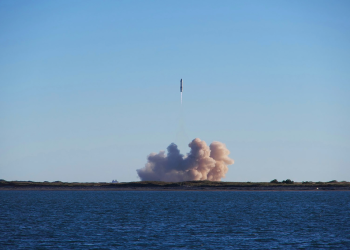
SpaceX launched its Starship vehicle from the company’s Starbase facility at Boca Chica Beach in Texas on Monday, September 28, and for the first time sent it into orbit around the Earth, according to NPR. During the flight SpaceX deployed 26 next-generation Starlink V3 satellites — the first time Starlink hardware has been released from the vehicle. An engine failure during ascent then cut a planned 10-hour mission to about three hours, NPR reports.
Key facts
- Liftoff came at 7:48 a.m. CT, when the Super Heavy booster ignited its 33 engines to send the 171-foot-tall vehicle on its 14th flight, NPR reports.
- Starship separated from the booster two-and-a-half minutes after launch and continued into space, according to NPR.
- It was the first Starship flight to reach orbital speeds — about 17,500 mph — at an altitude of about 170 miles, NPR reports; earlier test flights were suborbital, Caliber.az says.
- The 26 Starlink V3 satellites were deployed in a process expected to take about 30 minutes, per Caliber.az.
- One of the six engines on Starship failed during ascent, and about 22 minutes into the flight the team decided it was safe to continue to orbit, NPR reports.
- Starship splashed down north of Hawaii; the booster simulated a landing offshore in the Gulf of Mexico rather than being caught by the launch tower, according to NPR.
Why a rocket test is a broadband story
Starship is the only spacecraft that can launch the larger V3 version of SpaceX’s Starlink satellites, NPR reports — the satellites that feed the constellation of thousands of spacecraft providing broadband access worldwide. That single fact is the hinge of the day: the V3 hardware has no other ride to orbit, so the constellation’s next generation moves only as fast as this vehicle does.
SpaceX has said as much to its own investors. NPR reports that in filings made ahead of the company’s IPO in June, SpaceX said any failure or delay in developing Starship at scale, or in achieving the required launch cadence, reusability and capabilities afterwards, would delay or limit its ability to execute its growth strategy.
The near-term launch picture is split between two rockets and two coasts. SpaceX still launches Starlink satellites regularly on Falcon 9 from Florida and California, NPR notes, but announced the final Florida Starlink mission on Falcon 9 last month and plans to use Starship from the state’s Space Coast in future — a shift reported here as the end of Falcon 9’s Florida Starlink era. Falcon 9 keeps flying Starlink from California in the meantime, NPR says.
What it means for Starlink customers, and what it does not
For subscribers, the honest answer on Monday is that nothing measurable changed. SpaceX announced no new pricing, no plan changes and no coverage openings alongside Flight 14 in any of the accounts reviewed for this report, and none of those accounts contains a monthly price, a hardware price, a waitlist figure or a named capacity-constrained market. Readers tracking the cost of Starlink should treat this flight as an input to future capacity, not as a pricing event: there is no sourced number attached to it.
What can be stated with attribution is the dependency. NPR reports that the higher-capacity V3 satellites can only launch on Starship, and that SpaceX told investors its growth strategy depends on developing Starship at scale and achieving launch cadence and reusability. By this outlet’s reading of those two reported points, a Starship that reaches orbit and releases a batch is the first hard evidence that the supply line behind future Starlink capacity is functioning — but it is a step in a programme, not a delivery to any customer’s dish.
We have examined the cost side of that question separately in our earlier look at what Flight 14 could mean for the cost of Starlink capacity. This report does not independently verify any projected saving, and SpaceX has published no cost figure of its own tied to Monday’s flight in the reporting reviewed here.
The engine failure and a shortened mission
SpaceX had planned a 10-hour flight including six orbits of the Earth, but mission managers cut it back to about three hours after launch, NPR reports. One of Starship’s six engines failed during ascent; roughly 22 minutes into the flight, the team judged it safe to continue to orbit, according to NPR.
The company set out its reasoning in a flight update posted to its own site, quoted by NPR:
“Out of an abundance of caution given the engine issue experienced during ascent, the flight control team decided to limit the duration spent on orbit and proceeded with deorbiting Starship to a splashdown location in the northern Pacific Ocean.”
NPR says the mission’s launch profile included portions that would allow Starship to abort its orbital trajectory and return to Earth safely. Reading NPR’s account, that design choice is what turned an engine loss into a shortened mission rather than a failed one — an interpretation offered here, not a statement from SpaceX. NPR also reports SpaceX was testing upgrades to the booster’s software and hardware on this flight.
What the satellites were carrying
Three of the deployed Starlink satellites have cameras installed to capture data on Starship’s heat shield, NPR reports. Surviving reentry is key to SpaceX’s plans for spacecraft reusability, the outlet says, and the company is testing key systems of the vehicle including that heat shield. NPR does not say why SpaceX chose satellites rather than dedicated instrumentation to carry those cameras; this outlet reads it as a way to gather engineering data on a flight already carrying operational hardware, but that is inference. The remaining satellites join the constellation that delivers broadband from low orbit, the approach set out in our guide to how low-Earth-orbit satellite internet works.
Where the accounts differ
Pre-flight and post-flight reporting does not line up on two points. Caliber.az, writing as the mission unfolded, said the booster was expected back about seven minutes after launch and that Starship would splash down in the Pacific west of Chile after roughly six orbits; NPR, reporting afterwards, says the shortened flight ended with a splashdown north of Hawaii. The gap is best read as the plan versus what the engine issue forced.
On timing, LatestLY reported a 75-minute launch window opening at 7:15 a.m. Central Time, citing SpaceX’s announcement and a post by Elon Musk; NPR puts the actual ignition at 7:48 a.m. CT — within that window rather than in conflict with it.
Background
Starship is being developed by Musk’s SpaceX, the US launch and satellite-internet company, as a fully reusable launch system, Caliber.az reports, with Musk saying the technology could transform space travel by eventually carrying crew and cargo to Earth orbit, the Moon, Mars and beyond. SpaceX describes Starship as the world’s most powerful launch vehicle ever developed, according to Caliber.az, and LatestLY reported that both the Super Heavy booster and the upper stage were planned to perform controlled splashdowns after completing objectives including orbital insertion and satellite deployment.
The programme has not had a clean run to this point. Caliber.az reports several setbacks during testing in 2025, including a Starship that exploded into a fireball on its stand in June of that year, and says more recent tests have been more successful.
Beyond Starlink, NASA has tapped SpaceX to develop Starship as a human landing system for future Artemis missions, NPR reports; the agency plans to test docking its Orion crew capsule to Starship, alongside a separate commercial lander from Blue Origin, on Artemis III, which NPR says is slated to launch late next year. SpaceX has also announced a $100 billion Louisiana facility with dozens of launch pads, aiming to launch Starship from Starbase, La., in 2029, according to NPR.
A note on sourcing
Most of the hard numbers in this report — the 7:48 a.m. CT liftoff, the 17,500 mph orbital speed, the 170-mile altitude, the single failed engine, the 22-minute decision point, the Hawaii splashdown, the IPO filing language and the NASA and Louisiana plans — come from a single outlet, NPR. Caliber.az independently reports the orbital milestone, the roughly 30-minute deployment sequence and the programme’s 2025 setbacks; LatestLY independently reports the pre-flight launch window and the planned splashdown profile; SpaceX’s own flight update, quoted by NPR, is the source for the company’s explanation of the shortened mission. Where those accounts conflict, we have said so rather than picked one. Any figure not attributed above should be treated as unverified.
Frequently Asked Questions
Was anyone on board Starship Flight 14?
No. NPR reports that no one was on board; the payload bay carried 26 Starlink V3 satellites instead, three of them fitted with cameras pointed at the vehicle’s heat shield. Caliber.az separately describes Starship as currently uncrewed and says SpaceX intends to use the vehicle for human missions to the Moon and Mars once it is proven.
Does Flight 14 change Starlink prices or availability?
No. None of the reporting reviewed here records a pricing change, a plan change or a new coverage opening announced alongside the launch, and none of those accounts contains a subscriber price figure or a waitlist count for any market. The link is structural rather than same-day: NPR reports Starship is the only spacecraft that can launch the larger V3 satellites, and that SpaceX warned investors ahead of its June IPO that any failure or delay in developing Starship at scale would delay or limit its ability to execute its growth strategy. By this outlet’s reading of that filing language, a working Starship is a precondition for faster expansion, not a change to what anyone pays this month.
Will the V3 satellites make Starlink faster for existing customers?
The reporting reviewed here does not say. NPR describes the V3 units only as the larger, next-generation version of SpaceX’s Starlink satellites and as hardware that only Starship can launch; neither NPR nor Caliber.az publishes a per-satellite capacity figure, a speed figure or a date on which V3 capacity reaches consumer terminals. This outlet has not independently verified any performance claim for the V3 generation.
When will Starship start launching Starlink satellites from Florida?
NPR reports SpaceX announced last month that it had flown its final Falcon 9 Starlink mission from Florida and plans to use Starship from the state’s Space Coast in future, but that reporting attaches no date to the switch. Falcon 9 continues to fly Starlink missions from California, NPR notes. Further out, NPR reports SpaceX aims to begin launching Starship from a new site at Starbase, Louisiana, in 2029.
What role does Starship play in NASA’s Moon programme?
NASA tapped SpaceX to develop Starship as a human landing system to carry astronauts to the lunar surface on future Artemis missions, NPR reports. The agency plans to test docking its Orion crew capsule to Starship, alongside a separate commercial lander from Blue Origin, during Artemis III — a mission NPR says is slated to launch late next year.
How big is the Louisiana launch site SpaceX has announced?
NPR reports SpaceX has announced plans for a massive facility in Louisiana backed by a $100 billion investment that includes dozens of launch pads, with first Starship launches from Starbase, La., targeted for 2029. NPR also reports SpaceX told investors that achieving the required launch cadence is central to its growth strategy; the connection between pad count and cadence is this outlet’s inference, not a claim in the filing as reported.
Had Starship reached orbit before Flight 14?
No. NPR reports this was the 14th flight of the vehicle and the first to reach orbital speeds of about 17,500 mph, at an altitude of roughly 170 miles; Caliber.az says earlier test flights were suborbital. Caliber.az also notes the programme has absorbed setbacks, including a Starship that exploded into a fireball on its stand in June 2025, and says more recent tests have gone better.
Follow Starlink News on Google. Make us a preferred source to see more of our reporting in Google search results.