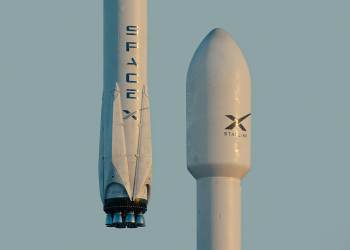
SpaceX launched 27 more Starlink broadband satellites from Vandenberg Space Force Base in California in the predawn hours of Wednesday, Aug. 26, on a mission the company designated Starlink 15-22, according to Spaceflight Now. The flight came a day after the same outlet reported that SpaceX had flown what its launch chief called the last planned Starlink mission on a Falcon 9 rocket from Florida, as the company shifts those East Coast flights to its much larger Starship vehicle.
Back to back, the two missions describe the moment the Starlink constellation changed rockets on one coast but not the other: Florida hands its Starlink work to Starship, while California keeps flying the Falcon 9 that built the network.
Key facts
- Mission: Starlink 15-22, carrying 27 broadband internet satellites to SpaceX’s low Earth orbit megaconstellation, per Spaceflight Now.
- Liftoff: Space Launch Complex 4 East at Vandenberg Space Force Base, at 2:35 a.m. PDT (5:35 a.m. EDT / 0935 UTC), with the rocket flying a south-easterly trajectory off the pad.
- Booster: Falcon 9 first stage with tail number B1082, on its 24th flight.
- Recovery: the booster landed on the droneship Of Course I Still Love You in the Pacific Ocean nearly 8.5 minutes after liftoff. Spaceflight Now posted an update confirming the landing at 6:15 a.m. EDT on Aug. 26.
- Landing tally: the 221st landing on that droneship and the 655th Falcon booster landing to date, the outlet reported.
- Cadence: SpaceX has flown more than 2,000 Starlink satellites to orbit so far this year, according to the same report.
- The day before: Starlink 10-49 from Cape Canaveral, described by SpaceX Vice President of Launch Kiko Dontchev as the last planned Starlink launch on a Falcon 9 from Florida.
Why it matters
Spaceflight Now describes the Starlink fleet as the largest low Earth orbit satellite constellation, providing connectivity to millions of people around the world, and the 27 satellites on Starlink 15-22 add to it. That is the direct line between a 2:35 a.m. launch on the California coast and the service customers buy: the constellation only grows batch by batch, and on Falcon 9 a batch is 27 satellites.
The second point matters more for the next year of deployments. The workhorse rocket that built the network is handing part of its Starlink job to Starship. Spaceflight Now reported that Dontchev said the Cape Canaveral mission flown the previous day, Starlink 10-49, was the last planned Starlink launch on a Falcon 9 from Florida as the company begins to pivot to Starship orbital launches. Nothing in that reporting attaches a date to the first Florida Starlink launch on Starship, and we are not going to guess at one.
The mission in detail
The booster used for Starlink 15-22, B1082, had already flown a mix of government and commercial payloads before this Starlink batch, according to Spaceflight Now: the NROL-145 and USSF-62 missions, OneWeb Launch 20, and 20 earlier batches of Starlink satellites. OneWeb is a rival low Earth orbit broadband operator, which makes the same booster a launcher for both SpaceX’s constellation and a competitor’s.
The outlet reported the touchdown on Of Course I Still Love You, one of SpaceX’s Pacific recovery vessels, as a routine close to the flight, with no anomalies described anywhere in its coverage.
The launch site matters to what the satellites do. Vandenberg’s Space Launch Complex 4 East is the pad SpaceX uses for missions heading into higher-inclination orbits, and Spaceflight Now noted the rocket flew a south-easterly trajectory after liftoff — the profile that fills the constellation shells covering higher latitudes, rather than the equatorial-leaning shells favoured from Florida.
What the numbers say about the pace
The figures in Spaceflight Now’s report are worth putting side by side. Taken together they show a launch programme running at industrial rhythm on the day it began handing part of that work to a new rocket. The arithmetic below is ours, drawn from the outlet’s published numbers.
- More than 2,000 Starlink satellites flown so far this year. At the 27-satellite batch size flown on Starlink 15-22, that is the equivalent of roughly 74 Falcon 9 Starlink missions in a single year.
- Roughly 260 Starlink missions from Cape Canaveral over seven years, per Dontchev’s figure — an average of about 37 a year from Florida alone, or one roughly every 10 days, sustained.
- 221 landings on Of Course I Still Love You against 655 Falcon booster landings overall — about one in every three recovered Falcon boosters has come home on that one Pacific droneship.
- 24 flights on B1082 alone, a single airframe that has carried national security payloads, a rival constellation’s satellites and 21 Starlink batches, counting this one.
Those comparisons are derived numbers, not claims made by Spaceflight Now or by SpaceX. We flag them as such because the underlying totals are the only cadence figures the available reporting provides; the outlet does not publish a year-over-year Starlink deployment comparison in this coverage, so we are not attributing a growth trend to anyone.
End of an era on the East Coast
The handover from Florida is the part SpaceX itself chose to mark, and it did so through its own executive rather than a press release. “You’ve made Falcon 9 the most reliable launch vehicle in history,” Dontchev wrote in a social media post quoted by Spaceflight Now, thanking the team and adding that it had helped build the constellation and set the foundation for what comes next.
In the same post, according to the outlet, he said Falcon has flown roughly 260 Starlink missions from the Cape in the last seven years, said Starlink missions out of Florida will now fly on Starship, and added that he could not wait to launch those missions and many more with the new vehicle.
Readers tracking that vehicle’s progress can follow Starship’s next orbital attempt and our running Starlink V3 launch timeline, price and availability coverage, which tracks the bigger satellites Starship is built to carry. Earlier this month, as we reported, Starship Flight 13 carried 20 Starlink V3 satellites on a suborbital path — the clearest published marker so far of where the Florida Starlink workload is being sent.
What it does not change for price or availability
For customers, the useful point is what was not announced. Neither the Starlink 15-22 launch nor the final Florida Falcon 9 Starlink mission came with any statement in this reporting on Starlink subscription pricing, hardware costs, country availability, capacity waitlists or new market licences, in Zimbabwe, elsewhere in Africa or anywhere else. Spaceflight Now’s coverage is launch reporting, and it stays inside launch operations.
That distinction is worth holding on to, because rocket news and service news move on different clocks. A rocket changing over on one coast tells you how satellites will get up; it does not, on its own, tell you what a kit costs in a given country or when a sold-out cell opens. Where price and availability do move, we cover them separately and say who announced them — our Starlink V3 launch timeline, price and availability coverage is where those threads are tracked.
Background
Vandenberg Space Force Base is the US Space Force installation on the California coast that SpaceX uses for launches heading into higher-inclination orbits; Cape Canaveral Space Force Station in Florida is its East Coast counterpart. Spaceflight Now identifies both as the sites behind the back-to-back Starlink missions described here, flown roughly a day apart on opposite sides of the country.
How we sourced this story
Readers are entitled to know how thin or thick the sourcing under a story is. This one rests on three layers, and only three:
- Spaceflight Now’s launch coverage of Starlink 15-22, which supplies the mission designation, pad, launch time, trajectory, satellite count, booster identity and flight history, landing time and vessel, and the landing and annual satellite totals.
- Kiko Dontchev’s social media post as SpaceX Vice President of Launch, quoted in that coverage. This is the primary statement behind the Florida handover, the roughly 260 Cape Starlink missions and the plan to fly Florida Starlink missions on Starship — a SpaceX executive speaking for SpaceX, rather than an outside assessment of the company’s plans.
- Starlink News’s own earlier reporting on Starship Flight 13 and the Starlink V3 timeline, linked above, used only for context on the vehicle taking over.
We hold no SpaceX press release, regulatory filing or second-outlet report on the Florida handover to place alongside Dontchev’s post, and we have not independently verified the launch and landing figures. Every number and quote above should be read as Spaceflight Now’s or Dontchev’s, not as an independent confirmation, and the comparisons in the cadence section are our arithmetic on their figures. If SpaceX or a regulator publishes something that firms up or contradicts the Starship handover timeline, we will update this story and say what changed.
Editor’s note: a working wire headline attached to this story referred to a Falcon 9 failure on a mission called Starlink 9-3 and to 20 satellites left to reenter. Nothing in the reporting available to us supports that, and we are not reporting it.
Frequently Asked Questions
Does this mean Falcon 9 has stopped launching Starlink satellites altogether?
No. According to Spaceflight Now, what SpaceX marked was the last planned Starlink launch on a Falcon 9 from Florida, and the Starlink 15-22 mission flew on a Falcon 9 from California a day later. The outlet reports no end to Falcon 9 Starlink launches from Vandenberg Space Force Base, and the West Coast pad SpaceX used for this flight, Space Launch Complex 4 East, is the one it uses for higher-inclination Starlink shells.
How often has Falcon been launching Starlink missions from Cape Canaveral?
SpaceX Vice President of Launch Kiko Dontchev said Falcon has flown roughly 260 Starlink missions from the Cape in the last seven years, in a social media post quoted by Spaceflight Now. On those figures that works out to an average of about 37 Starlink missions a year from Florida alone, or roughly one every 10 days sustained over seven years — a Starlink News calculation from the numbers Dontchev gave. Dontchev added that Starlink missions out of Florida will now fly on Starship.
What do the booster and droneship numbers say about SpaceX’s reuse record?
Spaceflight Now reported that the Starlink 15-22 first stage, B1082, was flying for the 24th time, and that its touchdown was the 221st landing on the droneship Of Course I Still Love You and the 655th Falcon booster landing overall. Comparing those two figures, that single Pacific droneship has caught about a third of every Falcon booster SpaceX has ever recovered — a Starlink News calculation from the outlet’s numbers.
Does the Starship handover change Starlink prices or availability in my country?
Nothing in the available reporting says so. Spaceflight Now’s coverage of Starlink 15-22 and of the final Florida Falcon 9 Starlink mission deals with launch operations only, and carries no announcement on Starlink pricing, hardware costs, country availability or new market licences, including in Zimbabwe or elsewhere in Africa. Starlink News tracks price and availability changes separately, including in our Starlink V3 launch timeline, price and availability coverage.
Was there a Falcon 9 failure on a Starlink 9-3 mission?
Not in any reporting we can cite. A working wire headline attached to this story referred to a Falcon 9 failure on a mission called Starlink 9-3 and to 20 satellites left to reenter. The Spaceflight Now report available to us covers the Starlink 15-22 launch from Vandenberg and makes no mention of that mission, of a launch failure or of satellites reentering. Starlink News has no sourced information on the claim and is not reporting it.
Follow Starlink News on Google. Make us a preferred source to see more of our reporting in Google search results.