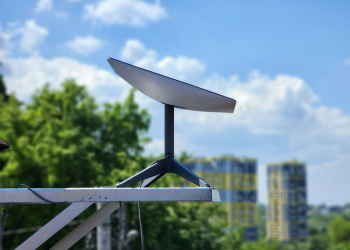
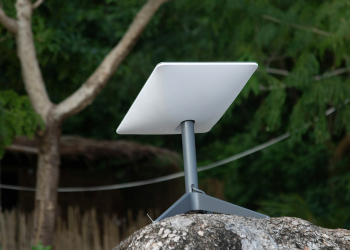
NuRAN Wireless Inc. (NASDAQ:NUR)(FSE:1RN), a Québec-based company that finances, builds, owns and operates rural mobile network infrastructure in Africa, said on 22 September 2026 that it will pilot licensed Starlink low Earth orbit (LEO) satellite service as backhaul at a single selected site in Nigeria. The test will be run with Infratel, described in the announcement as a long-time NuRAN partner, and NuRAN says the Starlink service is obtained through third-party service provider arrangements rather than from SpaceX directly.
One caveat belongs at the top rather than the bottom: everything known about this pilot comes from a single corporate announcement issued by NuRAN through ACCESS Newswire and syndicated the same day by two financial outlets. There is no independent reporting on it, no regulator filing, no named customer operator and no outside telecom analyst on the record assessing the claims. The numbers and the ambition below are NuRAN’s own.
What was announced, and what was left out
The announcement was issued from Québec and carried by Yahoo Finance and FinanzNachrichten.de on 22 September 2026. The two versions carry the same corporate text but differ in emphasis, and reading them side by side makes clear how much of the pilot is still open.
Confirmed in the release
- Partner: Infratel, with Managing Director Tunji Alabi quoted directly.
- Country and scale: Nigeria, at one selected NuRAN node.
- Supply route: licensed Starlink service bought through third-party service providers, with NuRAN stating it has no direct contractual or commercial relationship with Starlink or SpaceX in connection with the pilot.
- Portfolio size: more than 5,000 sites under contract, of which a portion have been built and are operating today.
- Stated test criteria: performance, reliability, integration and cost efficiency at commercial scale.
- Named expansion markets: the Democratic Republic of the Congo, Côte d’Ivoire, Benin and Cameroon.
- Company claim: NuRAN calls the pilot a first-of-its-kind initiative and, in the summary points published by Yahoo Finance, its first LEO integration anywhere in its network.
Not disclosed
- No start date, end date or duration.
- No cost, budget or per-site service price.
- No site name or state within Nigeria.
- No capacity target, latency figure or service-level commitment.
- No named third-party service provider supplying the Starlink capacity.
- No mobile network operator customer identified as the beneficiary of the upgraded site.
- No financial terms with Infratel.
The forward-looking statements notice published by FinanzNachrichten.de is explicit on the point: the timing, scope, performance, cost, reliability and results of the pilot are all listed as uncertain.
Why backhaul is the bottleneck
In the release, NuRAN argues that as it expands what its rural sites can do, backhaul — the link that carries traffic from a tower back into the wider network — becomes the decisive factor in both network performance and site economics. Higher-capacity 4G services and applications such as local content caching, edge compute, AI-enabled services and energy management all need reliable data transport that can be deployed in the realities of remote markets, the company says.
The physics behind the pitch is the part that is not in dispute. A satellite in low Earth orbit sits hundreds of kilometres up rather than the roughly 36,000 km of a geostationary spacecraft, which is why LEO services return round-trip times closer to terrestrial links than to legacy VSAT; readers who want the mechanics can compare low Earth orbit and geostationary satellite links. For a tower with no fibre and no usable microwave line of sight, that latency difference is what makes satellite viable as backhaul for a mobile site rather than merely as a consumer broadband product.
NuRAN frames the commercial logic bluntly: every additional megabit delivered to one of its towers is a megabit it can monetise. Where terrestrial backhaul is constrained, costly or unavailable, management says it believes licensed LEO satellite service can transform the performance, scalability and profitability of its owned rural infrastructure, turning hard-to-reach sites into high-value nodes.
The numbers NuRAN has put on the record
More than 5,000 sites under contract
The 5,000-plus figure is the company’s own and is stated as sites under contract, not sites built. NuRAN says only a portion of that total has been constructed and is operating today, and the release does not break out how large that portion is. That matters for reading the pilot: a backhaul technique proved at one node has to survive the economics of hundreds or thousands of nodes before the contracted pipeline turns into revenue, and NuRAN publishes no figure for how many of its existing sites are backhaul-constrained in the first place.
Four more markets, one copy-and-paste blueprint
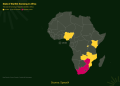
If the Nigeria test works, NuRAN says it could become a repeatable, copy-and-paste blueprint for the Democratic Republic of the Congo, Côte d’Ivoire, Benin and Cameroon. It says Starlink service has recently been licensed in the first three and that Cameroon is in process, and that capacity in those markets is available through third-party service providers. The company states it intends to become one of Africa’s most significant enterprise users of LEO satellite connectivity through such providers — while conceding in the same release that any scaling depends on suitable service-provider arrangements being available. No timetable is attached to any of the four markets.
What the pilot is meant to prove
According to the Yahoo Finance version, NuRAN will deploy the third-party-supplied Starlink service as a next-generation backhaul solution on a single NuRAN node in Nigeria. The stated aim is to show that LEO backhaul can accelerate 4G migration and higher-capacity rural connectivity, and support what the company calls its broader infrastructure platform initiatives, including edge AI, local compute and NuEnergy.
Microwave and TV white space stay in the mix
NuRAN also says it expects to continue using terrestrial transmission — naming microwave and TV white space — where line of sight and local conditions allow, describing the mix as a “best tool for the job” model. That hedge is the most informative line in the release, because it concedes that LEO is being positioned as the option for sites terrestrial links cannot reach economically, not as a wholesale replacement. It is the same logic that has driven farms and remote properties that turned to satellite service where fixed lines never arrived — applied one layer up the network, to the tower rather than the household.
What the executives said
Francis Létourneau, Director and Chief Executive Officer of NuRAN, is quoted in the release as saying: “Backhaul is the key that unlocks NuRAN’s next phase of growth,” as published by Yahoo Finance. He adds that the company has always described Starlink service as an opportunity rather than a threat, and says it is now testing that conviction through a service-provider-led pilot.
Tunji Alabi, Managing Director of Infratel, says in the release that his company values its long-standing relationship with NuRAN and the chance to support the evaluation in Nigeria, and that licensed Starlink service made available through third-party arrangements offers a way to bring LEO backhaul into live commercial networks. He says Infratel believes the initiative can accelerate reliable, higher-capacity connectivity to underserved communities.
Both quotes are prepared statements inside a company announcement. Neither executive was answering questions, and neither addresses the obvious follow-ups: what the service costs per site, whether a third-party reseller can offer the service-level guarantees a mobile operator customer would demand of its backhaul, or what happens to the blueprint if a regulator or SpaceX changes the terms on which intermediaries may resell capacity. This report will be updated if NuRAN, Infratel or SpaceX responds to those points.
How to read a single-source announcement
The buying structure NuRAN describes — licensed capacity obtained through an intermediary rather than from SpaceX — is not unusual in African markets, where carriers have built retail and wholesale products on top of the constellation, as with Airtel’s Starlink-powered mobile service in Uganda. What distinguishes NuRAN’s version is that it is explicitly a test at one site, with no SpaceX relationship behind it and no disclosed commercial terms.
That makes the absent cost data the central unanswered question rather than a footnote. NuRAN lists “cost efficiency” as one of four things the pilot is meant to validate, but publishes no baseline for what its existing microwave and TV white space links cost per site, no quoted price for the LEO service, and no capacity tier, so there is no way for an outside reader to judge whether satellite backhaul is cheaper, dearer or merely available where nothing else is. Any pricing figures circulating for Starlink business or maritime plans are consumer and enterprise retail rates in other markets and are not what NuRAN has said it is paying. Until the company discloses a per-site number — or a comparison against its own terrestrial baseline — the cost-efficiency claim remains a hypothesis the pilot is designed to test, not a result.
Nothing in either version of the release touches availability or pricing in Zimbabwe or elsewhere in southern Africa.
Background
NuRAN describes itself as a rural telecommunications infrastructure company operating a Network-as-a-Service model, financing, building, owning, operating and maintaining 2G, 3G and 4G infrastructure for mobile network operators that want coverage outside urban markets. It says it is developing plans to add modular edge compute nodes at selected built sites, and names 4G migration, local content caching, edge compute, AI-enabled services, energy management and NuEnergy as services it wants to run over higher-capacity backhaul, each a potential new revenue line. Further company information is published at nuranwireless.com.
Because both outlets carry the same corporate text, the facts in this report come from NuRAN and Infratel rather than from independent verification. Yahoo Finance includes the bulleted summary of the deployment and rollout plan; FinanzNachrichten.de includes the forward-looking statements notice. No financial terms, site name or schedule appear in either version.
Frequently Asked Questions
Does NuRAN have a contract with SpaceX or Starlink for this pilot?
No. The announcement carried by Yahoo Finance states plainly that NuRAN has no direct contractual or commercial relationship with Starlink or SpaceX in connection with the pilot. The service is obtained through third-party service provider arrangements. SpaceX has not commented publicly on the pilot.
Has NuRAN said when the pilot starts or what it will cost?
No. Neither syndicated version of the release gives a start date, duration, capacity target or budget. The forward-looking statements section published by FinanzNachrichten.de lists the timing, scope, performance, cost, reliability and results of the pilot as matters that are not yet determined.
What does Starlink backhaul cost NuRAN per site?
NuRAN has not said. The release claims the pilot will test "cost efficiency" but publishes no per-site figure for LEO service, no comparison against the microwave or TV white space links NuRAN already runs, and no capacity tier. Until those numbers are released, the cost-efficiency claim cannot be checked from the outside.
Will NuRAN drop microwave and TV white space backhaul?
No. The company says it expects to keep using terrestrial transmission technologies, including microwave and TV white space, where line of sight and local conditions support them. It describes the approach as a flexible, capital-efficient "best tool for the job" model.
Which countries could get the rollout if the Nigeria pilot works?
NuRAN names four: the Democratic Republic of the Congo, Côte d’Ivoire, Benin and Cameroon. It says Starlink service has recently been licensed in the first three and that Cameroon is in process, and that any scaling depends on suitable third-party service-provider arrangements being available.
Is this story independently confirmed?
Not yet. Every fact traces to one ACCESS Newswire release issued by NuRAN on 22 September 2026 and syndicated by Yahoo Finance and FinanzNachrichten.de. No independent reporting, regulator filing, customer operator or outside telecom analyst had verified or assessed the pilot at the time of writing.
What extra services does NuRAN want to run over higher-capacity backhaul?
The release names 4G migration, local content caching, edge compute, AI-enabled services, energy management and NuEnergy. NuRAN says it is also developing plans to add modular edge compute nodes at selected built sites, and that each of these could represent a new revenue line.
Follow Starlink News on Google. Make us a preferred source to see more of our reporting in Google search results.