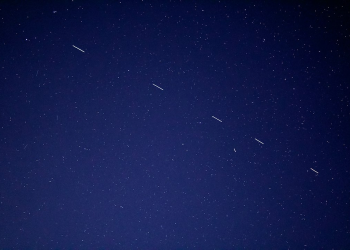
SpaceX is preparing to fly its 14th Starship test flight from Starbase in South Texas carrying 26 Starlink V3 satellites — the first of the new generation of satellite internet relays intended to reach orbit and be put into service rather than dumped back into the atmosphere. Four reports published 15–17 September 2026 agree on the payload. They do not agree on when it flies.
Two dates, one document
TIMES Indonesia, heise online and tech-insider.org all name Tuesday, 22 September. tech-insider.org traces that target to a SpaceX update posted on 15 September, which said that starting with Flight 14, Starship will begin flying orbital missions that enable delivery of Starlink V3 satellites, alongside an early orbital propellant transfer test; Reuters and TechCrunch carried the same date that day, it reports.
Light Reading first published the same 22 September window, then appended an editor’s note saying SpaceX now expects the flight as soon as Monday, 28 September, pending regulatory review. None of the four outlets explains the six-day shift, and none cites a Federal Aviation Administration filing or any other regulator document confirming either window — Reuters, as relayed by tech-insider.org and TIMES Indonesia, described the launch as still pending regulatory approval. Light Reading’s note carries the most recent dateline of the four, which makes 28 September the later-published figure and the one to watch; 22 September is the date SpaceX itself put in writing on 15 September. As of publication on 19 September, the flight had not taken place under either date.
Key facts
- Mission: Starship Flight 14 — the vehicle’s 14th test flight and the first intended to complete an orbital insertion — from Starbase, South Texas.
- Payload: 26 Starlink V3 satellites, to be deployed into orbit and brought into service.
- Date: 22 September per three outlets; “as soon as” 28 September per Light Reading’s later editor’s note.
- Window: 75 minutes, opening at 7:15 a.m. Central Time — 2:15 p.m. in Germany, heise online notes.
- Profile: roughly six orbits at about 275km, a flight of nearly 10 hours, ending with splashdown in the Pacific Ocean west of Chile.
- Secondary objective: an early orbital propellant transfer test, per the SpaceX update quoted by tech-insider.org.
- Consumer impact: no source links Flight 14 to a change in Starlink pricing, hardware costs or country availability.
Why it matters
Until now Starship has flown without adding anything usable to the Starlink network. Light Reading quotes analysts at Evercore ISI, an investment research firm, saying: “Flight 14 is the first point where Starship can begin adding usable broadband capacity rather than only proving the vehicle,” and that a successful orbital insertion and V3 deployment would be the first tangible proof point for the next leg of the broadband capacity ramp. One caveat on that quote: Evercore ISI distributes its research to clients rather than publishing it, so the wording can be checked only against Light Reading’s story, where it appears. We have not seen the underlying note, and we attribute it to Evercore ISI by way of Light Reading rather than to “analysts” generally.
The commercial framing differs by outlet. TIMES Indonesia calls this the first Starship flight to carry a commercial payload; tech-insider.org reports SpaceX positioned it as its first revenue-generating Starship mission, on the reasoning that the payload is SpaceX’s own constellation. Light Reading adds that SpaceX plans to use Starship to deploy its “Starmind” AI data centre satellites, and that company president Gwynne Shotwell said SpaceX is on track to start launching orbital compute satellites sometime in 2027 — a second revenue line for the same vehicle, on that outlet’s account, and one that depends on the orbital capability Flight 14 is meant to demonstrate.
Why “first orbital flight” needs a footnote
Starship has launched 13 times. TIMES Indonesia’s framing of Flight 14 as Starship’s first orbital test flight refers to the intended trajectory — the first attempt to complete an orbital insertion — not to the launch count. Light Reading reports that Flight 13, in July 2026, deployed 20 V3 satellites on sub-orbital trajectories for speed tests before they burned up in the atmosphere about 20 minutes later; heise online describes that deployment as a simulation, while tech-insider.org says SpaceX reported communicating with every satellite it released. Readers meeting the “first orbital flight” phrasing should treat it as shorthand for the first orbital-insertion attempt.
What the V3s change for satellite internet users
heise online reports the V3 satellites are larger than their predecessors and are to be deployed at 275km. Light Reading puts each one at a 10x improvement on the downlink and a 22x improvement on the uplink over a Starlink V2 satellite — about 1 Tbit/s down and 160 Gbit/s up per unit, or roughly 26 Tbit/s of downlink across this batch on the figures it attributes to SpaceX. heise online frames the same gain as ten times what V2 Mini satellites offer when launched on a Falcon 9. Deployed at scale, Light Reading says, the V3s will help Starlink bulk up on bandwidth, support more users and press its lead against rivals such as Amazon Leo, Amazon’s satellite broadband network. The same outlet reports V3 technology will support the Gen 2 satellites behind Starlink Mobile and its next-generation direct-to-device service, which draws on spectrum acquired from EchoStar; we covered Starlink Mobile’s global clearance separately.
What it does not change yet
For anyone weighing a subscription, the practical read is narrow. None of the four reports ties Flight 14 to a price change, a hardware discount, a lifted sold-out waitlist or a new country. The only availability claim any source makes is Light Reading’s: a V3 rollout at scale would give Starlink the ability to extend access into some denser areas, while the Evercore ISI analysts it cites still see the service as largely suited to low-density markets — the profile of much of the territory where readers track availability and pricing across Africa. That claim carries no date and no price, and it turns on a rollout at scale rather than one 26-satellite batch. Capacity added in orbit is the precondition for cheaper or wider service, not the same thing as it.
Hardware changes since Flight 13
During July’s flight, heise online reports, icing was detected on three engines of the Super Heavy booster, ending a post-separation manoeuvre early; tech-insider.org says the booster relit only 10 of 13 planned engines on descent and was lost in a harder-than-planned splashdown. SpaceX has since made hardware modifications and software changes, heise online reports, to be tested on the booster’s return — which is why the “landing burn” Light Reading describes at a point in the Gulf of Mexico matters even without a landing. heise online says the booster will splash down there rather than touch solid ground, and tech-insider.org reports SpaceX will not attempt to catch either the booster or the upper stage this time; Musk walked back earlier suggestions of a tower catch on the reasoning that an explosion at this stage would be too costly. Light Reading reports he said a catch of the ship stage will be attempted on Flight 15, with a 50% to 60% chance of succeeding first time, and told the All-In Summit panel that SpaceX will try to re-fly both the booster and the ship by the end of this year or “more likely” in early 2027, with full reusability and rapid re-flight extremely likely next year.
heise online also reports that because the Flight 13 vehicle splashed down relatively gently and was recovered from the Indian Ocean after more than three weeks, two tiles from its heat shield have been incorporated into the new Starship — a first, partial reuse.
What we could not confirm
Three gaps remain in the public record as of 19 September. No regulator document confirming either launch window appears in any of the four reports. No source explains why Light Reading’s date moved six days. And no source quotes SpaceX on what happens to the 26 V3 satellites — or to the capacity timeline Evercore ISI describes, per Light Reading — if the orbital insertion fails. Outside sentiment is one-sided but thin: tech-insider.org reports that a play-money market on Manifold asking whether SpaceX will attempt a Starlink deployment on the first fully orbital Starship flight was trading at a 99% implied yes as of 16 September, though the question covers only the attempt rather than success, and those figures are attributable to that report rather than checked by us against the live market. On the evidence available, the deployment attempt is well sourced; the date is not.
Frequently Asked Questions
Is the Starlink V3 launch on September 22 or September 28?
Both dates are in circulation. TIMES Indonesia, heise online and tech-insider.org reported Tuesday, 22 September, tracing it to a SpaceX update posted on 15 September. Light Reading published the same window, then appended an editor’s note saying SpaceX now expects the flight as soon as Monday, 28 September, pending regulatory review. That note is the most recent of the four datelines we reviewed, so 28 September is the later-published figure; no outlet explains the shift, and none cites a regulator document confirming either window.
Will Flight 14 change Starlink prices or availability in my country?
Not on the evidence available. None of the four reports reviewed — Light Reading, heise online, TIMES Indonesia and tech-insider.org — connects Flight 14 to a change in Starlink subscription prices, hardware prices or the list of countries where the service is sold. Light Reading comes closest, reporting that a V3 rollout at scale would let Starlink extend access into some denser areas, and citing Evercore ISI analysts who still view the service as largely suited to low-density markets. No source attaches a date or a price to that.
How much capacity does a Starlink V3 satellite add?
Light Reading puts each V3 at a 10x improvement on the downlink and 22x on the uplink compared with a Starlink V2 satellite — about 1 Tbit/s of downlink and 160 Gbit/s of uplink per unit, or roughly 26 Tbit/s of downlink across this 26-satellite batch, on figures it attributes to SpaceX. heise online frames the same gain as ten times what V2 Mini satellites offer when launched on a Falcon 9.
What happened to the Starlink V3 satellites carried on Flight 13?
Light Reading reports July’s Flight 13 deployed 20 V3 satellites on sub-orbital trajectories for speed tests before they burned up in the atmosphere about 20 minutes later. tech-insider.org says SpaceX reported communicating with every satellite it released; heise online describes that deployment as a simulation. Flight 14 is the first attempt to place V3s in orbit and put them into service.
Will SpaceX catch the booster on Flight 14?
No. tech-insider.org reports SpaceX has said it will not attempt to catch either the booster or the upper stage on this flight, and that Musk walked back earlier suggestions of a tower catch because an explosion at this stage would be too costly. Light Reading reports the booster will instead perform a landing burn at a point in the Gulf of Mexico, and that Musk said a catch of the ship stage will be attempted on Flight 15 with a 50% to 60% chance of working first time.
Follow Starlink News on Google. Make us a preferred source to see more of our reporting in Google search results.