Every Starlink satellite in orbit is, under United States law, a temporary object. The FCC’s order FCC 22-74, Mitigation of Orbital Debris in the New Space Age, requires spacecraft ending their missions in low Earth orbit to be removed from orbit within five years, replacing the older 25-year guideline. That one published, checkable line of licensing policy shapes satellite internet pricing and availability more than any debris headline does, because it converts replacement launches from an expansion cost into a permanent operating cost.
The reason we are writing about it this week is a business memo posted on 22 September 2026 on the Japanese publishing platform note.com, which argues that Starlink has grown large enough to make orbital debris removal an unavoidable future expense for satellite operators. Before going further: the memo was published under the account name nigayomogianko, states no institutional affiliation, no engineering or regulatory credential and no prior work in the field, and describes itself as a first-edition record of internal discussion about whether to enter the space sector. It is one person’s synthesis of public material — not a regulator’s filing, a company disclosure or an agency report. We treat it here as a set of claims to check, not as a source to relay.
Why the five-year rule makes a satellite a consumable
The arithmetic is the whole story. If a constellation numbers in the thousands and each spacecraft must leave orbit within five years of finishing work, then a large fraction of the fleet has to be rebuilt and relaunched every year simply to hold capacity flat — before a single new customer is signed. Launch cost stops being a line item and becomes the load-bearing number in the business.
That is why the company’s trajectory is tied so tightly to Starship and the Starlink V3 satellites it is meant to carry. Larger satellites lofted more cheaply per kilogram are the only way capacity grows faster than mandatory replacement consumes it. Slip the launch cadence and the treadmill wins.
What that means for satellite internet availability
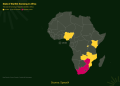
Satellite internet capacity is local in a way terrestrial broadband is not. A residential cell can only carry as many subscribers as the spacecraft passing over it can serve, which is why Starlink’s own availability map shows open cells, waitlisted cells and sold-out cells sitting next to one another.
Deorbit obligations press on that map indirectly. Replacement launches come first; only surplus launch capacity goes to growth. So anything that slows replacement or raises its cost — stricter licence conditions, higher insurance, competition for orbital slots, all of which the memo expects — slows the rate at which sold-out cells reopen. This is a supply-side constraint, and it sits entirely apart from the country-by-country licences, approvals and prices that decide whether Starlink may legally sell in a market at all.
And what it means for price
Here the honest position is that nothing has been announced. SpaceX has not said debris compliance affects Starlink bills; the memo does not claim it does; current rates remain on the company’s service plans page. What SpaceX has done historically is vary prices by region and charge differently in congested cells.
If the memo’s central prediction came true and debris handling became a condition of launch licences, it would land as a cost per launch — and launches are the input to capacity, which is the input to congestion pricing. We state plainly that this chain is our inference, not a SpaceX position, a regulator’s finding or a claim in the memo itself. It is the part of the story readers can act on, and it is worth separating from the numbers below, which they cannot.
The memo’s figures, stated once, with where to check each
The memo cites no docket numbers, no report pages and no data cut-off dates. Each claim below is therefore given once, with the primary source a reader can open instead.
- More than 11,000 Starlink satellites in orbit as of September 2026, roughly two-thirds of all active LEO satellites. Checkable against Jonathan McDowell’s Starlink statistics page, which splits launched, working and re-entered spacecraft, and against CelesTrak‘s catalogue. Neither we nor the memo supplies a dated snapshot matching the figure.
- An additional 7,500 satellites approved by the FCC in January 2026. US authorisations and modification requests are public and searchable in the commission’s space station filing system. The memo names no docket, and we did not locate one matching the claim.
- Collision-avoidance manoeuvres almost weekly per satellite, and 300,000 to 350,000 manoeuvres in 2025 — described as nearly three times the pace of a year earlier. SpaceX reports conjunction-avoidance counts in semi-annual constellation status filings lodged with the FCC through the same system. Without a named report, a reader cannot tell whether the figure covers screened conjunctions or executed burns, or which baseline the “three times” compares against — and a manoeuvre count that tracks fleet size will climb steeply even if the environment is unchanged.
- ESA’s 2026 space environment report showing collision risk up about 20% year on year, and describing the environment as “becoming unsustainable in the long term.” Current and archived editions are published through ESA’s space debris pages and its space debris user portal. ESA has used comparable sustainability language before; the percentage is undefined in the memo — risk to what, measured how, across which shells — so only the report settles it.
- An eventual configuration of up to 42,000 satellites filed internationally. Readers following Starlink’s filings with the ITU will recognise this as the widely repeated outer ceiling, but the memo cites no filing reference, and ITU network filings are submitted by national administrations rather than by companies.
Where the rules stop
The memo’s structural argument is easier to verify than its arithmetic, and it is the part that matters. Deorbit obligations are imposed by national licensing authorities and bind only the operators those authorities license. A satellite authorised outside the United States is outside FCC 22-74 entirely. There is no binding international treaty on orbital debris disposal and no settled answer to who runs orbital traffic management — a gap the FCC itself has acknowledged. The memo says the commission strengthened the rule again in 2026; it gives no docket for that, and we did not find the item.
Scope, and what this article does not cover
The memo ranges well beyond debris economics — into alumina from re-entering spacecraft and ozone recovery, astronomers’ long-documented complaints about satellite light trails, SpaceX’s internal financing of Starship, and military rendezvous-and-proximity operations. Those are separate subjects with separate evidence bases, and assessing them is not attempted here.
On method: this is a documents check rather than a response piece. We did not put questions to SpaceX, the FCC or ESA before publication, and none of the three has published anything addressing the memo. If the author supplies the docket and report references the piece currently lacks, or any of the three organisations responds publicly, we will update this article. The full memo is published on note.com.
Frequently Asked Questions
What is the FCC’s "5-year rule" and where can I read it?
It is the requirement that a satellite ending its mission in or passing through low Earth orbit be removed from orbit within five years, replacing the earlier 25-year guideline. The FCC adopted it in Mitigation of Orbital Debris in the New Space Age, published in full as FCC 22-74 on the commission’s document site, and later items sit with the FCC’s Space Bureau. It is a national licensing condition, not a treaty, so it binds only operators the FCC licenses.
How can I check how many Starlink satellites are actually in orbit?
Two public trackers are the standard independent check. Astronomer Jonathan McDowell’s Starlink statistics page at planet4589.org separates satellites launched, currently working and already re-entered, using public catalogue data. CelesTrak publishes the underlying orbital element sets. Both update continuously, which matters because any single quoted total is a snapshot with a cut-off date attached — and a figure repeated without that date tells you less than it appears to.
Does the debris problem mean Starlink prices will go up?
Nobody has announced that it will. SpaceX has not said debris compliance affects Starlink bills, the FCC has not framed its deorbit rule as a consumer pricing measure, and current rates remain published on Starlink’s service plans page. The plausible mechanism is indirect and is our inference rather than anyone’s stated policy: deorbit obligations make replacement launches a permanent cost, launches set capacity, and Starlink has historically priced congested cells differently from empty ones. Regional prices have moved up as well as down, usually tracking local demand.
Could debris rules affect satellite internet availability where I live?
Not directly, and not today. Availability in any cell depends on how much capacity passes overhead and whether Starlink is licensed to sell in that country, which is why Starlink’s own availability map shows open, waitlisted and sold-out areas side by side. The debris connection is a capacity connection: satellites retired on a five-year clock have to be replaced before any net growth happens, so anything that slows or adds cost to replacement launches slows the rate at which sold-out cells reopen.
How much weight should the note.com memo carry?
Treat it as a prompt to check primary sources, not as a source. It was posted under the account name nigayomogianko, states no institutional affiliation, engineering or regulatory credential and no prior publication in the field, and describes itself as a first-edition record of internal discussion about whether to enter the space sector. It is one person’s synthesis of public material, with no docket numbers, report page references or data cut-off dates attached to its figures. The underlying documents it gestures at are real and public; the specific numbers it prints are, as published, unverifiable.
Follow Starlink News on Google. Make us a preferred source to see more of our reporting in Google search results.