SpaceX’s Starshield — the government-focused satellite network the company says is built on Starlink’s technology, manufacturing and launch capability — is drawing fresh attention after Ukrainian forces said restrictions on their Starshield access disrupted frontline operations. An explainer published on 20 November 2026 by WEBTECH 360 sets out how SpaceX itself distinguishes the two products, while Times Now reported on 14 October 2026 that Kyiv and Elon Musk disagree over who imposed the limits.
Key facts
- SpaceX publicly describes Starshield as a secured satellite network for government entities with three mission areas: Earth observation, secure communications and hosted payloads, according to WEBTECH 360.
- Starlink, by contrast, is the commercial low-Earth-orbit broadband service sold to homes, businesses and roaming customers, WEBTECH 360 says.
- Times Now reported that Starshield offers stronger security than Starlink, letting it handle classified information, and that SpaceX designed it for U.S. national-defense use by the Department of Defense and other government partners.
- Musk wrote on X in 2023 that Starshield would be owned by the U.S. government and controlled by the Space Force, the Defense Department’s space branch, Times Now reported.
- Ukraine’s defence ministry blamed SpaceX for restricting Starshield terminals; Musk said limits are set by the U.S. military, according to Times Now.
- Starshield is not a consumer upgrade and cannot be selected in the Starlink app, WEBTECH 360 reports.
Why it matters
The two names are routinely treated as one service, and the Ukraine dispute shows the practical consequence: a restriction on one network does not necessarily mean the other was touched. For ordinary subscribers, WEBTECH 360 is explicit that Starshield is not something a household can buy, and that commercial customers should be looking at Starlink plans instead.
What SpaceX says Starshield does
WEBTECH 360 reports that SpaceX’s public description names three mission areas — Earth observation, secure communications and hosted payloads — and stresses that this is a list of broad mission categories, not a technical specification. The outlet notes that SpaceX does not publicly disclose all Starshield satellites, their precise sensors, coverage schedules, encryption implementation or customer tasking, and that details may vary by contract.
For government buyers, WEBTECH 360 describes the difference as a mission package: dedicated equipment, higher-assurance security capabilities, contractual controls and payload integration aimed at government needs. SpaceX says the shared technology and launch base can cut the time and cost of developing space systems, and describes its proliferated architecture as resilient and scalable — which WEBTECH 360 flags as company-stated design goals, not guarantees against outages, interference, cyber risk or physical disruption.
Earth observation and the NRO
WEBTECH 360 separates SpaceX’s own sensing claims from U.S. intelligence programmes. The U.S. National Reconnaissance Office, the agency that runs America’s spy satellites, has described its own proliferated satellite architecture launched with SpaceX and the U.S. Space Force. The outlet cautions that public announcements do not establish that every NRO satellite is a Starshield spacecraft, and that what an individual satellite can see should not be inferred from the name.
The Ukraine dispute
Times Now reported that Ukrainian forces said their battlefield operations had been hurt after losing some satellite communications access, pointing to restrictions on Starshield in particular. Serhiy Beskrestnov, an adviser to President Volodymyr Zelensky on weapons technologies, said the army received no warning, that a number of missions failed, and that the limits hit devices moving faster than 100 miles per hour and were tied to “the current political situation.”
Ukraine’s defence ministry said SpaceX had restricted the Starshield terminals on its own, and that this makes drone missions harder while weakening frontline logistics, reconnaissance and signal relaying, Times Now reported. The outlet said SpaceX, Musk and company president Gwynne Shotwell did not respond to requests for comment from the New York Times. Ukraine later said its Starlink speeds were restored.
Where the accounts conflict
Musk’s answer, posted on X and reported by Times Now, was that “Starshield systems are owned and controlled by the US government.” He added that any limits on speed or usage are decided by the U.S. military and ultimately the president, and that Starlink is a commercial service owned and controlled by SpaceX whose use is confined to civilian or defensive activity. Musk has drawn the same line in public, saying Starlink is civilian while Starshield handles strike-related work.
Times Now also reported that in March Musk said using commercial Starlink terminals for weapon systems breaks the service’s terms, that the rule applies to all users, and that violators are shut down when found. The Pentagon, for its part, lets Ukraine use Starshield, the outlet reported.
How separate are they?
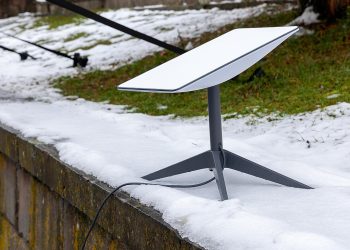
Times Now reported that some observers question how separate the two networks really are, because outages have knocked out both at the same time, and that governments including Ukraine have long used Starlink for war efforts despite its civilian label. WEBTECH 360 makes a similar point from the engineering side: SpaceX says Starshield draws on Starlink technology, and that Starlink laser communications terminals can be integrated with partner satellites, so the networks can share engineering, manufacturing or communications elements while serving different users. Readers wanting the civilian picture can review the dishes, orbits and laser links behind the consumer service.
What this means for public-sector buyers outside the US
WEBTECH 360 reports that SpaceX’s Starlink help guidance says commercial Starlink plans can serve civil-government users, including international civil-government agencies, while Starshield communications are described for U.S. national-defense use cases. SpaceX points prospective Starshield customers to U.S. government procurement channels. The outlet, writing for a Canadian audience, says that is not a statement that other countries’ agencies can buy Starshield on the same terms, and that any public-sector buyer would need to confirm eligibility, procurement rules, security requirements and availability directly with SpaceX and the relevant government authorities.
Frequently Asked Questions
How much does SpaceX earn from government and business connectivity?
Times Now reported that SpaceX took nearly $4.2 billion in revenue last year from providing connectivity to governments and businesses. It also reported that the U.S. government has put billions of dollars into the Starshield technology, which forms part of that figure.
What is the NRO’s proliferated satellite architecture, and when did it start launching?
According to WEBTECH 360, the U.S. National Reconnaissance Office says the architecture is meant to increase the number and diversity of satellites and improve the timeliness and resilience of intelligence collection. The NRO says its first launch in that architecture, NROL-146, took place on May 22, 2024, with SpaceX and the U.S. Space Force. WEBTECH 360 stresses that public announcements do not establish that every NRO satellite is a Starshield spacecraft.
What exactly is a “terminal” in this story?
Times Now described terminals as the devices that deliver satellite internet to users, and said they can be mounted on vehicles or drones to help steer them to their location. The restrictions Ukrainian officials complained about applied to terminals moving faster than 100 miles per hour.
How should a household check whether Starlink is sold at its address?
WEBTECH 360 advises customers to check the current availability map and service terms for their own address rather than assuming a plan or performance level is offered everywhere. Its example market, Canada, lists residential and roaming plans subject to coverage, service terms and plan limitations.