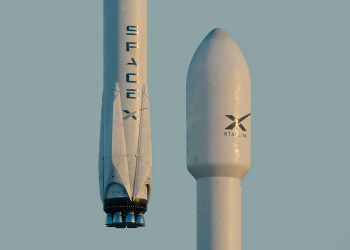
Elon Musk said on Saturday, October 10, that Starship Flight 15 is hopefully four to six weeks away and that the mission’s headline goal is to catch the rocket’s upper stage with the launch tower — something SpaceX has never attempted. He was speaking in a virtual interview titled “What Comes Next for Humanity” at the X Takeover fan event at Giga Texas in Austin, livestreamed by Tesla Owners Silicon Valley, according to Tesla North.
Key facts
- Musk put Flight 15 “hopefully in 4-6 weeks” and pointed to a window before Thanksgiving, Tesla North reported. SpaceX has not posted a firm launch date.
- The plan is to catch both the Super Heavy booster and the ship on the same flight. Musk said a ship catch would make it the first full recovery of an orbital-class rocket.
- Flight 14 flew on September 28 as Starship’s first orbital mission and deployed 26 Starlink V3 satellites, per Tesla North.
- A ship catch also requires clearance from the US Federal Aviation Administration, the American aviation regulator, as reported by Yahoo.
Why it matters for the Starlink network
Starship is the only vehicle built to carry SpaceX’s largest broadband satellites, and Flight 14’s orbital debut was their first deployment, Tesla North reported. Those are Starlink V3 satellites built for Starship.
Both Starship stages are designed to be fully and rapidly reusable, Yahoo reported, with rapid reuse enabled by landings directly on the launch mount with the aid of the tower’s “chopstick” arms, and Starlust noted the 408-foot vehicle was conceived from the start as an entirely reusable rocket. Until the tower can catch the ship, every orbital flight ends with an expended upper stage.
Reading those sourced facts together — and this is our own contextual assessment rather than a company or outlet claim — Starship’s flight rate is the practical ceiling on how fast SpaceX can add V3-class capacity to its satellite internet constellation, because cadence is capped by how quickly Starbase can build ships rather than turn them around. On the same reading, each slip in the catch attempt pushes out the point at which V3 deployment can accelerate, leaving near-term Starlink growth dependent on Falcon 9, the pattern documented in our report on how Starlink dominates SpaceX’s 2026 Falcon 9 launches.
The catch timeline has already slipped twice
On July 25, hours after Flight 13’s Indian Ocean splashdown, Musk said SpaceX would try to catch the ship on the next flight unless data review turned up problems, according to Starlust and Tech Times. Six days later he said the landing had been precise enough that the tower arms would have caught it, Tech Times reported, clearing the engineering gate SpaceX had set.
Musk repeated the plan on August 4 during SpaceX’s first call with investors as a public company, tying it to a flight tentatively scheduled for the end of that month, Yahoo reported. By August 20 he was saying the catch would probably come in a few months. As of October 10 it is Flight 15’s objective — and Musk’s own wording framed that window as a hope rather than a locked schedule.
Why catching the ship is harder than catching the booster
Trajectory and speed
Tech Times set out the difference. The booster’s return takes roughly seven minutes: it flips after hot staging, burns to reverse course, glides back to Starbase and lands from relatively low altitude. The ship instead continues to near-orbital velocity and must survive reentry at Mach 25-plus, generating a plasma sheath, before a flip-and-burn at the tower.
Tolerances
The tolerances also differ in kind, the outlet said: an ocean splashdown accepts error measured in kilometres, while a tower catch requires the vehicle to match the arms’ velocity vectors to what engineers have described as millimetre-scale precision, arriving nearly vertical with velocity nullified as it passes between the arms, which close around load-bearing points under the forward flaps.
Starlust reported that Pad 2 at Starbase, which debuted on Flight 12, has chopsticks built shorter than previous designs so they can swing faster, with main actuators switched from hydraulic to electro-mechanical for speed, redundancy and reliability.
Raptor reliability is the gating risk
A catch of either stage comes down to Raptor engines lighting on command, and that is where Starship’s recent flights have wobbled. Tech Times, citing NASASpaceFlight, reported that on Flight 13 Booster 20 completed its boostback burn with all 33 engines, but the landing burn fell short: of 13 centre engines targeted, only 10 ignited and two more shut down, leaving five before the vehicle hit the Gulf of Mexico at high speed. Starlust reported the same pattern of Raptors failing to light for the landing burn.
Flight 14 added its own flag. SpaceX’s recap noted engine shutdowns during ascent, Tesla North reported; Musk said the glitch “doesn’t seem to be too much of an issue” and traced it to engine computer software on a single engine, judged the risk low enough to continue to orbit, and said the heat shield and engines are looking robust while the company still needs very high engine reliability. He also flagged rocket improvements ahead of Flight 15.
The same engine programme is under outside scrutiny: Tech Times cited a July 23 US Government Accountability Office report that found SpaceX more than a year behind its original schedule on key Artemis Human Landing System events, with Raptor development a top risk. An earlier hard splashdown by Booster 19 grounded Flight 12 for 52 days, Tech Times said — a measure of what one bad landing could do to the four-to-six-week window — though the FAA declined to require a mishap investigation for Flight 13.
Frequently Asked Questions
Has SpaceX ever caught a Starship stage with the tower before?
Yes, but only the first stage. Tech Times reports SpaceX has caught the Super Heavy booster multiple times with Mechazilla’s arms since the first successful booster catch on October 13, 2024, and Yahoo noted those catches came on three of Starship’s 13 suborbital test flights, with two of them reusing boosters from Flights 7 and 8. The upper stage has never been caught.
Does SpaceX need regulatory approval for a ship catch?
Yes. Tech Times reported that FAA approval is separately required for the expanded landing-zone profile a ship catch would need at Starbase. Yahoo said Musk’s plan assumed the agency would sign off, and that it is possible approval had not been secured.
When could a Starship upper stage be reflown?
Musk has said the ship’s first reflight would come either at the end of 2026 or in early 2027, Yahoo reported. On October 10 he said he hoped Flight 16 could refly both the booster and the ship used on Flight 15, according to Tesla North.
What happened to the Starship upper stage after Flight 13?
Ship survived reentry and splashed down in its target zone in the Indian Ocean off the coast of Western Australia on July 24, Yahoo reported, and remained intact after toppling over — something no predecessor had managed. SpaceX towed it to Christmas Island to study it and inform future versions of the vehicle.
Follow Starlink News on Google. Make us a preferred source to see more of our reporting in Google search results.









![Using Your Own Router with Starlink: Bypass Mode [2026]](https://starlink-news.com/wp-content/uploads/2026/09/using-your-own-router-with-starlink-bypass-mode-20-f6c09f95-120x86.png)