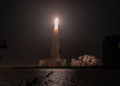
An Arianespace Ariane 6 rocket has delivered 36 satellites for Amazon Leo, the online retailer’s low-earth-orbit broadband network, lifting off from the European Space Agency’s spaceport in French Guiana on Monday 23 November at about 11:15am UK time, according to Hindustan Times. The flight came days after a United Launch Alliance Vulcan rocket failed on 15 November and destroyed 40 Amazon satellites, The Telegraph reported in a copy carried by Yahoo.
On the date, the Hindustan Times report of 24 November says the rocket blasted off “Tuesday” but then refers to “Monday’s mission”. Monday was 23 November — the date Livemint, in a version republished by Around Prague, had earlier reported Arianespace was targeting at the earliest. That is the date both reports support.
Key facts
- The mission was Ariane 6’s 10th flight and Arianespace’s fourth for Amazon, Hindustan Times reports.
- Successful completion brings the total number of Amazon satellites delivered to orbit by Arianespace to 136 — more than a quarter of Amazon’s current fleet, according to the same report.
- Amazon added six new Ariane 6 contracts in September, raising its planned launches on the European rocket to 24.
- Before the 15 November failure, Amazon had launched 396 satellites on 14 missions since April 2025, according to GeekWire.
- SpaceX’s Starlink already has more than 11,000 satellites in orbit and millions of customers, per The Telegraph.
- Amazon Leo, formerly called Project Kuiper, has not begun providing coverage, Hindustan Times reports.
Why it matters
For anyone waiting on a real competitor to Starlink, the arithmetic in these reports is unforgiving. Amazon’s first-generation licence covers 3,232 satellites. Even if all 24 booked Ariane 6 flights fly and each carries 36 satellites, Europe’s rocket accounts for under a third of that constellation, and Arianespace does not expect to reach 12 flights a year — a cadence Hindustan Times says would deliver as many as 200 satellites annually — until around 2030.
That makes Vulcan and Blue Origin’s New Glenn load-bearing rather than supplementary, which is why November’s failure and May’s pad explosion cost Amazon more than the 40 satellites destroyed: its build rate is set by other companies’ hardware, not by its own factories. The commercial cost compounds in the meantime. Starlink publishes hardware and monthly subscription prices and sells satellite internet in most of the world; Amazon Leo has no published price, no coverage map and no paying customers anywhere, and nothing in these reports points to a tariff, launch date or coverage area for Zimbabwe or the rest of Africa. Every quarter without a price list is a quarter in which Starlink signs the subscribers Leo was built to win — one reason Amazon remains far behind Starlink on satellite count and there are still few credible alternatives to Starlink in service today.
What went wrong on the Vulcan flight
ULA, a joint venture between Boeing and Lockheed Martin, said its 215-foot Vulcan rocket suffered an “anomaly” around 10 minutes after lifting off from Cape Canaveral in Florida, The Telegraph reports. “We don’t have any specific data yet to understand what occurred today,” the company said in remarks carried by the newspaper.
Spaceflight Now, Florida Today and GeekWire report it was ULA’s first outright mission failure since the venture was formed in 2006, and Vulcan’s first flight in nine months. Liftoff came at 12:40pm EST from Launch Complex 41 after a Friday scrub caused by a gaseous nitrogen plant outage, a Saturday delay tied to network problems between rocket and ground systems, and a countdown pause with 20 seconds left; whether that final issue played a role is not known.
The sequence reported by Spaceflight Now
Per Spaceflight Now’s account, the six Northrop Grumman solid rocket boosters appeared to work normally and fell away less than two minutes into flight. The first stage, powered by two BE-4 engines, appeared to burn longer than the pre-launch timeline called for and to separate late from the Centaur upper stage, with telemetry-based animation showing unusual orientation adjustments early in the Centaur burn. ULA’s last public update said the Centaur had ignited and the fairing had come off about six minutes in, at 95 miles up and faster than 11,000mph; the Centaur was meant to burn for 12 minutes 15 seconds, and Spaceflight Now said something went wrong during that burn.
Hindustan Times reports Vulcan is now grounded pending an investigation led by the US Federal Aviation Administration. ULA has given no return-to-flight timeline, said Amazon and other customers will have visibility into the investigation, and NASA Administrator Jared Isaacman offered the agency’s help.
A wider launch shortage
The Telegraph reports a Blue Origin rocket, from the space company founded by Amazon’s Jeff Bezos, exploded on its launchpad in May; New Glenn, on which Amazon has 24 launches reserved, has been grounded since.
Hindustan Times attributes part of the delay to a worldwide launch crunch as SpaceX began phasing out its Falcon 9 rocket with no viable replacement yet from the industry, and notes the FCC cited a shortage of rocket launches when it granted Amazon’s waiver request in June. TechCrunch reports that demand for orbital launch is growing faster than infrastructure, with Falcon rockets increasingly reserved for SpaceX’s own Starlink satellites, The Exploration Company raising $450 million and US rival Stoke Space raising a $1 billion round to build reusable alternatives.
What Amazon has booked, and what it owns
Vulcan is booked to carry more than 1,500 Amazon satellites across 38 missions, The Telegraph reports. Amazon also announced an $11.5 billion (£8.7 billion) deal in April to acquire Globalstar, another US satellite company, while European rivals have opened the EU’s biggest satellite factory to expand manufacturing capacity.
In a post on X quoted by The Telegraph, Amazon said: “ULA has been a trusted partner for Amazon, and we believe they’ll learn from this mission and deliver on their long-term plans for Vulcan.”
Frequently Asked Questions
When does Amazon say Leo internet service will start?
Amazon has not named a date. GeekWire reports the company plans an initial commercial service rollout this year, after earlier targets for 2025 and early 2026 slipped.
What deadline did the FCC set for Amazon’s satellites?
GeekWire reports the Federal Communications Commission required Amazon to put 1,616 satellites into service by 30 July, with satellites not operational by then temporarily losing priority in key spectrum bands. In June the regulator allowed Amazon to keep deploying despite missing that date, and Amazon has until 30 July 2029 to deploy and operate all 3,232 first-generation satellites.
Was the lost Vulcan mission carrying anything unusual?
Yes. Florida Today reports the mission carried more than 50,000 pounds — ULA’s heaviest payload ever — and was the first to fly a shorter, optimised version of the Centaur V upper stage.