A paid newswire release issued on 4 October 2026 from Baltimore, Maryland, revives years-old media doubts about Starlink in order to market an investment presentation from tech analyst James Altucher. Distributed through GlobeNewswire on behalf of Altucher’s Investment Network, it was carried the same day by The Manila Times and written up separately by Foreign Policy Journal, bylined to reporter Ewan Scott. Altucher’s argument, as both outlets describe it, is that expert scepticism preceded each of Elon Musk’s biggest successes and is now forming around his artificial intelligence plans.
Key facts
- A promotional GlobeNewswire release for an Altucher’s Investment Network presentation — not a SpaceX or Starlink announcement.
- It quotes CNBC saying Starlink had “failed to demonstrate it could deliver service” and CNN saying it was “not delivering promised speeds.” Neither quote is dated or linked to the original report.
- Its central AI claim rests on a publicly traded company it refuses to name, and neither carrier identifies one.
- It carries no satellite count, no price, no speed test and no licensing status. Starlink’s own order page lists standard US Residential service at $120 a month.
What the presentation says about Starlink
The quotes it recycles
According to The Manila Times, when Musk extended his effort into satellite internet “the skeptics returned on cue,” and the CNBC and CNN lines are offered as Altucher’s examples; Foreign Policy Journal reports the same two quotes in the same order. Neither carrier dates them, links them or sought comment from SpaceX, Tesla or any of the outlets quoted.
The counterclaim
Both then give Altucher’s rebuttal: that Starlink today operates the largest global high-speed satellite network on Earth. Foreign Policy Journal frames that as his own description rather than an independent measurement, and neither account supplies subscriber, speed or capacity figures to support it. On SpaceX the two differ only in degree — The Manila Times says it “now dominates” the commercial launch industry, Foreign Policy Journal that it “controls a commanding share of global launch capacity,” with no number attached either way.
“Elon has made a career out of proving the experts wrong,” Altucher says in the presentation, quoted identically by both outlets. The sequence runs Tesla, SpaceX, Starlink, then AI, with the same claim each time: that critics judged Musk’s plans by what already existed rather than by what was being built.
The company it will not name
The release says one publicly traded company sits at the centre of Musk’s AI plan and calls that the most overlooked part of the story — then withholds the name. No ticker appears in either write-up, and nothing in the published material allows the company to be identified; we could not establish which one is meant. That is the mechanism rather than an oversight: the name is the reason to watch the video. It also leaves the claim unfalsifiable. A reader cannot check whether the stock is already priced for an AI build-out, whether it supplies SpaceX at all, or whether its “central” role is the sponsor’s judgement rather than anything Musk or his companies have disclosed.
What Starlink’s price and coverage figures actually show
Starlink’s own order page lists standard Residential service in the United States at $120 a month, with a cheaper Residential Lite tier at $80 and a one-off $349 for the standard dish. Set against that sticker price, the figures we reported on 29 September — average revenue per user down to about $66 across roughly 12 million subscribers — mean the typical customer pays a little over half the headline US rate, because growth is coming from cheaper tiers and cheaper countries. Scale supports the “largest network” line; price per customer is moving the other way.
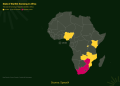
Coverage is the harder constraint, and it is regulatory rather than technical. Starlink’s availability map still shows South Africa as pending, where ICASA’s licensing rules on local equity ownership have kept the service formally unavailable, and several other markets carry the same “pending regulatory approval” label with no committed date. The capacity the V3 satellites are meant to unlock reaches customers only once spectrum and landing rights are granted country by country, which is why licensing, not telco competition, now sets the pace in Africa. A household in Johannesburg waiting for service is waiting on a regulator, not on expert sentiment about Musk.
Why it matters
Starlink has become a sales hook in material aimed at retail investors: undated criticism of its early performance, recycled to pre-empt doubt about an unrelated AI bet. Readers after commercial signals are better served by disclosed positions — Baron’s disclosed bet on Starlink reaching a $1 trillion valuation among them — than by a pitch that holds back its one specific claim until the close.
Frequently Asked Questions
Who is James Altucher?
Both carriers describe him as a tech analyst and former Wall Street money manager who publishes through Altucher’s Investment Network. The Manila Times says his analysis reaches a broad national audience of individual investors; Foreign Policy Journal says his reputation rests on identifying companies at the centre of technological shifts before the wider market does. Neither outlet reviews the track record of his past calls.
Which Tesla and SpaceX predictions does the presentation quote?
According to both reports, Altucher quotes Investing.com saying “Tesla is living on borrowed time” and MarketWatch predicting the carmaker would be “bankrupt within four months.” For SpaceX he cites an unnamed telecommunications expert who said the company was “heading on autopilot towards a concrete wall of bankruptcy.” No dates are given for any of the quotes.
Does it cost anything to watch the presentation?
No. Both The Manila Times and Foreign Policy Journal state that it is free and available on demand, and that it closes with Altucher explaining how he would position himself for what he expects next from Musk’s AI push.
How should readers treat a sponsored newswire item like this?
GlobeNewswire distribution is paid placement: the sponsor writes the copy, and a publisher carrying it under a newswire label has not independently checked the claims. Carriage by The Manila Times or a write-up at Foreign Policy Journal is therefore not editorial endorsement.
Follow Starlink News on Google. Make us a preferred source to see more of our reporting in Google search results.