ASELSAN, the Turkish defence electronics and communications company, has unveiled Astralink, a low-Earth orbit (LEO) satellite constellation it says is designed to provide fast and secure communications to military, government and civilian users. The system, also known as Gökbağı, was presented at the 77th International Astronautical Congress in Antalya, according to Azernews, which attributed the details to local media outlets.
Key facts
- Who: ASELSAN, described by Azernews as one of Türkiye’s leading companies in defence electronics, communications, radar and space technologies.
- What: Astralink, also called Gökbağı, a LEO communications constellation.
- Where it was announced: the 77th International Astronautical Congress, held in Antalya.
- Timing: the first satellites are expected to be launched into orbit within the next few years, per Azernews.
- Who it is for: military, government and civilian users, in Türkiye and allied countries.
- Not disclosed: satellite numbers, orbital altitude, launch provider, budget, service pricing or coverage maps.
Why it matters
Azernews reported that with Astralink, Türkiye is seeking to establish its own LEO communications infrastructure, broadly comparable to SpaceX’s Starlink system. That places the announcement alongside a run of state-backed efforts to avoid depending on one foreign operator for satellite connectivity — including the project Kyiv has described as Ukraine is building its own Starlink analogue.
The stated reasons are security and resilience rather than price. ASELSAN aims to make communications faster, more resilient and more secure through a network of satellites in low-Earth orbit, according to Azernews. The same logic drives Nokia and ICEYE’s plan for sovereign satcom.
What ASELSAN said
ASELSAN chief executive Ahmet Akyol said the project had been developed using domestic capabilities, starting at the chip level, Azernews reported. The report did not spell out which components that covers, nor which firms or agencies are involved beyond ASELSAN itself.
Azernews also noted that separate statements have indicated plans to develop a larger satellite constellation as part of Türkiye’s broader space and communications ambitions. The outlet did not identify who made those statements, did not say how many satellites such a constellation would hold, and did not tie it to a schedule — so the relationship between that wider plan and Astralink is unclear from the reporting available.
How Astralink fits a wider pattern
Astralink is not the first constellation pitched as an answer to Starlink. In August 2024, Daily Maverick reported that Shanghai Spacecom Satellite Technology (SSST), a Chinese satellite operator, had launched the first batch of its “Thousand Sails Constellation” from the Taiyuan Satellite Launch Centre, carried aboard a Long March 6 rocket, citing state broadcaster CCTV.
Daily Maverick described that state-backed plan as one of China’s answers to Starlink, which it reported at the time as a growing commercial broadband constellation of about 5,500 LEO satellites serving consumers, companies and government agencies. Starlink News has since reported Musk putting the constellation at 11,000 satellites.
The military dimension
The defence framing around Astralink echoes arguments already made about LEO generally. Daily Maverick reported that control over the satellites occupying these altitudes has significant military implications, and that since 2022, when the Ukraine war demonstrated the importance of Starlink to battlefield communications, media affiliated with China’s People’s Liberation Army have published several editorials about the threat Starlink poses to Chinese interests.
Those editorials, Daily Maverick wrote, described Starlink and SpaceX as part of the “space hegemony” the United States is trying to create in space, giving it a “unilateral space military advantage”. Neither source applies that language to Astralink, and ASELSAN’s own description, as relayed by Azernews, is of a dual-use system for defence, state and civilian customers.
What is still unknown
Azernews did not publish a satellite count for Astralink, an orbital altitude, a launch vehicle, a cost, a frequency allocation or a user-terminal design. There is no indication in either report of consumer subscription plans or prices, and no list of the allied countries ASELSAN expects to serve.
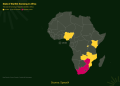
For readers in Zimbabwe and elsewhere in Africa, that matters in a specific way: nothing in these reports mentions African markets, licensing or regulators in connection with Astralink. Until ASELSAN publishes coverage plans or seeks local authorisations, the announcement tells African buyers nothing about availability or cost in their countries.
The congress presentation is also the only public reference point in the sources. Azernews relied on local media accounts rather than a company newsroom post, and no filing or regulatory document was cited, so the firmest claim on record remains ASELSAN’s own: a domestically developed LEO network with first satellites expected in orbit within the next few years.
Frequently Asked Questions
What counts as low-Earth orbit, and why do operators choose it?
Low-Earth orbit satellites usually operate between about 300km and 2,000km above the Earth’s surface, according to Daily Maverick. The outlet reported that satellites at those altitudes have the advantage of being cheaper and providing more efficient transmission than satellites in higher orbits.
How large was Starlink’s constellation when China’s rival project launched?
Daily Maverick reported in August 2024 that Starlink had about 5,500 low-Earth orbit satellites in space, providing near-global internet to consumers, companies and government agencies. Starlink News has since reported Elon Musk putting the constellation at 11,000 satellites.
Which Chinese company is behind the Thousand Sails Constellation?
The operator is Shanghai Spacecom Satellite Technology, or SSST. Daily Maverick reported that SSST launched the first batch of the state-backed Thousand Sails Constellation from the Taiyuan Satellite Launch Centre in Shanxi province aboard a Long March 6 rocket, citing Chinese state broadcaster CCTV.
Will Astralink be sold to home internet customers?
Azernews reported that Astralink is designed to serve military, government and civilian users, and that the project is intended to serve both Türkiye and its allied countries. The report named no consumer product, no pricing and no list of countries, so there is no basis yet for saying how or where individuals could buy it.
Follow Starlink News on Google. Make us a preferred source to see more of our reporting in Google search results.


![Starlink Australia: NBN Alternative for Rural Areas [2026]](https://starlink-news.com/wp-content/uploads/2026/09/starlink-australia-nbn-alternative-for-rural-areas-9f7790a6-120x86.png)