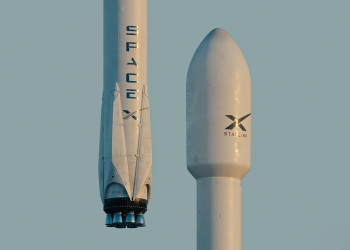
The US Federal Communications Commission (FCC), the American telecoms regulator, has granted SpaceX permission to put a further 15,000 next-generation satellites into low Earth orbit to feed its Starlink Mobile service. The approval was issued on 6 October 2026, according to ISPreview UK, which reported the decision the following day; PCMag described it in its headline as the FCC green lighting 15,000 satellites for Starlink Mobile.
Key facts
- The FCC has approved a further 15,000 satellites specifically for Starlink Mobile, ISPreview UK reports.
- The new satellites are expected to orbit at just 326km to 335km above Earth, the outlet says.
- They will use radio spectrum recently acquired from T-Mobile, the US mobile operator, and EchoStar, the US satellite and spectrum company, according to ISPreview.
- Starlink currently has about 11,160 satellites in orbit for broadband and mobile combined, mostly at roughly 340-550km, the outlet says.
Why it matters for today’s Direct to Cell users
For anyone already using Starlink’s Direct to Cell (DtC) service, nothing changes in the near term. ISPreview UK describes the current product as a fairly basic and app-specific 4G remote roaming style service running at about 5Mbps, carried by only around 650 of Starlink’s satellites. The faster system the FCC has now authorised depends on hardware that, per ISPreview, does not begin launching until 2027.
That timing matters most to the people paying for the service now. ISPreview says UK buyers can currently only get Direct to Cell through O2 Satellite, the UK mobile operator’s satellite offer, for £3 extra per month — which means they are buying the first-generation service for at least the next year or more. None of the three reports says whether the upgraded service will cost more, whether handsets that work with DtC today will reach it, or when it goes on sale commercially.
What changes with V2 Mobile
ISPreview UK puts the planned speed increase down to bandwidth. The current mobile system uses about 5MHz, which the outlet says is why the first generation is only good for basic communications tasks and apps. V2 Mobile will have at least 65MHz available via the EchoStar spectrum, and ISPreview says the second-generation system is expected to deliver 5G and mobile broadband speeds of around 150Mbps per user.
In this outlet’s assessment, the grant is a question of scale rather than a new product line: Starlink already has around 11,000 satellites in orbit, and the authorisation sets the upper bound on how far the mobile half of that constellation can grow. The 2027 launch date is the nearest firm milestone in any of the reports, and it tracks with how Starlink Mobile is being built out elsewhere.
The EchoStar condition
The grant comes with a restriction, and it supplies the only words from the FCC’s own order that appear in the three reports. As ISPreview relays, citing PCMag, the service will only be allowed to “test” using the EchoStar radio frequencies “until Step Two of the SpaceX-EchoStar transaction is consummated” — a step ISPreview says is scheduled for 30 November 2027. Neither the FCC nor SpaceX is quoted directly in any of the three reports, which summarise the filing rather than reproduce it.
ISPreview also notes that the FCC granted the application despite rising concerns over the wider impact of satellites on the future of ground-based telescopes, and that SpaceX had been seeking permission for the extra 15,000 satellites since last year.
What Starlink Mobile costs where it is already sold
ISPreview UK gives the clearest published pricing in the three reports, for the UK market. Residential Starlink satellite internet there starts at £40 a month for the 100Mbps unlimited data plan, which the outlet says also promises uploads of about 15-35Mbps and latency of around 20ms. The mobile service is sold separately, as the O2 Satellite add-on above. On this site, readers say price matters more than coverage when deciding whether to take a satellite mobile add-on.
Kazakhstan switches its service on
Days before the FCC decision, Kazakhstan launched Starlink’s satellite-to-mobile connectivity service, Telecom Review Asia reported on 5 October 2026. The outlet says it is being introduced by the country’s Ministry of Artificial Intelligence and Digital Development, the mobile operator Beeline Kazakhstan and Starlink Mobile using Direct to Cell technology, and that the launch follows agreements reached during President Kassym-Jomart Tokayev’s official visit to the United States in 2025.
Users connect directly to Starlink satellites from compatible smartphones without a dedicated satellite phone, external antenna or other specialised equipment, the outlet says. Zhaslan Madiyev, Kazakhstan’s Deputy Prime Minister and Minister of Artificial Intelligence and Digital Development, said the country had become the first in Central Asia where Direct to Cell had undergone practical testing and was now moving to the user service stage, according to Telecom Review Asia. The outlet says the service is designed for areas without terrestrial mobile coverage, which it describes as particularly relevant to Kazakhstan given its large territory.
What the reports do not settle
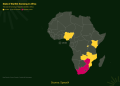
None of the three reports gives a launch schedule beyond the first V2 Mobile satellites in 2027, and none sets out which countries will get the upgraded 5G service or at what price. The only commercial deployments they describe are in the UK and Kazakhstan; the FCC authorisation itself applies to SpaceX’s US licence for the constellation, so it carries no stated implication for licensing in Zimbabwe or elsewhere in Africa.
Frequently Asked Questions
Which radio bands has SpaceX asked to use for Starlink Mobile?
According to ISPreview UK, Starlink Mobile aims to use the 1695-1710MHz, 1910-1915MHz, 1915-1920MHz, 1990-1995MHz, 1995-2000MHz, 2000-2020MHz and 2180-2200MHz bands. ISPreview adds that a decision on some other bands has been deferred for now because of ongoing discussions.
Do Beeline Kazakhstan customers pay for the new satellite-to-mobile service?
Telecom Review Asia reports that Beeline Kazakhstan customers will get access to the service free of charge during the promotional period. The outlet says the initial service will focus on messaging and selected applications, and that what is available depends on the device and on what the satellite-mobile service supports.
Are the new V2 Mobile satellites the same as Starlink’s V2 broadband satellites?
No. ISPreview UK stresses that the V2 Mobile satellites should not be confused with Starlink’s V2 broadband satellites, which the outlet says are already starting to be replaced by significantly larger V3 satellites.
Will the UK version of Starlink Mobile use exactly the same frequencies?
Not necessarily. ISPreview UK says the band line-up may yet differ slightly for the UK because of differences in Ofcom’s regulatory approach, the UK telecoms regulator, and because of existing users on some of the relevant frequencies.
Follow Starlink News on Google. Make us a preferred source to see more of our reporting in Google search results.



![Starlink Australia: NBN Alternative for Rural Areas [2026]](https://starlink-news.com/wp-content/uploads/2026/09/starlink-australia-nbn-alternative-for-rural-areas-9f7790a6-120x86.png)