A prominent technology analyst says SpaceX, Elon Musk’s rocket and satellite company, will eventually build its own smartphone designed to run on Starlink, a move he argues would pressure US wireless carriers as well as Apple and Samsung. The prediction, posted by analyst Gene Munster on X, came a day after SpaceX said late Thursday it will acquire a nationwide low-band spectrum portfolio, according to Yahoo Finance on 9 October 2026.
One point on sourcing before the detail: the AOL version of this story is a verbatim syndication of the same Yahoo Finance piece, not a second newsroom confirming it. The reporting behind the handset claim is one wire story plus Munster’s own post.
Key facts
- SpaceX announced late Thursday that it will buy a nationwide low-band spectrum portfolio.
- Munster predicted on X that SpaceX will eventually make a handset built for a Starlink mobile network, while noting Musk says he does not want to make a phone.
- Shares of AT&T, T-Mobile and Verizon — the three large US wireless operators named in the report — fell in premarket trading on Friday, while SpaceX shares rose 4%.
- KeyBanc analyst Brandon Nispel said the added low-band spectrum makes Starlink a more credible mobile operator, because those lower frequencies penetrate buildings.
- Yahoo Finance characterised the announcement as SpaceX signalling that it is coming for a share of the wireless industry’s subscribers.
Why it matters
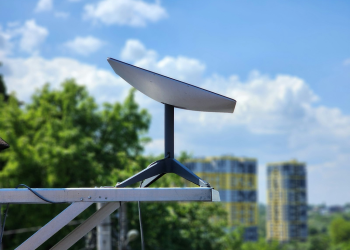
Starlink’s business today is satellite internet sold as a monthly subscription with upfront hardware — a dish, a router and a fixed address. A handset would change what SpaceX sells rather than just how well it sells it: a phone plan competing for the same monthly spend AT&T, Verizon and T-Mobile collect, bought by people who never install a terminal. Yahoo Finance reports that Wall Street concern about Starlink moving from rural broadband into mobile had already built before the announcement; the spectrum deal turns that worry into a concrete step.
What the analyst actually said
Munster’s argument is that a vertically integrated handset running on a Starlink mobile network could offer features carriers cannot match, at a lower price. “Elon says he doesn’t want to make a phone,” he wrote in the post quoted by Yahoo Finance, adding that he still expects SpaceX to build one eventually. He also split the two biggest handset makers: Samsung, the South Korean manufacturer, would face the bigger problem, while Apple’s combination of hardware and services would be harder to dislodge. He attached no numbers to either.
Spectrum, and how it differs from direct-to-cell
SpaceX already connects ordinary, unmodified phones to its satellites through direct-to-cell, which works inside a partner mobile operator’s licensed airwaves — the operator supplies the spectrum and the customer relationship, SpaceX supplies coverage where towers do not reach. Buying terrestrial spectrum, the radio frequencies ground-based networks run on, removes that dependency: SpaceX would hold the licence itself, and the reports describe the purchase arriving alongside rapid deployment of more advanced satellites.
That is where a dedicated handset would fit, and also where the unanswered question sits. A SpaceX-built phone tuned to SpaceX-owned low-band spectrum and SpaceX satellites would not need a carrier partner at all — but neither the report nor Munster says whether such a device would replace direct-to-cell, sit above it as a premium tier, or serve only the places terrestrial networks miss. The deal also still needs regulatory sign-off before SpaceX can use the airwaves at all.
How markets reacted
The share moves were measured in premarket trading on Friday, before the regular US session opened: the three carriers lower, SpaceX up 4%, with no figures given for the size of the carriers’ declines.
The one technical claim in the story — that low-band frequencies carry into buildings — is also the one worth flagging for traceability. It reaches readers as a paraphrase of Nispel inside the wire piece; KeyBanc’s note is not public and neither the bank nor Nispel has published the underlying reasoning, so the single piece of real analysis here cannot be checked against its source. Carriers dispute the premise anyway: T-Mobile executives have played down the threat from a Starlink mobile network.
What is still unknown
The report does not give the price of the spectrum portfolio, the seller, the specific bands, or any timetable for a cellular launch, subscriber pricing or handset production. It carries no comment from AT&T, Verizon, T-Mobile, Apple, Samsung or SpaceX, and nothing on Starlink availability, pricing, licensing or regulation outside the United States.
Keep the two halves of the story apart. The spectrum acquisition is an announcement SpaceX made itself. The phone is an outside analyst’s forecast, attributed to Munster alone, and it runs against what Musk has said publicly about not wanting to build one.
Frequently Asked Questions
Has SpaceX said it will build a Starlink phone?
No. The handset is Gene Munster’s personal forecast, posted on X; he notes Musk has said he does not want to make a phone. SpaceX’s only announcement is the spectrum purchase.
Would a Starlink phone replace direct-to-cell?
Unclear. Direct-to-cell works on ordinary phones through a partner mobile operator’s licensed airwaves; a SpaceX-built handset on SpaceX-owned spectrum would not need that partner. Neither SpaceX nor Munster has said whether one would supersede the other.
Why would Samsung be hit harder than Apple?
Munster’s reasoning is lock-in: Apple’s hardware-plus-services bundle is harder for a rival handset to break than Samsung’s hardware position. He put no numbers on either.
Does this change Starlink service outside the United States?
Not as reported. The spectrum is a US nationwide portfolio and the story deals only with US carriers, so satellite internet availability, pricing and licensing in Zimbabwe and other markets are unaffected until SpaceX says otherwise.
Follow Starlink News on Google. Make us a preferred source to see more of our reporting in Google search results.






![Using Your Own Router with Starlink: Bypass Mode [2026]](https://starlink-news.com/wp-content/uploads/2026/09/using-your-own-router-with-starlink-bypass-mode-20-f6c09f95-120x86.png)