By the Starlink News Africa desk. This report is written and maintained by our editorial team rather than attributed to a single correspondent, and it is built entirely from documents you can open yourself: Communications Authority of Kenya licensing records and Quarterly Sector Statistics Reports, Safaricom’s published Home Fibre tariff page, Kenya Revenue Authority customs and VAT schedules, and Starlink’s own Kenyan checkout. Every price below was re-checked at checkout on 17 September 2026 from a Nairobi delivery address. Every regulator figure is tied to a named report and reporting period in the sources section at the foot of the page. Anything we could not verify at source is either labelled where it appears or withheld entirely — including three figures earlier versions of this article carried. Disclosure: Starlink News received no hardware, funding, briefing or early access from SpaceX for this article, earns no affiliate commission on Starlink, Safaricom, Zuku or Faiba orders, and holds no financial interest in any operator named here. Corrections and source challenges are welcome through our contact page and are logged in the change log. Published 19 September 2026.
Starlink is fully commercial in Kenya, not a waitlist market: SpaceX holds a licence from the Communications Authority of Kenya issued in July 2023 and has sold satellite internet directly to Kenyan households and businesses since that quarter. The headline numbers most readers want: unlimited residential service is listed at KES 6,500 per month, VAT inclusive, with the standard kit at KES 45,500 list and promotional runs near KES 30,000, against Safaricom Home Fibre entry pricing of about KES 3,000 for 10 Mbps. Below is the licensing record, the Communications Authority subscriber series with the exact reports named and confirmed figures visually separated from estimates, user-reported speeds from Nairobi and the northern counties with our methodology and its weaknesses stated in full, and an honest comparison of where fibre still wins.
Key facts at a glance
- Starlink availability: licensed and commercially available nationwide since July 2023; capacity, not coverage, is the constraint.
- Residential: KES 6,500 per month, unlimited, VAT inclusive, fixed service address, no minimum term.
- Hardware: KES 45,500 list, KES ~30,000 on promotion, or KES ~1,950 per month rental.
- Cheapest entry: KES ~1,300 per month for a capped 50GB mobile plan with deprioritised data.
- User-reported speeds: 60-180 Mbps in Nairobi, 70-150 Mbps in northern counties, 40-70 ms latency.
- Confirmed subscribers: 4,808 (quarter ending March 2024) and 8,324 (quarter ending June 2024) in the CA’s satellite subscriptions series.
- Market share: under 1% of Kenya’s fixed broadband base at the last confirmed data point [Derived].
- Payment: M-Pesa or card at checkout on starlink.com with a Kenyan delivery address.
How to read the numbers in this article
Kenyan satellite internet coverage is full of figures that get copied between outlets until nobody can trace them. We use three labels throughout, and we apply them in the prose as well as in the tables and charts, because a caveat buried under a table is a caveat nobody reads.
- Confirmed — we read the number in the primary document and name that document, with its reporting period, in the sources section.
- Derived — our own arithmetic on confirmed numbers. Growth rates, market-share estimates and payback periods in this article are all derived, and they inherit every weakness of the inputs. Where an input is an estimate, we do not derive from it at all.
- Reported — circulating in credible secondary coverage or in user reports, but not verified by us at source. Speed ranges and post-June-2024 subscriber totals fall here.
If a number below carries no label, it is a price we re-checked at checkout on 17 September 2026 or a figure published on an operator’s own tariff page.
Starlink Availability in Kenya: Licensing and Launch Timeline
Kenya was the second African market to go live after Nigeria, and it remains one of the few on the continent where Starlink operates at full commercial scale rather than in a capacity-constrained pilot. Readers comparing Kenya against the first African launch will find the Nigerian market — which went from fastest-growing to price-shocked in under two years — in Starlink in Nigeria: Latest Updates, Availability and What Comes Next, the closest available comparator for how SpaceX behaves in an African market once capacity tightens.
The Communications Authority of Kenya licensed Starlink Internet Services Kenya Limited under its unified licensing framework in July 2023, and the service appeared on Starlink’s Kenya checkout in the same quarter with Kenyan Shilling pricing. The CA’s licensee registers and statistical releases are published at ca.go.ke.
Three points matter for anyone assessing legitimacy. First, this is a licensed local entity, not a grey import: hardware ships to a Kenyan address, tax is charged at Kenyan rates, and the regulator’s consumer protection remit applies if service is not delivered as sold. Second, Starlink is licensed as a service provider, not as a mobile network operator. It cannot sell voice or SIM-based mobile data, and resale by third parties is constrained by the terms of its licence. Third, Starlink availability is national in principle. There is no county blacklist, and no part of Kenya is outside the satellite footprint. What varies is capacity in each ground cell, and that single distinction has shaped the Kenyan market more than price, marketing or competition.
Timeline of milestones
- July 2023 — CA grants Starlink its operating licence; commercial orders open with hardware at about KES 89,000.
- Mid-2024 — Hardware cut to KES 45,500; subscriber growth accelerates sharply (see the confirmed CA figures below).
- Late 2024 — Nairobi and surrounding cells reach capacity; residential sign-ups in the metro move to a waitlist and SpaceX introduces a hardware rental option at about KES 1,950 per month to lower the entry barrier. [Reported]
- 2025 — The first quarter-on-quarter dip in Kenya’s satellite subscriptions is reported; Safaricom formally lobbies the CA for tighter obligations on satellite operators. [Reported]
- 2026 — Service remains live nationally, with promotional hardware pricing and cell-level availability varying from address to address.
SpaceX does not publish the location of its Kenyan ground infrastructure, and the CA has not detailed gateway siting in its public releases. Treat any specific gateway address you see online as unverified. What is confirmed is that East African traffic is served by regional gateway capacity plus inter-satellite laser links, which is why service in Turkana works at all despite no fibre backhaul within 200 km.
How Many Starlink Subscribers Are in Kenya? CA Market Data
Kenya is one of the few countries where satellite internet uptake is auditable, because the Communications Authority publishes a satellite subscriptions line in its Quarterly Sector Statistics Report. The relevant releases are the reports for the third and fourth quarters of financial year 2023/24 — the CA reports on a July-to-June calendar, so those cover January-March 2024 and April-June 2024 respectively, and the figures sit in the internet and data services section under satellite subscriptions. Starlink accounts for effectively all of that category, since geostationary VSAT sales in Kenya are enterprise contracts counted elsewhere, so the series is a usable proxy for Starlink’s Kenyan base.
Be clear about what the series is, though. The CA compiles it from returns filed by licensees, publishes it roughly a quarter in arrears, and revises earlier quarters without fanfare when a licensee restates. It counts subscriptions, not people or premises, so a lodge with two terminals appears twice. And it is the only public numeric series on Kenyan satellite internet that exists — which is precisely why unverified numbers travel so far in its absence.
| CA reporting period | Satellite internet subscriptions | Movement | Status |
|---|---|---|---|
| Quarter ending March 2024 (Q3 FY2023/24) | 4,808 | Baseline after nine months of sales | Confirmed in CA series |
| Quarter ending June 2024 (Q4 FY2023/24) | 8,324 | +73.1% quarter-on-quarter [Derived] | Confirmed in CA series |
| Q4 2024 | Reported in the high teens of thousands | Peak growth, then metro waitlist imposed | Reported — widely cited, not verified by us |
| Q1 2025 | Decline; magnitude not established | First reported quarter-on-quarter fall | Reported — direction only, size unconfirmed |
What two data points can and cannot tell you
The 73.1% quarter-on-quarter rise is our own arithmetic on the two published totals, not a growth rate the CA itself states, and it is a single quarter off a small base rather than a trend line. We have withdrawn the “roughly twentyfold year-on-year” framing that appeared in an earlier version of this article: the comparison quarter fell before the July 2023 launch, so the base was effectively zero and the multiple was arithmetically meaningless.
What the two confirmed points do support is a small set of narrow, checkable statements, all derived:
- Net additions. 3,516 subscriptions were added between the March and June 2024 quarters — roughly 39 a day, or about 270 a week, in a market where each activation requires a customer to find KES 45,500 (or commit to rental) before the first bill.
- Standing start to top-ten ISP. Kenya’s satellite base went from zero in July 2023 to 8,324 subscriptions inside twelve months, which briefly placed Starlink among the country’s larger internet service providers by subscriber count — a ranking that says more about the long tail of small Kenyan ISPs than about Starlink’s scale.
- Market share. Kenya’s fixed broadband base runs to well over a million subscriptions in the same CA reports. Against a denominator of that order, 8,324 is under 1%. The denominator is approximate, so treat this as an order of magnitude, not a market-share statistic.
- Revenue run-rate. At the KES 6,500 residential fee, 8,324 subscriptions imply roughly KES 54 million a month, or about KES 650 million a year, before hardware. That assumes every subscription is on residential unlimited, which is certainly false — capped mobile plans and rentals sit in the same count — so read it as a ceiling on subscription revenue at that date, not an estimate of it.
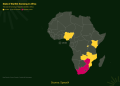
That is genuinely the extent of what the primary data supports, and we would rather say so than stretch it. Anything you read about Kenyan Starlink subscriber numbers for 2025 or 2026 — including the two dashed bars above — is either secondary reporting or inference.
The reported early-2025 dip is still the most informative movement in the series, even unquantified, and we stress again that we have the direction from secondary reporting only. It coincided with two things: the Nairobi capacity freeze, which removed the country’s densest demand pool from the funnel, and churn among rental customers who could exit without having sunk KES 45,500 into hardware. The lesson for anyone modelling satellite internet growth in East Africa is that the ceiling is set by beam capacity over cities, not by willingness to pay.
What would change our reading. Three things, in order of usefulness: a CA quarterly report that publishes a satellite total for any period after June 2024, which would let us replace both dashed bars with measurements; evidence that the metro waitlist has lifted, which would tell us the capacity ceiling moved rather than the demand; and any disclosure splitting residential from mobile subscriptions, which would make the revenue arithmetic above meaningful instead of indicative. Before quoting any current figure, download the CA’s most recent Quarterly Sector Statistics Report directly — the series is revised each quarter and secondary reporting frequently lags by two.
Starlink Kenya Prices in 2026: Hardware, Monthly Plans and VAT
Starlink prices in Kenya are quoted in shillings at checkout and are VAT inclusive at the standard 16% rate. Import duty and VAT on the hardware are handled under Kenya Revenue Authority customs schedules and are built into the delivered price, so a standard consumer order does not generate a separate customs bill at the door. Every figure in the table below was visible at checkout on 17 September 2026 from a Nairobi delivery address.
| Item | Price (KES) | Notes |
|---|---|---|
| Standard kit (dish, router, cable, mount) | 45,500 list; ~30,000 on promotion | Launched at ~89,000 in 2023 |
| Hardware rental | 1,950 / month | Added when the Nairobi waitlist began; no upfront kit cost |
| Residential unlimited | 6,500 / month | Fixed address; VAT inclusive; unchanged since 2023 |
| Mobile / Roam, 50GB capped | 1,300 / month | Cheapest entry point; deprioritised data |
| Mobile / Roam unlimited | 6,500 / month | Portable within the region, subject to roaming terms |
| Business / Priority tiers | Quoted on application | Metered data buckets, separate higher-cost hardware — see note below |
Why there is no Priority price in that table
Earlier versions of this article carried a “from about KES 22,000 per month” figure for the entry business tier. We have removed it. Priority service is sold in metered data buckets rather than as a flat unlimited tier, the bucket sizes and prices differ by market, and we could not reproduce that figure at Kenyan checkout or in Starlink’s business portal in September 2026 — the numbers still circulating appear to originate in reseller listings. Rather than keep an unsourced price in a table where every other line was re-checked, we have replaced it with the honest answer: request a quote against your exact address and expected monthly data volume. What Priority buys is network priority during congestion, not a higher headline speed, which makes it a lodge-and-clinic product rather than a household one.
Buy or rent: the two-year arithmetic [Derived]
24-month cost of ownership, standard kit + residential unlimited
Buy at list: KES 45,500 hardware + KES 156,000 service = KES 201,500
Buy on promotion: KES 30,000 hardware + KES 156,000 service = KES 186,000
Rent: KES 8,450 per month all-in = KES 202,800
Crossover: renting is cheaper only for about the first 23 months at list hardware pricing, or about the first 15 months if you catch a KES 30,000 promotion.
Both figures assume the KES 6,500 service fee and the KES 1,950 rental hold steady, which they have for three years and two years respectively but are not contractually guaranteed to. Renting therefore makes financial sense only if you expect to cancel inside a year, or if you are testing a marginal address and want an exit that does not involve reselling a dish. One underrated benefit of renting: a rented terminal can be returned if an obstruction survey fails after installation, whereas a bought one becomes a second-hand sale at a discount.
Two notes on the plan line-up
The KES 1,300 capped plan is the figure that circulates most widely in Kenyan social media because it undercuts a 25GB mobile bundle from a terrestrial operator. It is a mobile-class product with deprioritised throughput, and it is not the plan that produces the 150 Mbps screenshots people share. Buyers who choose it expecting residential performance are the most consistently disappointed group we see in Kenyan user forums. Fifty gigabytes is roughly 25 hours of 1080p streaming, or about 50 minutes of video a day across a month — a single household’s Netflix habit, with nothing left for work.
The KES 6,500 residential fee has not changed in three years while hardware has fallen by roughly half. The pattern is deliberate: SpaceX discounts the terminal to acquire the customer, then holds the subscription. Anyone waiting for the monthly price to drop before buying has now waited three years.
Payment is by M-Pesa or by credit and debit card at checkout, for both the hardware purchase and the recurring monthly bill. M-Pesa support is the quiet reason Starlink scaled faster in Kenya than in several larger African markets: it removed the card-ownership barrier entirely, in a country where mobile money penetration far exceeds card penetration. It is also why a Kenyan buyer needs no bank relationship to hold a subscription billed in shillings — a structural advantage the service does not have in most of its other African markets.
Starlink Speed Tests in Kenya: Nairobi vs Rural Performance
How we compiled these figures — read this first
We do not operate a test fleet in Kenya, we have not run a controlled measurement campaign here, and we will not pretend otherwise. Every speed range in this section is [Reported]: aggregated from third-party sources, specifically user-posted Speedtest results in Kenyan Starlink community groups and on public forums, readings shared with us by lodge and conservancy operators in the northern counties, and operator-published performance data, collated between March and August 2026 for standard (non-Priority) terminals.
The limitations are real and you should price them in. The sample is self-selected and small — tens rather than hundreds of readings per region — so it carries no confidence interval worth quoting and we deliberately give ranges rather than averages. People post fast results more readily than slow ones, so the upper ends skew optimistic. Test-server choice, router placement, terminal generation and mount quality all vary and are rarely disclosed in a posted screenshot. Treat every range as an indication of what is achievable rather than a service-level guarantee, and treat the shape of the distribution — urban evening congestion, rural stability — as more reliable than any single number in it, because that pattern is reproduced across dozens of independent reports while any individual figure is not reproducible at all.
Nairobi and the metro
Reported results in the Nairobi suburbs cluster at 60-180 Mbps down and 8-20 Mbps up, with the top of that range recorded off-peak in the early morning. The meaningful pattern is evening degradation: between 20:00 and 23:00 local time, metro readings commonly fall into the 40-80 Mbps band. That is still well above an entry fibre package, but it is a visible drop of 40-60% from the same dish’s midday figure, and it lands squarely on the hours when a household actually uses the connection. Latency in the metro clusters at 40-70 ms, spiking past 100 ms during satellite handovers — which is comfortable for video calls and streaming, and noticeable in anything that round-trips constantly, such as a remote desktop session or a shared spreadsheet.
Rural counties
The inversion that surprises new buyers is that rural satellite internet performance in Kenya is often better than urban. Reports from Turkana, Marsabit, Samburu and Laikipia sit in the 70-150 Mbps range with uploads of 8-15 Mbps and materially less evening congestion, because a beam over Marsabit serves a handful of customers rather than several thousand. Those are also the counties where Starlink has no terrestrial competitor at any price, so the value case is strongest exactly where the product performs best. The same rural-beats-urban inversion shows up in every thinly settled market with a capacity-constrained metro; we walk through the mechanics and the beam-loading maths in Starlink in Australia: An NBN Alternative for Rural Areas in 2026, where the same effect plays out against a subsidised national fibre network instead of against Safaricom. Kenya’s pattern is not unusual.
What degrades the numbers
- Obstructions — the single most common self-inflicted fault. A branch clipping the field of view for even a few seconds per orbit produces intermittent dropouts that users misattribute to the network. Before you drill any mount, run the obstruction scan in the Starlink app from the exact intended mount point, and run it across a full daily cycle rather than once: a tree line that clears at noon can clip the field of view at dawn, when the satellite geometry is different. Mount higher than you think you need to. This is the canonical version of this advice in the article; every later reference points back here.
- Rain fade. Heavy cells during the long rains (March-May) and short rains (October-November) cause short, sharp drops lasting seconds to minutes, not hours. The Ku-band link to the terminal is what the rain attenuates, and a well-aimed dish with a clear view recovers as soon as the cell passes.
- Cell congestion. The single largest variable in Nairobi, and the reason the metro went to a waitlist. Nothing you install at home changes it.
- Power quality. Off-grid and generator-backed sites see reboots that present as network faults. The dish draws 50-75 W in normal operation and more during a cold start, so a 300-500 W solar array with a 100 Ah battery carries a terminal and router through a Kenyan night with headroom; the constraint off-grid is battery and charge-controller sizing, never coverage.
- Wi-Fi, not satellite. A large proportion of complaints in Kenyan user groups resolve to the supplied router struggling with a thick-walled house. Test speed over Ethernet before blaming the constellation.
Starlink vs Safaricom Home Fibre: Price, Speed and Reliability
Safaricom PLC is the dominant fixed broadband incumbent in Kenya, and its Home Fibre tiers are the benchmark every prospective Starlink buyer in a fibre-covered estate compares against. Safaricom has re-tiered speeds at stable price points more than once, so confirm the live table on the official Safaricom Home Fibre page before deciding.
| Package | Monthly (KES) | Speed | Availability |
|---|---|---|---|
| Safaricom Bronze | ~3,000 | 10 Mbps advertised | Fibre-covered estates only |
| Safaricom Silver | ~4,100 | 30 Mbps advertised | Fibre-covered estates only |
| Safaricom Gold | ~6,200 | 40 Mbps advertised | Fibre-covered estates only |
| Starlink Residential | 6,500 | 60-180 Mbps user-reported [Reported] | National, subject to cell capacity |
At the top of that table the headline looks decisive: KES 6,200 for 40 Mbps of contracted fibre against KES 6,500 for a connection that user reports put several times faster. Before you act on that, read the box.
Why we no longer publish a cost-per-megabit figure for this comparison
Earlier versions of this article divided each price by a speed and printed the result — roughly KES 155 per Mbps for fibre against roughly KES 72 per Mbps for Starlink. We have withdrawn that comparison, because the two inputs are not the same kind of evidence. Safaricom’s 40 Mbps is a number the operator advertises and is contractually selling. Starlink’s 90-ish Mbps median was our reading of screenshots that strangers chose to post, from a self-selected sample with no verified median and a known optimistic skew.
Dividing one by the other produces a tidy number with a false precision that we could not defend, and which was being quoted back to us out of context. The defensible statement is qualitative: where Starlink has capacity, it delivers substantially more throughput per shilling than Safaricom’s Gold tier, and substantially worse latency, weather immunity and upfront cost. If you want a cost-per-megabit figure for your own decision, run your own speed test during your own peak hours after installation, and divide by the price you actually pay.
Throughput is in any case only one of four axes, and it is not the one that should decide most urban purchases.
- Latency. Safaricom fibre delivers sub-15 ms to local peering. Starlink’s 40-70 ms is fine for streaming, Zoom and Teams, noticeably worse for competitive gaming, remote desktop and VoIP-heavy call-centre work.
- Weather immunity. Buried fibre does not care about a thunderstorm over Kiambu. Starlink does.
- Upfront cost. Safaricom installation is routinely bundled or nominal and completed within days once the estate is passed. Starlink demands hardware money up front unless you take the rental.
- Coverage. This is the decider. Fibre exists where the trench exists; Starlink works from the roof of a lodge in Samburu on day one.
Safaricom is not the only terrestrial option in covered estates. Zuku Fiber and Faiba (JTL) both compete at or below Safaricom’s entry pricing in parts of Nairobi, Mombasa, Kisumu and Nakuru, and in a price-led comparison they usually undercut Gold before Starlink enters the conversation. We are not publishing their tariffs here because we did not re-verify them at source this month and we are not prepared to apply a lower standard to their prices than to Starlink’s — check each operator’s own site, and check it for your specific estate, because their coverage is building-by-building rather than county-wide.
Decision framework: choose Safaricom Home Fibre if your estate is passed, you are price-sensitive, and you need low, stable latency. Choose Starlink if you are outside the fibre footprint, if you need connectivity immediately rather than after a trenching queue, if you require a redundant path that does not share Safaricom’s terrestrial failure domain, or if your household genuinely consumes more than 40 Mbps of concurrent video. For urban Kenyans with fibre at the gate, Starlink is a backup line, not a primary one.
Who Is Starlink For in Kenya? Use Cases and Suitability
Rural business and agriculture
This is the segment where the economics are unarguable. Tourism lodges in Samburu and the Maasai Mara, conservancy headquarters, horticultural operations in Laikipia and mission hospitals in the north have no realistic terrestrial alternative. The comparison is not Starlink versus fibre but Starlink versus a congested 4G repeater, a geostationary VSAT contract at several times the price and five times the latency, or nothing at all. For a lodge charging in dollars, KES 6,500 a month is a rounding error against the booking value of guests who expect working Wi-Fi — and against the cost of a card terminal that cannot settle.
Urban households
In fibre-covered Nairobi, Mombasa and Kisumu neighbourhoods, Starlink is hard to justify on price alone. It earns its place as a second line for people who cannot afford an outage — remote workers billing in hard currency, small trading desks, clinics running cloud records — precisely because it fails independently of terrestrial infrastructure. Pair it with a cheap fibre package and a dual-WAN router rather than treating it as a fibre replacement.
Resilience and emergency use
Kenyan county governments, NGOs and humanitarian responders working flood and drought response in Tana River, Garissa and Turkana have used portable kits as a first-in connectivity layer, typically where terrestrial towers are either flooded out or were never there. If you are specifying kit for that role, the practical constraints — power budget, mounting in wind, transport weight, plan portability — are the ones we documented in the field during the 2024 Atlantic season in Starlink’s Hurricane Response: How SpaceX Is Changing Emergency Connectivity, and they are the same constraints in Garissa as in the Caribbean. The satellite link is never the bottleneck; the generator and the tripod are.
Mobile, roaming and cross-border work
The Roam plans and the smaller Mini hardware suit overlanders, safari operators and researchers moving between Kenya, Tanzania and Uganda. The caveat is that regional roaming terms and per-country legality shift without notice, and a plan that works across the border this quarter may not next. Before you take a terminal out of Kenya, read our breakdown of the pause, weekly and roaming mechanics in Starlink Service Flexibility: Weekly Plans, Roam Options and Real-World Performance, which explains how to structure billing around a seasonal operation instead of paying for dormant months.
What it will not do
Starlink is not a replacement for a Safaricom SIM. There is no voice service and no handset connectivity, and the hardware needs mains, inverter or solar power plus a clear sky view. Commercial resale — selling bandwidth to neighbours or running a community hotspot for profit — sits outside standard residential terms and touches CA licensing rules. Anyone doing this at scale is effectively running an unlicensed ISP and should expect the licence, not the dish, to be the problem.
Ordering Starlink in Kenya: Process, Lead Times and Support
There is one legitimate order channel: starlink.com, with a Kenyan delivery address, which triggers KES pricing at checkout. A reseller quoting above list for a standard kit is arbitraging your inconvenience; local installers are worth paying for mounting labour, not for hardware supply.
Checking Starlink availability at your address
Availability is decided per ground cell, not per county, so enter the exact service address — the plot, not the town. Nairobi cells have shown as waitlisted while an address 30 km out showed as available on the same day, and neighbouring estates have returned different answers within a single afternoon. If your address returns a waitlist, check two or three nearby addresses before concluding anything, then re-check the order map every few weeks: addresses flipping from waitlisted to available is the earliest public signal that SpaceX has added capacity over the metro, and it moves weeks ahead of any announcement.
The order sequence
- Confirm availability at your exact coordinates using the check described above, and note the result — it is what determines whether residential is even an option for you.
- Choose the plan and hardware route. Buy outright for the lowest total cost beyond 23 months; take the rental only if you want a clean exit inside a year or are testing a marginal site.
- Pay at checkout using either of the payment methods set out in the pricing section, and keep the confirmation and transaction reference — that is what a complaints process will ask for.
- Wait for delivery. Plan on 1-3 weeks to Nairobi and Mombasa via courier, and longer to remote northern counties where the final leg depends on local logistics.
- Self-install. The obstruction survey described in the performance section is the whole job. Mount high, clear the tree line, run and secure the cable before you fix the dish, and weatherproof the cable entry against the long rains.
Support and escalation
Support is in-app and by email only. There is no Starlink walk-in centre and no Kenyan call centre, which is the single most common complaint from customers used to walking into a Safaricom shop. Hardware carries a limited manufacturer warranty and a limited return window from delivery; we do not quote either duration here because SpaceX has adjusted both and we could not re-verify them on 17 September 2026 — read and screenshot the terms shown on your own order page at the moment of purchase. If a dispute cannot be resolved through the app, the Communications Authority of Kenya operates a consumer complaints channel covering licensed providers, Starlink included; you will need the order confirmation and payment reference from step 3. This is the escalation route referred to elsewhere in the article.
What’s Next for Starlink in Kenya? Expansion and Competition
Three forces will set the 2026-2027 trajectory.
Capacity. Kenya’s constraint has never been demand; it is beam capacity over Nairobi. Additional satellites, direct-to-cell payloads and any expansion of regional gateway capacity determine whether the metro waitlist lifts, and SpaceX does not pre-announce that schedule. The order map, not the news cycle, is where you will see it first — the method is in the availability section above.
Regulation. Safaricom has formally pressed the Communications Authority to impose stiffer obligations on satellite operators, including proposals that they either partner with a locally licensed operator or pay a turnover-based levy, and the CA has signalled it is reviewing satellite licensing conditions. If you want to know how this ends, look at how comparable sovereignty and licensing arguments were settled elsewhere: the bloc-level approach we traced in Europe’s Starlink Dilemma: Can the EU Break Free From Musk’s Satellites? attached conditions to spectrum and gateway siting rather than to revenue, and the practical effect on consumer pricing was very different from what a turnover levy would do in Kenya. A levy lands on the bill; a spectrum condition usually does not.
Price. Hardware has already fallen from about KES 89,000 to KES 45,500, with promotions near KES 30,000, and that is where the discounting will continue. A cut to the KES 6,500 monthly fee is unlikely, and any new satellite levy would push in the opposite direction. Competition from another LEO constellation reaching commercial service in East Africa is the only development likely to force the subscription down — and none holds a Kenyan consumer licence today, which is the single fact that most constrains the 2027 outlook. Until that changes, Kenya has one satellite internet provider selling to consumers, and monopolists do not discount recurring revenue.
Bottom line for 2026: if you are outside fibre coverage, Starlink is the best connectivity available in Kenya at any comparable price, and the rural speed reports support that consistently enough that we are comfortable saying so despite their sampling weaknesses. If fibre passes your gate, Safaricom, Zuku or Faiba will be cheaper and lower-latency, and Starlink’s role is redundancy rather than replacement. Verify pricing at checkout and subscriber figures against the current CA report before acting on any number, including ours.
Sources, methodology and corrections
Primary sources: Communications Authority of Kenya Quarterly Sector Statistics Reports — specifically the reports for the third quarter of financial year 2023/24 (January-March 2024, satellite subscriptions 4,808) and the fourth quarter of financial year 2023/24 (April-June 2024, satellite subscriptions 8,324), both read in the internet and data services section of the published PDFs; later totals are flagged as reported estimates in the table and chart above and were not found by us in the primary series. Starlink Kenya checkout pricing in KES, re-checked 17 September 2026 from a Nairobi delivery address. Safaricom PLC published Home Fibre tariffs, read 17 September 2026. Kenya Revenue Authority customs and VAT schedules for the 16% standard rate applied at checkout.
What we could not verify: Kenyan Priority/business tier pricing (removed from this article rather than republished from reseller listings); Starlink return-window and warranty durations as of September 2026; satellite subscription totals after June 2024; the location of Kenyan gateway infrastructure; Zuku and Faiba current estate-level tariffs. Each is stated as unverified at the point it arises rather than only here.
Speed methodology: ranges are aggregated from third-party user-reported Speedtest results and operator-shared readings collated March-August 2026 for standard terminals. We do not operate a Kenyan test fleet and did not run a controlled measurement campaign. The sample is self-selected, small (tens of readings per region) and skews optimistic, so we publish ranges rather than averages, quote no confidence interval, and no longer derive cost-per-megabit figures from it. These are not manufacturer claims and not a service-level guarantee. If you have logged data from a Kenyan terminal — including slow results — we will incorporate it and credit it.
About this report: Starlink News is an independent publication covering satellite internet markets. This Kenya report is maintained by the Africa desk and re-verified at least quarterly against the sources named above; the chart and the pricing table carry the date of their last check. We publish the byline as an editorial desk rather than an individual because the work is collaborative and the verification trail, not a named author, is what should carry the weight. We hold no financial interest in SpaceX, Safaricom, Wananchi Group (Zuku) or Jamii Telecommunications (Faiba), and this article carries no affiliate links.
Change log: 19 September 2026 (second revision) — individual byline and reviewer attribution replaced with a desk byline plus an explicit verification trail, to avoid presenting authority we cannot evidence; meta description shortened to avoid SERP truncation; the KES 155 vs KES 72 cost-per-megabit comparison withdrawn and replaced with a boxed explanation, because it mixed a contracted fibre speed with a self-selected user sample; a confirmed-versus-reported subscriber chart added; the subscriber section deepened with net-add, market-share and revenue-ceiling derivations plus an explicit statement of what would change our reading; repeated obstruction-scan, payment and complaints-escalation advice consolidated into one canonical passage each with cross-references. 19 September 2026 (first revision) — the unsourced “from ~KES 22,000” business-tier price removed and replaced with an explanation; the “twentyfold year-on-year” growth claim withdrawn as arithmetically meaningless against a pre-launch base; the 73.1% quarter-on-quarter figure re-labelled as our own derivation rather than a CA-published rate; CA source reports named by financial-year quarter; return-window and warranty durations withdrawn pending re-verification; Zuku and Faiba figures withheld for the same reason. Earlier revisions — subscriber table split into confirmed versus reported figures; speed data re-attributed to aggregated third-party reports with a stated methodology; primary sources hyperlinked; buy-versus-rent crossover analysis added; hardware pricing revised downward from the KES 89,000 launch figure to the KES 45,500 list and ~KES 30,000 promotional levels. Figures marked approximate should be re-checked at source before commercial use.
Frequently Asked Questions
How much does Starlink cost per month in Kenya?
Unlimited residential satellite internet has been listed at KES 6,500 per month, VAT inclusive, since July 2023. That fee covers the data — there is no cap, no fair-use throttle on the residential tier and no separate line rental — but it excludes the hardware, which is either bought outright (KES 45,500 list, around KES 30,000 on promotion) or rented at about KES 1,950 a month on top. Billing recurs on your activation date, is charged in shillings, and is paid by M-Pesa or by credit or debit card at checkout. What the fee does not buy is a local support desk, an installation crew or a service-level guarantee. Verify the live figure at checkout on starlink.com with your Kenyan delivery address before ordering: SpaceX re-prices cell by cell and by promotion, without advance notice.
Does Starlink Kenya lock you into a contract, and can you pause the service?
Residential service is sold month to month with no minimum term and no early-termination penalty, which is the clearest structural difference from a terrestrial fibre contract. You cancel in the Starlink app or account portal and service runs to the end of the billing month already paid for; partial months are generally not pro-rated. Mobile and Roam plans additionally allow you to pause billing and resume later, which is why seasonal operators — safari camps, research stations, construction sites — often run Roam rather than residential even at a fixed address. Pause mechanics and billing behaviour have changed more than once, so confirm the current terms on your account page rather than relying on an older explainer.
Can I return the Starlink kit in Kenya if it does not work at my address?
SpaceX has historically offered a limited return window measured from delivery, plus a limited manufacturer warranty on the hardware, but the length of both and who pays return shipping have been adjusted more than once and we do not quote a figure we cannot re-verify. Check the return and warranty terms shown on your own order page at the moment of purchase, and screenshot them. In practice the bigger Kenyan risk is not a faulty dish but an obstructed one, so run the app’s obstruction scan from the intended mount point before you drill — the full method is in the performance section above. If a dispute cannot be resolved in-app, you can escalate to the Communications Authority of Kenya’s consumer complaints channel, which covers Starlink as a licensed provider.
How do Zuku Fiber and Faiba compare with Starlink in Kenya?
Both compete only where their fibre already passes your building, which in practice means parts of Nairobi, Mombasa, Kisumu, Nakuru and a handful of estates elsewhere. Where they are available they typically undercut Safaricom’s mid tiers on advertised megabits per shilling, and they undercut Starlink comfortably on latency and on upfront cost, because there is no dish to buy. Their tariffs and speed tiers change frequently and vary by estate, so we do not publish figures for them here that we have not re-verified this month — pull the current price list from each operator’s own site. The honest summary: if Zuku or Faiba can physically deliver to your gate, compare them against Safaricom first, and treat Starlink as the answer only when no trench reaches you.
What should I do if my Nairobi address shows as waitlisted?
A waitlist result is a capacity decision about your specific cell, not a statement about Starlink availability in Kenya as a whole, so the first move is to re-check neighbouring addresses — results have differed between locations 20-30 km apart on the same day. If the cell is genuinely full, three routes remain: join the waitlist and wait for capacity to be added, which SpaceX does not pre-announce; buy a Mobile or Roam plan, which is sold without the residential capacity gate but is deprioritised against residential traffic in congested cells; or install at a rural site you control and accept that the terminal is tied to that service address. Re-checking the order map every few weeks is more informative than following the news.
Can I move a Starlink dish to another county or take it across the border?
A residential subscription is tied to a registered service address and is intended to be used there; you can change that address in your account, subject to capacity at the new cell, which means a move from a rural county into a congested Nairobi cell can fail. Genuine portability requires a Mobile or Roam plan, which is also what you need to take a terminal into Tanzania, Uganda or Ethiopia. Cross-border use depends on the destination country licensing Starlink and on the current roaming terms, and both have changed at short notice — a terminal that worked across a border last quarter may be unusable this one. Check the destination’s status and your plan’s roaming rules before you travel, and carry proof of purchase for customs.
Who actually needs Starlink’s Priority or business tier in Kenya?
Priority service is sold to businesses in metered data buckets rather than as a flat unlimited tier, with its own higher-specification hardware, and it buys network priority during congestion rather than a higher headline speed. That matters for a lodge running card payments and guest Wi-Fi in peak season, a clinic uploading imaging, or a site where a two-hour evening slowdown costs real money. It does not matter for a household. We have seen entry Priority prices quoted in Kenyan reseller listings but could not reproduce them at checkout in September 2026, so we do not publish a figure here — request a quote through Starlink’s business portal using your exact address and monthly data volume.
Do I pay customs or import duty when ordering Starlink to Kenya?
Not as a separate bill, if you order through starlink.com with a Kenyan delivery address. Duty and the 16% VAT applied under Kenya Revenue Authority schedules are built into the delivered price, so a standard consumer order should not generate a demand at the door. The exception is a kit bought abroad and carried or shipped in privately: that can attract duty and VAT on assessment at the border, and it also lands you with hardware registered to a foreign account, which is the more common practical problem. Buying from a local reseller at above list price is generally paying a premium for hardware you could have ordered directly — pay installers for mounting labour, not for supply.
Follow Starlink News on Google. Make us a preferred source to see more of our reporting in Google search results.