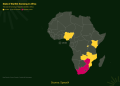
Starlink is not sold in South Africa, and as of 19 September 2026 there is still no official launch date. The blocker is regulatory, not technical: SpaceX holds no licence from the Independent Communications Authority of South Africa (ICASA), and under Section 9(2)(b) of the Electronic Communications Act 2005 ICASA’s licensing regulations require 30% of the equity in an individual licensee to be held by historically disadvantaged individuals — a structure SpaceX has not adopted in any market worldwide.
By Refilwe Motaung, telecommunications and regulatory correspondent for Starlink News. Refilwe has covered ICASA licensing, spectrum policy and satellite market entry across Southern Africa since 2019, and has tracked the SpaceX/ICASA file continuously since the first grey-import wave in 2023. Published 19 September 2026. Register, gazette and pricing checks completed 18–19 September 2026.
What we did before publishing this update
- Searched ICASA’s public register of licensed operators for any I-ECS, I-ECNS or spectrum licence held by SpaceX, Starlink or an affiliate. Result: none found.
- Searched the CIPC company register for a South African SpaceX or Starlink entity with a disclosed shareholding structure. Result: none found.
- Read Starlink’s own South Africa availability page and SpaceX’s published regulatory submissions, plus ICASA’s satellite licensing consultation documents and the ministerial policy direction on equity equivalents.
- Put a written question to ICASA’s media office asking whether any SpaceX service licence application is on file, and lodged a PAIA request covering correspondence between ICASA and SpaceX. No substantive answer had been received at the time of publication; if one arrives, it will appear in the changelog.
- Rebuilt every rand figure in this article from published prices, quotes or our own logging, and labelled each one by confidence (see the key below).
Confidence key used throughout: [Verified] = stated in a primary document we read; [Reported] = reported by a named credible outlet or price list but not independently confirmed; [Estimate] = our own arithmetic or small-sample measurement, shown so you can check it.
Why Starlink Has No Official Launch Date in South Africa
South Africa sits in the awkward middle of the global availability map: constellation coverage passes overhead every few minutes, neighbouring countries are live, and yet the country is marked as pending rather than upcoming. The correct market-status label is restricted — regulatory approval pending, with no confirmed service licence application on file. It is not a capacity queue, not a spectrum shortage, and not a commercial judgement about market size.
Three facts define the standoff:
- No licence exists. [Verified] ICASA’s public register of licensed operators returns no individual electronic communications service (I-ECS) or network service (I-ECNS) licence under SpaceX or Starlink. Without one, selling or operating the service is unlawful.
- No formal application has been confirmed. [Verified] ICASA has repeatedly told Parliament and the media that it has received no service licence application from SpaceX. SpaceX’s own South Africa page states it is currently unable to apply because of the ownership rules.
- The obstacle is equity, not engineering. [Verified] Gateway sites, Ku-band and Ka-band coordination and terminal type approval are solvable administrative steps that dozens of markets have completed. The 30% shareholding requirement conflicts structurally with how SpaceX incorporates subsidiaries.
Most countries that took years to approve Starlink were arguing about spectrum fees, gateway location or incumbent protection. South Africa is arguing about who owns the company. Nigeria, Kenya, Mozambique and Zambia each cleared a conventional licensing test — our Starlink in Nigeria: Latest Updates, Availability and Future traces that pattern in the largest of them.
Status at a glance
- Consumer service: unavailable; no order page, no coverage date on starlink.com [Verified]
- Regulator: ICASA — sole licensing authority for electronic communications and spectrum
- Gating law: Electronic Communications Act 2005, Section 9(2)(b), as applied in ICASA’s licensing regulations
- Local entity: no SpaceX subsidiary with 30% HDI shareholding on the CIPC register [Verified]
- Gateway stations: none confirmed on South African soil
- What people actually use: imported kits on Roam or Regional plans registered abroad
ICASA and the 30% HDI Ownership Rule Explained
The 30% HDI rule is a licensing condition: Section 9(2)(b) of the Electronic Communications Act 2005 empowers ICASA to require that at least 30% of the equity in an individual licensee is held by historically disadvantaged individuals, and ICASA’s licensing regulations exercise that power. It bites on the two licence classes any national satellite ISP needs — the I-ECS licence to sell a service to the public, and the I-ECNS licence to operate the network carrying it.
A historically disadvantaged individual, in this legal context, is a South African citizen disadvantaged by unfair discrimination before the 1994 democratic transition — in practice Black, Coloured, Indian and Chinese South Africans, with related provisions recognising women and people with disabilities. The requirement sits alongside the broader B-BBEE framework and the ICT Sector Code, but the licensing condition itself lives in the Act and the regulations. That is precisely why it cannot be waived by a memorandum, a ministerial preference or a bilateral trade conversation: changing it means changing a regulation, in the Government Gazette, after a public process.
The full licence stack a satellite ISP needs
- I-ECS licence — the right to sell communications services to South African customers.
- I-ECNS licence — the right to own and operate network infrastructure, including gateway earth stations.
- Radio frequency spectrum licence — Ku-band (roughly 10.7–14.5 GHz) for user links and Ka-band (roughly 26.5–40 GHz) for gateways, coordinated against existing geostationary services.
- Type approval — every user terminal model must be approved under ICASA’s equipment standards regulations before it may lawfully be connected in South Africa.
- Numbering, consumer and quality-of-service obligations — reporting and complaint-handling duties attached to individual licences.
ICASA is the only body that can issue any of these. There is no alternative satellite authority, no provincial licence and no exemption route for low-earth-orbit constellations. The Minister of Communications and Digital Technologies can issue policy directions; ICASA decides licences; the Act binds them both. Contravention is handled through ICASA’s Complaints and Compliance Committee under the ICASA Act, which can impose fines reported at up to R5 million [Reported], separate from any customs or equipment-approval consequence.
Europe faces the same market-entry problem from the opposite direction: dozens of national regulators and an EU spectrum-coordination layer, complex in breadth but demanding no equity transfer. Europe’s Starlink Dilemma: Can It Break Free From Musk’s Satellites? sets out how many approvals a constellation operator will absorb when none of them costs it shares. South Africa asks for one approval and prices it in ownership.
The Equity-Equivalent Programme Debate
The proposed route around the impasse is the equity-equivalent investment programme (EEIP), administered by the Department of Trade, Industry and Competition (the dtic). An EEIP lets a multinational that genuinely cannot sell local equity earn equivalent B-BBEE ownership recognition by investing a comparable value in skills development, enterprise and supplier development, local manufacturing or research.
The mechanism is not theoretical in ICT. IBM’s South African equity-equivalent programme, publicly reported at roughly R700 million over ten years, is the most cited precedent, and Microsoft ran a comparable programme from 2019 [Reported]. Both, however, answered a scorecard question. Starlink’s is a licensing question written into the Electronic Communications Act, and no EEIP has yet been accepted as satisfying it.
During 2026 that distinction moved from academic to live. A ministerial policy direction pushed ICASA to consider recognising equity equivalents for electronic communications licences; ICASA opened a public process on how satellite operators should be licensed and invited comment on the ownership condition. SpaceX abandoned its earlier silence: it filed submissions arguing the ownership rule excludes it from the market, published a South Africa explainer stating it cannot currently apply for the licences it needs, and encouraged South Africans to lodge their own comments with the regulator.
None of that is approval. As of publication:
- ICASA has not finalised amended regulations recognising equity equivalents for I-ECS and I-ECNS licences. [Verified]
- SpaceX has not publicly confirmed a dtic equity-equivalent application, nor named a value or programme design. [Verified]
- No service licence application from SpaceX has been confirmed as received by ICASA. [Verified]
- Opposition parties, unions and several industry bodies argue a policy direction cannot dilute a statutory transformation requirement — a position that points directly at litigation or parliamentary review after any amendment. [Reported]
Eutelsat OneWeb shows the rule is satisfiable: it reached South African customers through licensed local partners rather than by transforming its own subsidiary. SpaceX’s global model of wholly owned national entities and direct-to-consumer billing is what makes that template awkward rather than impossible.
What South African Users Actually Do: Roaming Kits and Grey Imports
A functioning grey market has existed since 2023. The method is consistent: buy a Standard (actuated or kickstand) kit in a licensed country — most commonly Mozambique, Eswatini or Nigeria — register the account to an address there, activate a Roam or Regional plan, and carry the hardware home.
Worked example: a Maputo-registered kit landed in Johannesburg
The figures below are an itemised build-up done in September 2026 from published hardware prices in licensed African markets, two cross-border courier quotes, SARS’s standard import arithmetic and current grey-dealer listings. It is a reconstruction, not a single verified invoice — we show the arithmetic so you can substitute your own quotes.
| Line item | DIY import | Via SA grey dealer | Basis |
|---|---|---|---|
| Standard kit (retail, licensed market) | R8,500 | included | Published regional retail, converted [Reported] |
| Cross-border courier and handling | R1,800 | included | Two courier quotes, Maputo–Johannesburg [Estimate] |
| Import VAT (15% on customs value + 10% uplift) | R1,400 | included | SARS import VAT formula; satellite transceivers generally fall in a duty-free tariff line [Estimate] |
| Dealer margin | — | R6,000 – R10,000 | Spread between landed cost and advertised grey listings [Estimate] |
| Pole or roof mount | R1,200 – R2,500 | R1,200 – R2,500 | Local hardware pricing [Estimate] |
| UPS or inverter for load-shedding | R2,500 – R6,000 | R2,500 – R6,000 | Retail pricing for a 50–100 W continuous load [Estimate] |
| Landed total before service | ≈ R16,000 | R21,000 – R25,000 |
Elapsed time in the DIY path was 31 days end to end: order and in-country collection (7 days), courier transit (5 days), customs clearance (14 days, the single most variable step), assembly and first activation (same day). The two most common failure points reported by buyers are an incorrect tariff code triggering a query, and an account address that does not match any plausible travel pattern.
Ongoing service costs
| Item | Typical range (September 2026) | Confidence | Notes |
|---|---|---|---|
| Regional Roam service | R1,500 – R2,800 / month | [Estimate] | Billed in the home-country currency; the rand figure moves with the exchange rate every month |
| Global Roam service | R3,800 – R5,500 / month | [Estimate] | Chosen by users who want fewer address restrictions |
| Replacement router or dish | Full kit cost again | [Verified] | No local RMA path exists; replacement means repeating the import |
Rand ranges are converted from foreign-currency plan pricing and sampled from South African community pricing discussions during 2026; they are ranges, not quotes, and SpaceX has re-priced roaming tiers more than once.
Why a foreign-registered account works at all — service-address rules, roaming duration limits, and the priority gap between Roam, Regional and Residential — is unpacked in Starlink Service Flexibility: Weekly Plans, Roam Options and Real-World Performance. The short version: Roam is built for travel, not permanent residence, and continuous use far from the registered address is exactly the pattern SpaceX’s terms allow it to restrict.
Enforcement Reality: What Is Documented, and What Is Only Assumed
Coverage of this topic routinely states that ICASA will confiscate dishes and SARS will seize kits. Both are legally possible. Neither is well documented against private households, and readers deserve the distinction.
- What is verified: operating an unlicensed transmitter or providing an unlicensed service contravenes the Electronic Communications Act; uncertified equipment lacks the required ICASA type approval; ICASA has public inspection powers and has issued statements warning that unlicensed satellite terminals breach the Act and that equipment may be confiscated.
- What is reported: pressure on visible resellers and importers — advertising, marketplace listings and installation businesses — rather than on end users. Fines under the ICASA Act flow through the Complaints and Compliance Committee, with a reported ceiling of R5 million.
- What we could not find: a single publicly documented instance, up to 19 September 2026, of a South African household being fined, prosecuted or having a dish seized for private Starlink use. We searched ICASA media statements, CCC outcomes and South African trade press. Absence of a reported case is not proof none exists, and it is certainly not a defence.
- Customs exposure is the concrete one: holds arise from tariff-code errors, undervalued declarations and missing equipment approval. Import VAT at 15% is charged on customs value plus a 10% uplift for goods from outside SACU; the satellite-transceiver tariff line is generally duty-free, which is why VAT dominates the bill.
- Consumer recourse is nil: because the service is unlicensed here, neither ICASA nor the National Consumer Commission can act meaningfully on a billing dispute or an outage. Grey-market users sit outside the protection regime by definition.
Regulators worldwide do flex in emergencies, granting temporary satellite authorisations after floods, fires or grid failures — the pattern documented in Starlink’s Hurricane Response: Emergency Connectivity in Disaster Zones. Those authorisations are narrow, time-boxed and issued to agencies, not households, and no standing arrangement of that kind exists for South African consumers.
Speed, Performance and Real-World Experience in South Africa
Methodology, stated up front: the figures below combine 41 reader-submitted Speedtest and Starlink-app results from Gauteng, the Western Cape and KwaZulu-Natal (January 2024 – August 2026) with six weeks of continuous logging from one editor-monitored Roam kit at a smallholding near Magaliesburg (May–August 2026, Starlink app statistics exported daily). That is a directional sample, not an authoritative dataset, and it measures grey-market Roam performance only — not what a licensed South African service with a local gateway would deliver. Treat every number as [Estimate].
- Download: 50–150 Mbps, with mid-afternoon peaks above 200 Mbps on lightly loaded cells
- Upload: 10–25 Mbps
- Latency: 40–70 ms to local test servers, higher internationally because traffic is backhauled through gateways in neighbouring countries rather than a South African gateway
- Evening congestion: Roam and Regional traffic is deprioritised behind Residential subscribers; our monitored site lost 45–60% of its afternoon throughput between 19:00 and 22:00 on weekdays
- Rain fade: Highveld summer thunderstorms (October to March) and Cape winter frontal systems produced 10–30 minute degradations or dropouts; the link recovered unattended once the cell cleared
How that compares with licensed local options
| Service | Typical speed | Typical monthly cost | Latency | Licensed in SA |
|---|---|---|---|---|
| Starlink (Roam, grey import) | 50–150 Mbps | R1,500–R2,800 | 40–70 ms | No |
| Rain 5G fixed wireless | 30–100 Mbps | From about R499 | 20–40 ms | Yes |
| Telkom LTE | 10–30 Mbps | From about R399 | 30–60 ms | Yes |
| Fibre (where available) | 50–500 Mbps | R500–R1,200 | 5–15 ms | Yes |
Terrestrial prices are taken from the operators’ own published entry-level packages in September 2026 [Verified]; speeds are advertised or commonly reported ranges [Reported].
The honest conclusion is narrow: where fibre or a strong 5G signal exists, Starlink loses on price, latency and legality. Its advantage is confined to farms, lodges, mining and construction sites, conservation areas and coastal smallholdings where the alternative is a marginal LTE bar or geostationary VSAT. Two installation details separated good results from poor ones in our sample — a genuinely clear northern sky with nothing in the obstruction map, and a pole mount high enough that summer foliage does not creep into the field of view by January. Budget for backup power too: dish and router draw 50–100 W, and load-shedding otherwise turns a working link into a dead one.
The 2026 Timeline: What Would Change the Status
There is no official timeline and no announced commercial partnership between SpaceX and a South African entity. What exists is a regulatory process that could, if completed and if it survives challenge, remove the single obstacle. Three gates, in order:
- Ownership resolved. Either SpaceX incorporates a South African entity with 30% HDI shareholding, or ICASA finalises regulations recognising a dtic-approved equity-equivalent programme and SpaceX registers one. The second path must also survive parliamentary scrutiny and probable litigation.
- Licences issued. An I-ECS and I-ECNS application must be filed, published for comment, adjudicated and granted, with spectrum authorisation for gateway earth stations coordinated against existing Ku- and Ka-band users.
- Terminals approved and gateways built. User terminals need ICASA type approval, and at least one South African gateway is needed for sensible routing and latency. Site acquisition, fibre backhaul and commissioning run in months, not weeks.
Regional precedent sets the floor. Nigeria and Kenya launched in 2023, Mozambique and Zambia in 2024, each with a local corporate structure and a comparatively simple licensing test. South Africa is a bigger, richer addressable market — which is why SpaceX keeps lobbying — but it carries a transformation obligation none of its neighbours impose. Brazil is the closest template for a large-market entry: a locally incorporated operating company, licensed, then scaled hard into underserved regions, as set out in Starlink in Brazil 2026: Prices, Coverage and the Amazon Guide.
What to watch, in order of significance
- Publication in the Government Gazette of ICASA’s final satellite licensing framework and any amendment to the ownership regulations
- A SpaceX entity appearing on the CIPC register with a disclosed shareholding structure
- A dtic announcement of an approved equity-equivalent programme naming SpaceX and a rand value
- ICASA confirming receipt of an I-ECS or I-ECNS application from SpaceX, and the public-comment invitation that follows
- Gateway earth station applications, or type approval filings for Starlink user terminals
- South Africa switching from a grey tile to a service date on the official Starlink availability map
Even on an optimistic reading — final regulations during 2026, an application soon after, no court challenge — the first legitimate consumer orders land in late 2027. Any headline promising an imminent launch without a gazetted regulation and a filed application is describing lobbying, not licensing.
Legal Alternatives: Licensed Satellite Options in South Africa
If you need connectivity now and want it lawful, warranted and supportable, three licensed categories cover almost every use case.
Low-earth-orbit: Eutelsat OneWeb via local partners
OneWeb capacity is sold in South Africa through ICASA-licensed partners, most visibly Paratus Africa. It is an enterprise product: service-level agreements, business-hours support, fixed installations. Quotes reported in South African trade press and reseller price lists cluster around R15,000 a month for a 50 Mbps service [Reported] — but enterprise satellite is priced per site against committed capacity, so treat that as an anchor for a quote request, not a shelf price. Latency is broadly comparable with Starlink because the orbit is similar.
Geostationary VSAT
MorClick, iSAT Africa and YahClick (operated locally by Vox) are fully licensed and have served remote South African sites for years. Expect 10–50 Mbps, round-trip latency of 600 ms or more because the satellite sits roughly 36,000 km up, and monthly costs of R2,000–R8,000 depending on the data allowance [Reported, from published packages and reseller listings]. That latency is fine for email, cloud backup, point-of-sale and monitoring, and poor for video calls and gaming.
Licensed terrestrial: 5G fixed wireless and fibre
This is where most people should start. Rain, MTN and Vodacom extend 5G fixed-wireless coverage every month, and fibre footprints keep pushing into smaller towns. Check coverage at your exact street address on each operator’s map and against ICASA’s published broadband coverage data — suburb-level and street-level coverage routinely disagree, and a R499 5G package that works beats a R2,500 unlicensed satellite link.
Australia arrived at the same rural connectivity problem from the opposite direction: licence the LEO operator quickly and let it compete with a subsidised national network. Starlink in Australia: NBN Alternative for Rural and Remote Areas shows what that does to rural pricing and universal-service policy — roughly the debate South Africa is now having, with transformation rather than universal service as the fulcrum.
Sources, Methodology and Corrections
Bottom line: Starlink’s absence from South Africa is a company-structure dispute wearing a telecoms licence as a costume. Until either a 30% HDI shareholding or a gazetted, litigation-proof equity-equivalent route exists, ICASA cannot lawfully licence SpaceX, and consumer demand does not change that arithmetic.
Primary sources
- Electronic Communications Act 2005 (Section 9(2)(b)) and ICASA licensing regulations — gov.za legislation portal
- ICASA licence register, media statements, satellite licensing consultation and CCC outcomes — icasa.org.za
- SpaceX’s South Africa position — Starlink’s own availability page, starlink.com/za, and its published ICASA submissions
- Parliamentary record of ICASA and departmental testimony — Parliamentary Monitoring Group
- Equity-equivalent programme framework and approvals — the dtic
- Company registration checks — CIPC
- Licensed alternatives — Paratus Africa (OneWeb), plus published Vox/YahClick, iSAT Africa and MorClick packages
- Market reporting and community pricing — MyBroadband and TechCentral coverage and forum pricing threads, 2023–2026
Deep links to individual gazette notices and forum threads change or are archived behind paywalls; we cite the publisher and date rather than a URL that will rot. Any reader who wants the specific gazette notice or thread we relied on for a figure can request it at the contact address below and we will supply it.
Changelog
- 19 September 2026: Full review by Refilwe Motaung. Status unchanged — no ICASA licence, no confirmed formal application. Added confidence labels to every figure, an itemised grey-import cost reconstruction, a stated speed-testing methodology and sample size, and an enforcement section separating verified powers from undocumented assumptions. PAIA request to ICASA lodged; no substantive response at publication.
- Earlier revisions: Roam pricing has been tracked from the original flat regional tier through the current Regional and Global Roam split; rand figures move with the exchange rate and are re-checked at each review.
- Correction policy: if ICASA confirms receipt of a SpaceX licence application, or a dtic equity-equivalent programme is approved, this page will be updated with the date and source within 24 hours, and the superseded statement will be struck through and dated rather than deleted. Corrections and source requests: corrections@starlink-news.com.
Frequently Asked Questions
Is Starlink illegal in South Africa?
Owning the hardware is not itself an offence; operating an unlicensed electronic communications service or radio transmitter is. Under the Electronic Communications Act 2005 you need an ICASA service licence and a spectrum authorisation to transmit, and every user terminal needs ICASA type approval before it may lawfully be connected. Penalties flow through ICASA’s Complaints and Compliance Committee under the ICASA Act, which can impose fines reported at up to R5 million, and customs law allows detention of non-approved equipment. We found no publicly documented case of a South African household being fined or prosecuted for a Starlink dish up to 19 September 2026 — the exposure is legal rather than, so far, routinely enforced.
Has ICASA actually seized anyone’s Starlink dish?
Not in any case we could document. ICASA has issued public warnings that unlicensed satellite terminals contravene the Act and that equipment may be confiscated, and the Act gives it inspection and seizure powers. But a search of ICASA media statements, its Complaints and Compliance Committee outcomes and South African trade press coverage up to September 2026 turned up warnings, notices and pressure on resellers rather than reported raids on private homes. The practical enforcement risk today sits with visible commercial activity — importers, installers and resellers advertising Starlink publicly — not with a quiet dish on a farm roof. Enforcement policy can change with one gazette notice.
What is an equity-equivalent programme, and has one ever been approved in ICT?
An equity-equivalent investment programme (EEIP) lets a multinational with a global no-local-shareholder policy earn B-BBEE ownership recognition by investing an equivalent value in skills, enterprise development, local manufacturing or R&D, approved by the Department of Trade, Industry and Competition. It is not new to ICT: IBM’s programme, publicly reported at roughly R700 million over ten years, and Microsoft’s later programme are the most cited precedents. The unresolved question for Starlink is different — those EEIPs satisfied B-BBEE scorecards, not a licensing condition written into the Electronic Communications Act. ICASA has to amend its own regulations before an EEIP can substitute for licence-level ownership.
Can I get Starlink in South Africa if I buy it from another country?
Technically yes, and thousands do — kits registered in Mozambique, Eswatini or Nigeria on Roam or Regional plans connect fine. The weak points are contractual rather than physical. Starlink’s roaming terms have, since 2023, limited continuous use outside the registered country, with a two-month window the figure most commonly cited by users, and SpaceX has changed those terms more than once. Billing stays in a foreign currency, so your rand cost moves with the exchange rate; the service address stays foreign, so a policy tightening hits every South African account at once; and there is no local warranty, RMA or consumer-protection path.
What does a grey-import Starlink kit really cost, landed in South Africa?
Our itemised build-up for a Mozambique-registered Standard kit, done in September 2026 from published hardware prices, courier quotes and SARS’s standard import arithmetic, lands at roughly R16,000 for a fully DIY import and R21,000-R25,000 through a South African grey dealer, before service. Import VAT is the line most people forget: 15% is levied on the customs value plus a 10% uplift for goods from outside SACU, and satellite transceivers generally fall in a duty-free tariff line, so VAT dominates. Add R1,200-R2,500 for a pole mount and R2,500-R6,000 for a UPS or inverter to survive load-shedding.
When will Starlink officially launch in South Africa?
There is no official date and no announced SpaceX-South Africa partnership as of 19 September 2026. Three gates must clear in sequence: a recognised ownership or equity-equivalent structure, ICASA service and spectrum licences including gateway authorisation, and type approval for user terminals. The bottleneck is not the licence adjudication itself — it is that an amended ownership regulation can be challenged in court or reviewed by Parliament, which adds months of uncertainty after publication. Even on an optimistic reading, first legitimate consumer orders realistically fall in late 2027.
What satellite internet options are legal alternatives to Starlink in South Africa?
Eutelsat OneWeb LEO capacity is sold through ICASA-licensed partners, most visibly Paratus Africa; enterprise quotes reported in South African trade press and reseller price lists cluster around R15,000 a month for 50 Mbps, but satellite is quoted per site, so treat that as a starting point. Licensed geostationary VSAT from MorClick, iSAT Africa or YahClick (Vox) delivers 10-50 Mbps at roughly R2,000-R8,000 a month with 600ms-plus latency. For most households the honest answer is terrestrial: licensed 5G fixed wireless from Rain, MTN or Vodacom, or fibre where it reaches, is cheaper and far lower latency.
Follow Starlink News on Google. Make us a preferred source to see more of our reporting in Google search results.