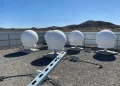
NuRAN Wireless, a Québec-based rural telecommunications infrastructure company that builds mobile networks across Africa, said on 22 September 2026 that it will pilot licensed Starlink low Earth orbit (LEO) satellite service as backhaul at one of its sites in Nigeria. The company said the pilot will be run with Infratel, described in the announcement as a long-time NuRAN partner, and that the service will be obtained through third-party service provider arrangements rather than from SpaceX directly.
Key facts
- The announcement was distributed through ACCESS Newswire on 22 September 2026 and published by Yahoo Finance and FinanzNachrichten.de. NuRAN trades as NASDAQ:NUR and FSE:1RN.
- NuRAN calls it a first-of-its-kind pilot to evaluate licensed Starlink LEO service as a high-performance backhaul solution at a selected NuRAN site. The Yahoo Finance version adds that it is the company’s first LEO integration anywhere in its network.
- The release states plainly that NuRAN has no direct contractual or commercial relationship with Starlink or SpaceX in connection with the pilot.
- Stated aims: validate performance, reliability, integration and cost efficiency at commercial scale, and support 4G migration, edge AI, local compute and NuEnergy at rural sites.
- NuRAN says it has more than 5,000 sites under contract, of which a portion have been built and are operating today.
- Infratel’s Managing Director, Tunji Alabi, is quoted in the release; NuRAN’s Director and Chief Executive Officer, Francis Létourneau, gives the company’s view.
Why it matters
For readers watching satellite internet in Africa, this is a use of Starlink service that sits behind the phone rather than in the home: the release frames LEO capacity as transport feeding a mobile tower, not as a consumer dish. NuRAN says management believes the combination can unlock capacity, speed and site economics that were previously out of reach in remote regions in certain African countries.
The company also puts a monetisation line on it. As the release states, every additional megabit delivered to a NuRAN tower is a megabit the company can monetise, with higher-capacity 4G services, local content caching, edge compute, AI-enabled services and energy management all named as applications that need reliable data transport.
What the pilot is meant to prove
NuRAN describes backhaul capacity as a significant driver in its shift from a Network-as-a-Service provider toward what it calls a full-stack digital infrastructure platform. In locations where terrestrial backhaul is constrained, costly or unavailable, the release says management believes licensed LEO satellite service can transform the performance, scalability and profitability of the company’s owned rural infrastructure, turning hard-to-reach sites into high-value nodes.
The Yahoo Finance version of the release goes further on scaling, saying that if the pilot succeeds it could create a repeatable, copy-and-paste blueprint. It adds that any scale-up remains subject to the availability of suitable service-provider arrangements.
The quotes
Létourneau said backhaul is the key that unlocks NuRAN’s next phase of growth and, in the release carried by Yahoo Finance, added: “We have always said Starlink service is an opportunity for NuRAN, not a threat.” Alabi said licensed Starlink service made available through third-party arrangements offers a way to bring LEO satellite backhaul into live commercial networks, and that the initiative can accelerate reliable, higher-capacity connectivity to underserved communities.
The licensing picture NuRAN is counting on
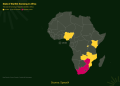
The release ties the expansion plan to regulatory status in specific markets: it says Starlink service has recently been licensed in the Democratic Republic of the Congo, Côte d’Ivoire and Benin, with Cameroon in process. NuRAN says it intends to become one of Africa’s most significant enterprise users of LEO satellite connectivity through third-party service providers across the markets where it holds its contracted sites.
That country-by-country pattern is the same one consumers run into, which is why we keep a Starlink country approvals tracker and a primer on how licensing and landing rights work. Neither source mentions Zimbabwe, Botswana or southern Africa in connection with this pilot; readers there can compare residential terms in our guide to Starlink prices in Zimbabwe.
What is not settled
Both publications carry the same corporate announcement, so there is no independent verification of the technical claims in either report, and neither quotes SpaceX or Starlink. NuRAN itself labels the pilot and its expected benefits as forward-looking statements under Canadian and United States securities laws, including the pilot’s timing, scope, performance, cost, reliability and results, and the ability of LEO backhaul, microwave, TV white space or other terrestrial technologies to support 4G upgrades, edge AI, local compute and NuEnergy.
The company directs further enquiries to Létourneau and to its site at nuranwireless.com. Neither report names the Nigerian site, the third-party service provider or the mobile operator whose traffic the site carries.
Frequently Asked Questions
Is NuRAN dropping microwave and TV white space backhaul?
No. The announcement carried by Yahoo Finance says NuRAN expects to continue using terrestrial transmission technologies, including microwave and TV white space, where line of sight and local conditions support their deployment. It describes LEO satellite service as the option for locations where terrestrial backhaul is constrained, costly or unavailable.
What exactly does NuRAN’s Network-as-a-Service model do?
According to the company description in the release, NuRAN finances, builds, owns, operates and maintains 2G, 3G and 4G mobile network infrastructure for mobile network operators that want coverage outside urban markets. The release says NuRAN combines telecommunications engineering, low-power wireless technology, renewable-energy-enabled infrastructure, site selection and field operations.
Did NuRAN give a start date, duration or cost for the pilot?
No. Neither the version published by Yahoo Finance nor the one on FinanzNachrichten.de includes a start date, a pilot length, a price for the satellite service or any capital figure. The release lists the timing, scope, performance, cost, reliability and results of the pilot among its forward-looking statements.
What is NuRAN planning beyond mobile coverage at these sites?
The release says NuRAN is developing plans to add modular edge compute nodes at select built sites, bringing local computing and future AI-driven services closer to the communities it serves. It also lists local content caching and energy management among the applications that need reliable data transport.
Follow Starlink News on Google. Make us a preferred source to see more of our reporting in Google search results.