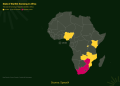
Amazon said in July that it will bring its Amazon Leo satellite internet service to South Africa in 2027 through the local internet provider Herotel, according to thenextweb.com, which credited the original reporting to the Associated Press. The same coverage says Starlink, the market-leading low-earth-orbit service owned by Elon Musk’s SpaceX, is still not licensed to operate in the country where Musk was born.
Key facts
- Amazon announced on a Wednesday in mid-July that Amazon Leo will launch in South Africa in 2027, thenextweb.com reported, citing the Associated Press.
- The partner is Herotel, which heise online describes as reportedly the country’s largest provider of fixed-line internet access, with 350,000 customers.
- Herotel will market Leo connections to private households from 2027, according to heise online.
- thenextweb.com says it is Amazon’s first satellite deal on the African continent, that the South African government backed it, and that Communications Minister Solly Malatsi appeared alongside Amazon and Herotel at the announcement.
- Amazon disclosed no financial terms, thenextweb.com reported. No subscription price or hardware cost has been published for South Africa.
- A second South African partner, the US company Vanu, will use Leo to connect rural mobile base stations, heise online said.
What Amazon and Herotel announced
Amazon will work with Herotel to reach the South African consumer market, with no financial terms disclosed, according to thenextweb.com. heise online reports that most South Africans use mobile phones to get online and only about one-sixth have a traditional fixed internet connection, with the offering particularly sparse outside the cities — which, the outlet says, is why low-earth-orbit satellites are particularly attractive there.
thenextweb.com describes South Africa as the start of a wider African push for Amazon, with Vanu lined up as a second partner for rural mobile coverage rather than direct-to-home service.
One caveat on sourcing: both write-ups are secondary accounts of the same announcement, and we have not seen an Amazon or Herotel press release, an ICASA filing or a transcript from the event. Minister Malatsi is reported as present but is not quoted in either piece. The only verbatim quote either outlet carries from any party to the deals is from Vanu, below. We will update this report if Amazon, Herotel or the Department of Communications publishes a statement of its own.
Why Starlink is not in South Africa
Musk has blamed the country’s rules, thenextweb.com reports, saying South African regulations blocked Starlink because he is white and accusing the government of racism. The outlet says he was pointing at affirmative-action policies that require foreign firms in the communications sector to sell a minority stake in their local arm to Black or other non-white owners before they can get a licence, and that the government says the policy exists to redress opportunities denied under apartheid. Readers following the licensing detail can see our background on South Africa’s ICASA licensing and HDI ownership rules.
heise online describes the same requirement in more detail: foreign companies in the ICT sector must ensure that historically disadvantaged groups hold at least 30 percent of the shares and voting rights, with South African citizenship a prerequisite, and a small percentage of net profit must flow into beneficial projects, half of it supporting relevant companies from the firm’s own supply chain.
The same outlet reports that in 2025 the government offered an alternative for multinational organisations such as SpaceX: financing recognised measures against illiteracy, or vocational training, critical infrastructure, research and development, or support for local tech startups, can be credited towards the shareholding. On that basis, heise online writes, Musk would not have to sell any shares at all — yet there is still no sign of Starlink entering the market.
Why it matters
For readers tracking where satellite internet is legally on sale, this is a rival reaching a major market first. thenextweb.com frames the contrast directly: Musk has refused South Africa’s ownership rules, while Amazon, by taking a local partner, appears willing to work within the same rules. The outlet also sets out the size of the prize, reporting that Africa has more than 1.5 billion people, many in rural areas with no fixed line, and that this is exactly the gap satellites promise to fill.
The practical consequence for South African households is that, on the published timeline, there is no licensed low-earth-orbit consumer option before 2027 at the earliest — and when one arrives, it arrives without a competitor. That is the part worth watching on price. Amazon has not said what Leo will cost in South Africa, and a partner-led launch into a market with a 350,000-customer fixed-line incumbent gives Amazon little reason to price aggressively against a service that is not there. For a regional reference point, our reporting on Starlink’s Zimbabwe pricing and POTRAZ licence put the headline residential plan at roughly $80 a month before hardware — a figure that tells you what a licensed LEO service charges nearby, not what Herotel will ask.
Analysis: two things would change that picture, and neither is confirmed. First, if SpaceX ever took up the 2025 equity-equivalence route that heise online describes, Starlink could in principle license without selling shares, and a two-operator market would put the first real downward pressure on satellite pricing in South Africa. Second, the Vanu deal points at a quieter commercial route: if Leo backhaul lets mobile operators light up rural base stations cheaply, the competitive effect may show up in mobile coverage and data prices rather than in dish subscriptions. Both are possibilities, not plans — no timetable, tariff or regulatory filing has been reported for either.
Vanu and rural mobile coverage
heise online reports that Amazon’s second South African partner, Vanu, is a US company founded by Vanu Bose, son of Bose audio founder Amar Bose, and that Vanu Bose died suddenly in 2017 at the age of 52. Vanu installs and operates small, solar-powered mobile base stations in rural areas with neither data lines nor a power grid, and mobile network operators rent capacity from it to extend coverage.
Until now Vanu has relied on microwave links for backhaul, which require a direct line of sight, according to heise online; it will instead use Leo to connect those base stations, first in rural South Africa and later in other parts of Africa and beyond. That mirrors operator interest elsewhere in satellite backhaul for rural mobile sites. heise online quotes Vanu’s head of development Victor Lum, speaking in February: “Our dream would be to go anywhere, with one truck, and in two days, provide connectivity to people who’ve never had it before.”
What is not yet confirmed
Neither report gives a launch month, a pre-order date, consumer pricing or hardware costs for Leo in South Africa, and neither says whether the Vanu rollout starts before or after the Herotel consumer service. The two outlets also describe the ownership requirement at different levels of precision — heise online specifies at least 30 percent of shares and voting rights, while thenextweb.com refers only to a minority stake — and put South Africa’s population at 63 million and 62 million respectively, a rounding difference rather than a conflict. Until Amazon, Herotel or ICASA publishes something first-hand, the deal stands on a single announcement relayed by two secondary accounts.
Frequently Asked Questions
How much will Amazon Leo cost in South Africa?
No price has been published. Amazon disclosed no financial terms for the Herotel deal, according to thenextweb.com, and neither that report nor heise online gives a monthly subscription figure or hardware cost for Leo in South Africa. For scale, our own coverage of Starlink in Zimbabwe put the headline residential plan at about $80 a month before hardware — a regional benchmark, not a Leo price.
When exactly does Amazon Leo launch in South Africa?
Sometime in 2027. Neither thenextweb.com nor heise online reports a launch month, a pre-order date or a phased rollout plan. heise online says Herotel will market Leo connections to private households from 2027; the separate Vanu deal, which uses Leo to backhaul rural mobile base stations, is not given a start date at all.
Why can Amazon launch in South Africa when Starlink cannot?
Amazon is entering through a licensed local partner, Herotel, while Musk has publicly refused the ownership rules, thenextweb.com reports. heise online notes that since 2025 multinationals have had an alternative to selling equity — funding literacy, skills, infrastructure, R&D or local tech startups can be credited towards the 30 percent requirement — meaning, on that reading, Musk would not have to sell shares at all. There is still no sign of a Starlink application.
How many satellites does Amazon Leo have compared with Starlink?
More than 390 in low-earth orbit against Starlink’s 10,000-plus, per thenextweb.com and heise online — roughly a 25-to-1 gap. Amazon launched its first satellites last year and is adding more continuously; Starlink began in 2019 and now serves more than 160 countries, including around two dozen in Africa.
Which other markets is Amazon Leo entering?
thenextweb.com lists signed launch deals in Thailand, Kazakhstan, Australia and several Latin American markets. heise online adds that Amazon is close to switching on service in Germany, France, Great Britain, Canada and the USA, and that a trial with selected business customers has run since autumn. South Africa is Amazon’s first satellite deal on the African continent.
Follow Starlink News on Google. Make us a preferred source to see more of our reporting in Google search results.